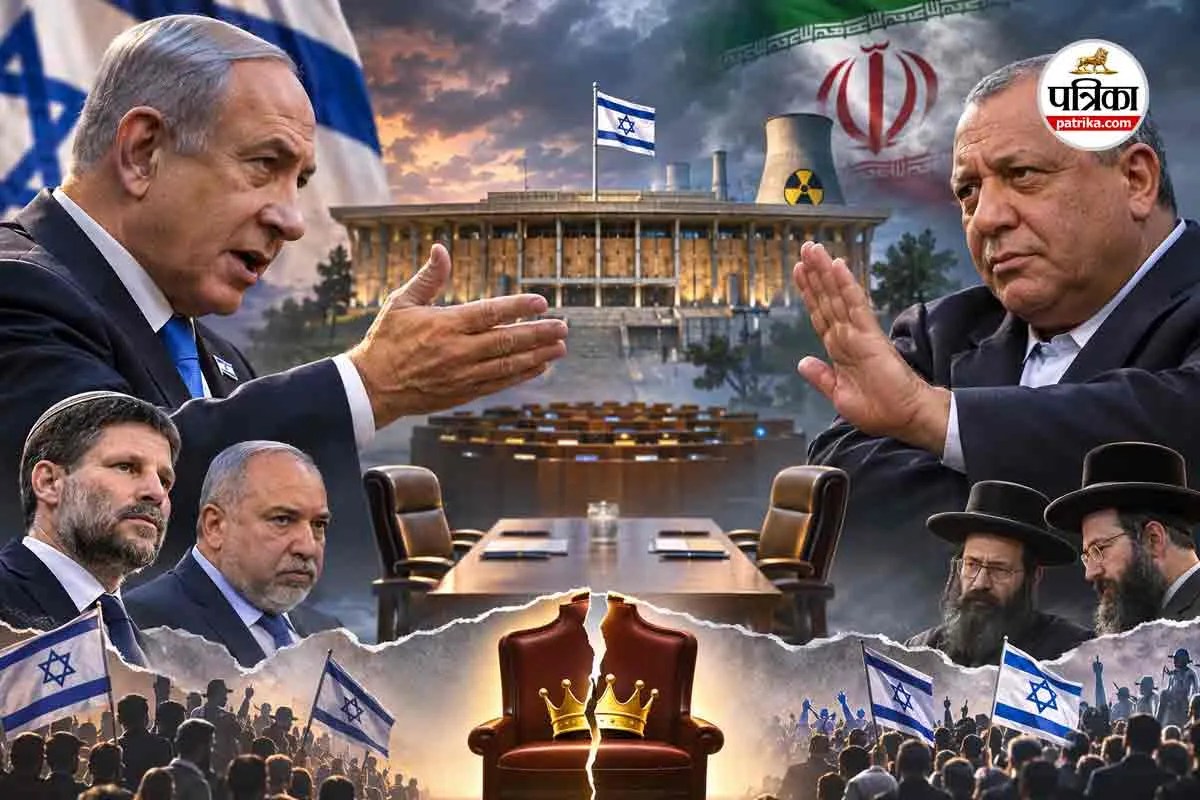
When an incumbent leader loses—or stands on the verge of losing—a functional legislative majority in a parliamentary system, appeals for a "national unity government" stop functioning as pure consensus-building and begin operating as an instrument of political survival. In Israeli politics, the recurring debate over whether Prime Minister Benjamin Netanyahu invokes the strategic threat from Iran to justify an emergency unity government sits at the intersection of genuine national security imperatives and acute domestic coalition math. The competitor framing—summarized in the Hindi headline asking whether Netanyahu is invoking the fear of Iran to save power after losing a majority—captures a prominent critical narrative in political commentary, yet reduces a multi-variable institutional game into a single motive. A rigorous strategic breakdown requires separating verifiable parliamentary mechanics from competing political interpretations, examining how existential security threats alter coalition bargaining power, and mapping the trade-offs each actor faces inside Israel's 120-seat Knesset.
The Structural Mechanics of Knesset Coalition Fragility
To understand why unity government rhetoric surfaces during moments of legislative vulnerability, one must first examine the institutional architecture of Israel's unicameral parliament. Under Israel's proportional representation system, no single party has ever won an outright 61-seat majority in the 120-member Knesset. Every governing coalition is therefore a negotiated contract among distinct ideological, religious, and sectoral factions, each holding an implicit veto once the coalition's margin shrinks toward the 61-seat threshold.
In a razor-thin coalition, bargaining power inverts. Small partner parties gain disproportionate leverage because the defection of even a handful of lawmakers can strip the government of its floor majority, stall budget passage, or trigger a motion to dissolve the Knesset. Three distinct pressures routinely converge to erode a slim majority in Israeli coalition politics:
- Ideological and Statutory Friction: Governing alliances often bind together factions with incompatible domestic priorities—such as ultra-Orthodox (Haredi) parties seeking military draft exemptions and state funding, far-right nationalist factions demanding aggressive settlement or military policies, and secular right-wing legislators focused on economic or judicial agendas. When binding legislation, particularly the state budget or conscription laws, hits a statutory deadline, internal compromises become mathematically impossible without alienating at least one indispensable bloc.
- External Security Escalation: Prolonged multi-front military pressure—encompassing direct confrontation with Iran, missile and drone threats, and regional proxy conflicts involving Hezbollah, Hamas, or the Houthis—forces tactical decisions regarding ceasefires, hostage negotiations, and escalation thresholds. Hardline coalition partners frequently threaten to bolt if the prime minister accepts diplomatic de-escalation, while centrist or opposition figures refuse to join unless those same hardliners are sidelined.
- Institutional Deadlines and Automatic Dissolution: Under Israeli Basic Law, failure to pass a state budget by the statutory deadline automatically dissolves the Knesset and forces snap elections. Similarly, a successful 61-vote majority on a dissolution bill or a constructive vote of no confidence terminates the government's tenure immediately.
Once a prime minister faces a deficit below 61 reliable votes—or faces a coalition partner willing to collapse the government over a single policy demand—there are only three operational escape routes: capitulate to the rebellious partner's demands, call early elections from a position of institutional weakness, or widen the coalition base by recruiting centrist opposition factions under the banner of national emergency.
Securitization Theory and the Strategic Use of the Iran Threat
The core premise raised in critical commentary—that Netanyahu emphasizes the threat from Iran to justify a unity government and preserve his premiership—maps directly onto what international relations scholars term securitization. Developed by the Copenhagen School of security studies, securitization describes the process by which political actors frame an issue as an existential threat requiring extraordinary measures that bypass normal political bargaining and partisan opposition.
In Israel's strategic environment, the Iranian threat is not a fabricated construct; Iran's nuclear program, ballistic missile arsenal, and regional proxy network represent long-standing, bipartisan national security concerns across the Israeli defense establishment and political spectrum. The analytical distinction lies not in whether the threat exists, but in how that threat is operationalized within domestic coalition bargaining.
Two Competing Interpretations of Unity Appeals
Political observers, opposition leaders, and supporters of the prime minister interpret unity government overtures through fundamentally opposed frameworks:
- The Coalition-Preservation Critique (Opposition and Critical Media View): Critics argue that when domestic controversies—such as judicial overhaul disputes, military conscription exemptions, wartime governance failures, or corruption trials—erode Netanyahu's parliamentary majority and public polling, elevating the Iranian threat serves a dual political purpose. First, framing the moment as an existential war shifts public and media focus away from domestic accountability and governance deficits toward external defense, where an incumbent leader can claim indispensable experience. Second, calling for "unity" places opposition leaders in a reputational trap: refusing to enter a unity government during an active Iranian crisis exposes centrist rivals to accusations of putting partisan ambition ahead of national survival, whereas entering the government rescues Netanyahu from coalition collapse and neutralizes the threat of early elections.
- The National-Security Necessity Argument (Government and Supporter View): Defenders of the prime minister contend that confronting a state-level adversary like Iran requires broad domestic legitimacy, unified cabinet decision-making, and insulation from the ideological blackmail of small fringe factions. From this perspective, a narrow coalition dependent on ultra-nationalist or sectarian parties lacks the international diplomatic credibility and strategic flexibility required to coordinate with Washington and regional partners during direct military confrontation with Tehran. Bringing centrist figures with senior defense credentials into a war cabinet or unity framework is presented as a stabilizing measure designed to broaden the decision-making base rather than a purely partisan maneuver.
Both interpretations rest on observable incentives, and neither cancels the other out in practice. In parliamentary politics, a leader can simultaneously confront a genuine external security crisis and utilize the institutional dynamics of that crisis to extend political survival.
The Payoff Matrix for Opposition Leaders
A unity government cannot be formed unilaterally; it requires the consent of opposition party leaders who command enough Knesset seats to offset departing or unreliable coalition partners. For centrist opposition figures—such as Benny Gantz, Yair Lapid, or Avigdor Liberman—an invitation to join a Netanyahu-led unity government triggers an asymmetric cost-benefit calculation.
- The Cost of Entry: Joining a coalition headed by Netanyahu immediately delivers him a parliamentary lifeline, neutralizing the opposition's primary strategic objective: forcing early elections while the incumbent's standing is damaged. Furthermore, historical precedent in Israeli politics—including Benny Gantz's 2020 power-sharing agreement and his post-October 7 emergency war cabinet participation—demonstrates that junior partners inside a Netanyahu-led government often absorb public blame for policy stalemates while possessing limited control over core diplomatic or legislative outcomes. Once the immediate acute phase of a crisis subsides, the prime minister retains institutional control over the cabinet agenda and the timing of coalition breakups.
- The Cost of Refusal: Rejecting a unity appeal during heightened confrontation with Iran carries severe electoral risk in a security-conscious electorate. Government messaging can frame non-participation as partisan obstructionism during a national emergency, potentially eroding centrist support among swing voters who prioritize national solidarity over anti-Netanyahu alignment.
- The Structural Condition for Entry: Because of this asymmetry, opposition leaders rarely accept unconditional entry into an existing coalition. Instead, they demand structural preconditions: either the removal of far-right coalition partners from key ministries, a binding rotation agreement, or an agreed-upon statutory date for early elections. When Netanyahu refuses to jettison his ideological base—because doing so would destroy his long-term political bloc after the emergency ends—unity negotiations frequently stall at the rhetorical stage.
Operational Limitations of the Unity Strategy
Even when executed successfully, using external security threats to assemble a unity government faces hard institutional limits that prevent it from serving as a permanent solution to coalition instability.
First, an emergency coalition does not resolve underlying statutory deadlocks. Even if centrist lawmakers temporarily bolster the government's floor numbers on security votes, fundamental disputes over the state budget, military draft legislation, judicial authority, and post-war diplomatic frameworks remain intact. Once a major legislative deadline arrives, the temporary consensus fractures along the exact ideological fault lines that caused the initial crisis.
Second, international diplomacy constrains domestic political theater. Major strategic actions involving Iran—particularly military strikes on nuclear or energy infrastructure, regional air-defense coordination, and diplomatic ceasefires—depend heavily on intelligence sharing, munitions resupply, and diplomatic backing from the United States and allied governments. External allies evaluate Israeli policy through their own strategic interests and domestic timelines, limiting the extent to which any prime minister can calibrate external confrontation solely for domestic parliamentary advantage.
Third, repeated appeals to emergency unity suffer from diminishing marginal returns. Voters and rival politicians update their expectations based on prior coalition cycles. When unity agreements repeatedly end in broken rotation deals or the marginalization of centrist ministers, opposition parties raise the price of entry to levels—such as demanding the prime minister's resignation or immediate election dates—that defeat the incumbent's survival objective.
Strategic Outlook for Coalition Bargaining
In any parliamentary system facing simultaneous domestic legitimacy erosion and high-intensity external security threats, the viability of a unity government depends on whether the incumbent is willing to trade ideological coalition loyalty for centrist institutional stability. If Netanyahu preserves his existing right-wing and religious bloc intact while inviting centrist rivals merely to supplement lost votes, opposition leaders face an unfavorable risk-reward ratio and will continue to withhold parliamentary rescue, pushing the Knesset toward budget deadlocks and early elections. Conversely, a genuine unity realignment only becomes mathematically viable if external escalation with Iran forces a structural break with hardline coalition partners, trading the survival of a narrow ideological bloc for a broad centrist cabinet bound by a fixed election timetable.