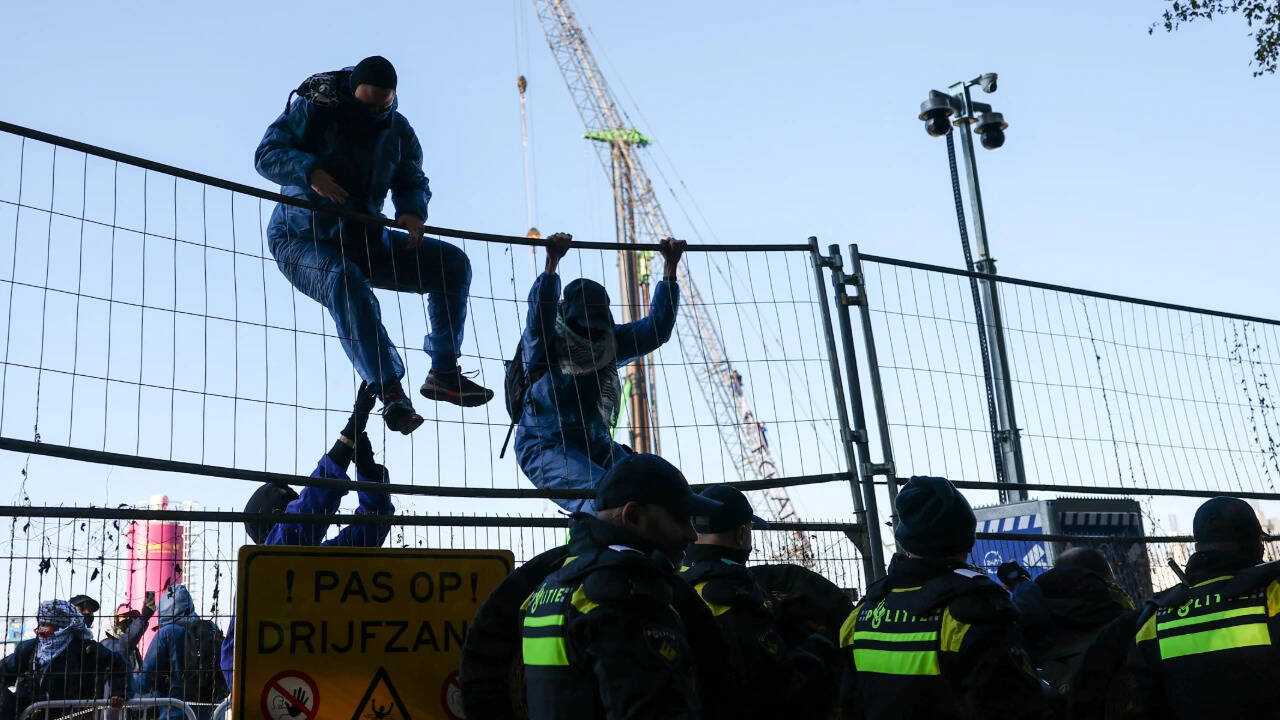
Dozens of climate activists breached the perimeter of a Microsoft data centre site near Amsterdam, leading to multiple arrests by Dutch police and putting Big Tech's physical infrastructure right in the crosshairs of environmental protesters.
It wasn't a random act of vandalism. For years, the conversation around cloud computing has been weirdly sterile, mostly focused on digital privacy, server uptime, and corporate tax breaks. Protesters who stormed the site in North Holland—specifically around the Wieringermeer polder region, where Microsoft operates a massive hyperscale campus—wanted to drag the physical reality of the cloud into the daylight. When police moved in to clear the demonstrators who had occupied the grounds and locked themselves to equipment or barriers, they weren't just breaking up a trespass. They were defending the front lines of the artificial intelligence boom.
Most people still think of "the cloud" as something invisible and weightless. You upload a photo, run a prompt, or stream a movie, and it just happens.
In reality, the cloud is millions of tons of concrete, steel, copper wiring, and diesel backup generators sitting on prime agricultural land. And it's thirsty.
What Actually Happened at the Amsterdam Data Centre Site
Local law enforcement responded quickly when activists from climate action groups—including coalitions linked to Extinction Rebellion and anti-capitalist environmental networks—entered the restricted construction and operational zones of Microsoft's Dutch facility. Protesters draped banners over fencing, blocked access roads, and occupied parts of the site to halt ongoing expansion work.
Dutch riot police and local units established a cordon around the polder site. After issuing warnings to disperse, officers moved in and detained several individuals on charges of trespassing and obstructing public order.
If you've ever driven through the Wieringermeer polder in the municipality of Hollands Kroon, you know how jarring the scenery is. Flat, windswept Dutch farmland suddenly gives way to windowless, warehouse-sized concrete monoliths humming with industrial cooling fans. Microsoft started building there years ago, attracted by cool temperatures, nearby subsea fiber-optic cables, and abundant wind energy from the North Sea.
Local resentment has been simmering for a long time. Protests didn't come out of nowhere.
Why Activists Are Targeting Data Centres Now
For the past decade, climate protesters focused almost exclusively on fossil fuel extraction, coal plants, and airport expansions. Going after a tech company's server farm marks a major strategic shift.
Here is why tech infrastructure became a primary target:
- The AI energy spike: Training and running large language models requires exponentially more electricity than traditional web hosting. According to the International Energy Agency (IEA), global electricity consumption from data centres, AI, and cryptocurrency could double between 2022 and 2026.
- Grid congestion in the Netherlands: The Dutch power grid is notoriously overloaded. Thousands of businesses, housing developments, and schools in the Netherlands have been put on waiting lists for grid connections because high-voltage capacity is maxed out. Watching a multinational tech giant consume massive amounts of local power while regular citizens wait years to hook up solar panels or build homes creates instant political friction.
- Water consumption: Even in a country famous for managing water, industrial cooling drains local freshwater supplies during dry summer months.
Activists argue that tech companies use greenwashing—buying renewable energy credits on paper—while physically straining local ecosystems and power grids.
The Hollands Kroon Controversy and Broken Promises
You can't understand the Amsterdam-area protests without looking at the political mess in Hollands Kroon.
When Microsoft first pitched its expansion in North Holland, local officials welcomed the investment, expecting high-tech jobs and regional economic growth. Instead, residents got massive industrial sheds that employ relatively few full-time staff once construction finishes, alongside soaring power demands.
The water issue blew up publicly a few years back. Initial estimates suggested Microsoft's cooling systems would use roughly 12,000 to 20,000 cubic meters of drinking water per year. Later disclosures revealed that during hot weather, the facility actually consumed up to 84,000 cubic meters in a single year—more than four times the original public estimate. That revelation destroyed public trust overnight.
Following intense backlash from farmers, environmental groups, and national politicians, the Dutch government eventually passed temporary moratoriums and strict zoning rules limiting new hyperscale data centres across most of the country, restricting them largely to designated zones like Hollands Kroon and Eemshaven.
Protesters storming the site are reacting to a system they believe allowed corporations to lock in land and power deals before citizens realized what the true environmental cost would be.
How Tech Giants Defend Hyperscale Expansion
To be fair, Microsoft and other cloud providers have a counterargument, and it's worth looking at honestly rather than dismissing it outright.
Tech executives point out that centralized hyperscale data centres are vastly more energy-efficient than thousands of small, poorly cooled corporate server rooms scattered across office basements. By consolidating computing power, companies can achieve much lower Power Usage Effectiveness (PUE) ratings, meaning less energy is wasted on cooling and overhead.
Microsoft has also signed massive power purchase agreements (PPAs) to fund new wind farms in the North Sea, arguing that their capital actually accelerates the build-out of renewable energy infrastructure that wouldn't exist otherwise. They've pledged to become carbon negative, water positive, and zero waste by 2030.
The problem? Timing and physical reality.
Signing a contract for wind power generated off the coast doesn't magically fix a localized bottleneck in a regional transformer station, nor does it replace clean tap water evaporated through cooling towers during a summer drought.
What This Means for the Future of Cloud Infrastructure
The arrests outside Amsterdam aren't an isolated incident. Similar protests have popped up against data centre developments in Ireland, France, Germany, Spain, and the United States.
In Ireland, data centres already consume over 20 percent of the nation's entire electricity supply, forcing grid operators to restrict new connections around Dublin. In Virginia's "Data Center Alley," local residents are fighting zoning boards over noise pollution, diesel generator emissions, and massive high-voltage transmission lines cutting through residential neighborhoods.
If you're a business leader, developer, or policymaker watching this unfold, the era of frictionless data centre expansion in Western Europe is over. Expect stricter permitting laws, mandatory heat-recovery systems that pipe waste warmth into local district heating networks, and forced transitions away from evaporative drinking-water cooling toward closed-loop liquid cooling systems.
Start auditing your own cloud footprint and vendor sustainability disclosures now, because regulatory costs and carbon taxes on compute power are coming straight down the pipeline to enterprise customers.