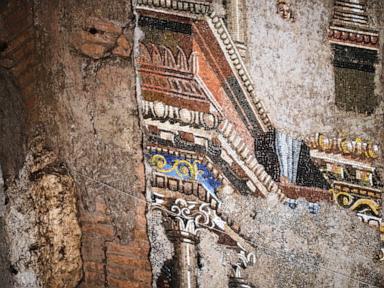
The marble did not want to surrender. It held onto its red pigments and ochre hues with a stubbornness that defied two thousand years of dirt, dampness, and the grinding weight of a modern metropolis.
Picture, if you will, a Roman artisan standing in the dim heat of a bathhouse chamber. It is late afternoon in the second century. The air smells of woodsmoke, wet stone, and perfumed olive oil. Sunlight filters through high clerestory windows, catching the rising steam. This worker is not carving an emperor or sealing a treaty. He is kneeling on scaffolding, pressing tiny cubes of colored glass and polished stone into wet mortar. He is building a world. Specifically, he is building a maritime city on a wall, a glittering vision of harbors, villas, and ships riding choppy blue waves that seem to swell with every flicker of torchlight.
Centuries later, that same vision sits under harsh LED work lights in Rome, quietly rescued from the subterranean dark.
Recent excavations at the Baths of Trajan have brought to light an extraordinary fresco and mosaic composition featuring a bustling maritime city. To read about this discovery in a standard archaeological bulletin is to encounter a list of attributes: dimensions, material composition, stratigraphic layers, and chronological markers. But numbers do not capture the salt spray of an ancient port or the ambition of an empire that stamped its identity onto every available surface.
To understand why this discovery matters, we have to look past the dirt brushes and the catalog numbers. We have to walk the streets of ancient Rome when the Baths of Trajan were not a ruin overrun by tourists and stray cats, but a monumental palace of water, light, and marble.
Emperor Trajan did not build small. When his architect, Apollodorus of Damascus, carved out a sprawling complex on the Oppian Hill in the early second century, they buried the remnants of Nero's infamous Golden House beneath tons of rubble. They built a civic leisure center for the masses. Picture citizens of every rank—senators rubbing elbows with freedmen—sweating in the caldarium, scraping their skin with strigils, and stepping out into sunlit courtyards.
And on the walls of these spaces, art spoke to them. Not just abstract patterns or stoic gods, but scenes of empire.
The newly unveiled fresco and mosaic cycle captures a coastal cityscape with startling vibrancy. Think of the way light hits the Mediterranean at dusk, shifting from cobalt to deep turquoise. The ancient mosaicist captured that exact optical illusion using tesserae so minute they resemble brushstrokes. Ships with square sails glide toward fortified harbor walls. Warehouses line the quays. You can almost smell the garum, the rotting kelp, and the roasted grain pouring from the holds of cargo vessels arriving from Alexandria or Ostia.
Why put a bustling port city inside a bathhouse wall?
Water. Water was the lifeblood of the complex, fed by the Aqua Traiana. But water was also the medium of empire. Rome did not conquer the world by land alone; it ruled through the sea lanes that fed its voracious stomach. Every grain of wheat from Egypt, every amphora of Spanish wine, every block of Numidian marble arrived on ships that braved treacherous winter seas. By placing a maritime city on the wall of a public bath, the decorators reminded every bather of the invisible machinery keeping them alive. You are here, warm and clean, because a ship survived a storm off the coast of Sicily.
Restoration is a violent, tender act.
When archaeologists first breached this underground chamber, the frescoes were choking beneath centuries of calcium carbonate crusts and fungal spores. I imagine the conservator leaning in with a scalpel, holding their breath, scraping away a millimeter of calcified history to reveal the eye of a painted sailor or the sharp angle of a ship's prow. One false twitch of the hand and a face lost for millennia vanishes permanently.
There is a profound vulnerability in ancient art. We treat stone and mosaic as permanent, indestructible. Yet they are fragile skins. A minor shift in the earth, a leaking sewer pipe from the nineteenth century, or the relentless vibration of modern Rome's metro line can turn a masterpiece into dust.
When the news broke about the Baths of Trajan discovery, the academic world buzzed with the usual nomenclature. Typologies were debated. Dating was refined. Parallels were drawn with wall paintings from Pompeii and Stabiae. But the real heartbeat of the story is simpler and stranger. It is the sudden, violent jolt of connection across time.
A Roman mason working in the shadow of the Colosseum had a favorite blue pigment. He pressed it into the mortar, stepped back, wiped his hands on a dirty tunic, and went home to his dinner. Two thousand years later, someone working by the light of a battery-powered lamp stares at that exact blue and feels the chill of the sea.
We build our cities out of steel and glass, tearing down yesterday to make room for tomorrow, convinced of our own modernity. We pave over the past, burying aqueducts beneath subway tracks and forgetting the names of the builders. Then a shovel hits stone. A wall opens up. And a painted harbor reminds us that we are just the latest tenants in a very old house, staring out at the same unchanging sea.