The black oil sloshing against the hull of a supertanker in the Strait of Hormuz looks identical to the oil refined into gasoline for a commuter stuck in Atlanta traffic. It smells the same. It carries the same immense economic weight. But out here, in a strip of water only twenty-one miles wide at its narrowest point, that oil ceases to be a mere commodity. It becomes gunpowder.
To understand the modern world is to understand the fragile geography of our own anxieties. We live in an era of hyper-connectivity, yet our survival remains anchored to ancient, physical trade routes. If you stand on the coast of Oman and look out across the gray-blue expanse toward Iran, you are looking at the jugular vein of the global energy supply. One-fifth of the world’s petroleum passes through this tight corridor. It is a terrifyingly small bottleneck for a world that runs on constant, uninterrupted consumption.
Right now, that corridor is breathing heavily.
The air in Tehran is thick, not just with summer heat, but with the suffocating weight of a massive public collective grief and political uncertainty. Ayatollah Ali Khamenei is dead. His funeral, a sprawling sea of black-clad mourners stretching across miles of asphalt, is more than a ritual of mourning. It is a moment of profound vulnerability for a nation that has spent decades defining itself through resistance. As the chants echo through the capital, the elite units of the Islamic Revolutionary Guard Corps stand on high alert. Their fingers are on the triggers of fast-attack boats docked along the Persian Gulf. They are grieving, yes. But they are also watching.
Thousands of miles away, Washington watches back.
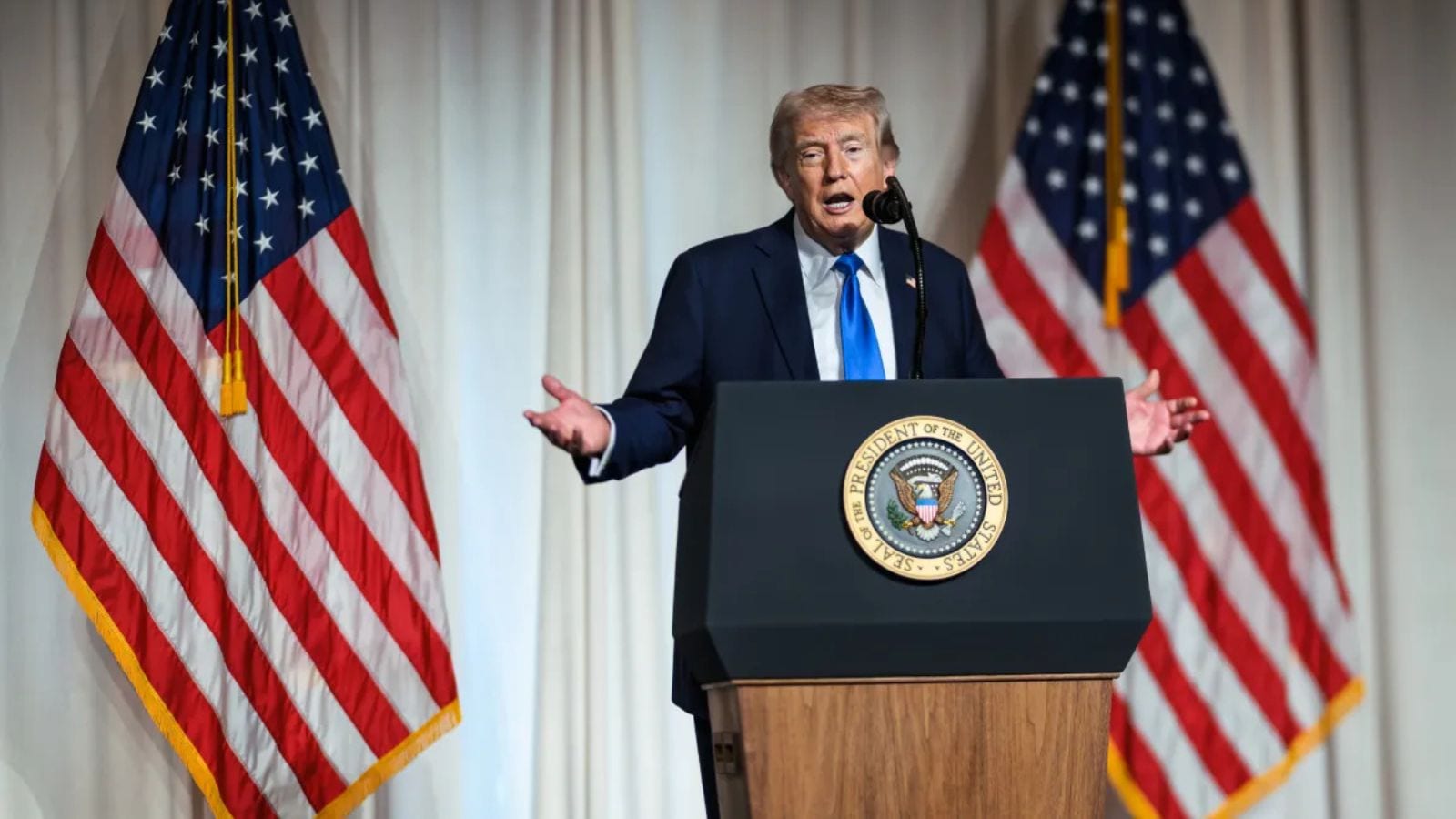
President Donald Trump did not offer condolences. Instead, he issued a stark, public ultimatum: make a deal, or face the consequences. The warning was timed with mathematical precision, designed to land exactly when the Iranian regime is at its most fractured, its leadership transition uncertain, and its public focus turned inward.
It is a classic display of geopolitical leverage, but it ignores the human calculus on the water.
The View from the Bridge
Consider a captain steering a 300,000-ton vessel through those disputed waters today. Let us call him Marcus. Marcus does not care about the grand rhetoric of Washington or the theological continuity of Tehran. He cares about the depth finder. He cares about the radar signature of a swarm of incoming speedboats.
When a superpower threatens a regional adversary during a time of national mourning, Marcus feels it in the tightening of his jaw. He knows that if a single missile is fired—even by accident, even by a rogue commander reacting out of grief or panic—the insurance rates for his vessel will skyrocket by tomorrow morning. If the strait closes, the global economy shifts instantly.
The numbers are cold, but their impact is brutally intimate. A prolonged disruption in the Strait of Hormuz does not just mean higher prices at the pump for a family trying to make ends meet. It means a factory closing in Ohio because the cost of plastics became unsustainable overnight. It means a shipping container full of medical supplies delayed in a port halfway across the world.
We treat these geopolitical standoffs like a game of chess played by distant giants. We watch the news feeds, read the transcripts of press briefings, and analyze the satellite imagery of naval deployments. But chess pieces do not bleed. They do not have families waiting for them in port cities.
The tragedy of the current escalation is that both sides are reading from entirely different scripts.
Washington views the situation through the lens of maximum pressure. The logic is straightforward, almost transactional: Iran is hurting, its economy is crippled by sanctions, its supreme leader is gone, and therefore, it must capitulate. It is the strategy of a businessman squeezing a competitor who has run out of options.
But Iran’s leadership does not operate on a corporate timeline. To the regime in Tehran, and to the millions who filled the streets for Khamenei's funeral, submission is not an economic calculation; it is a spiritual impossibility. History matters deeply in this part of the world. Every sanction, every naval maneuver, and every aggressive statement from the White House is viewed through the prism of decades of perceived Western intervention. When backed into a corner during a moment of national mourning, the instinct is not to negotiate. The instinct is to lash out.
The Illusion of Control
It is tempting to look for a simple villain or a straightforward hero in this narrative. The reality is far more unsettling. We are witnessing a collision of two distinct forms of pride, both convinced they hold the upper hand, and both playing with fire next to an open powder keg.
The United States possesses the most powerful military force in human history. Its fifth fleet is stationed just across the water in Bahrain, a massive, high-tech deterrent capable of devastating retaliation. But high-tech weaponry is remarkably poor at managing human psychology. A billion-dollar destroyer can be threatened by a handful of cheap, explosive-laden speedboats utilizing swarm tactics. The asymmetric nature of modern warfare means that the illusion of absolute control is just that—an illusion.
What happens if an Iranian naval officer, raw with emotion after watching his country's leader laid to earth, misinterprets a standard U.S. freedom of navigation exercise?
What happens if a nervous American sonar operator mistakes a civilian fishing trawler for an incoming threat?
The margin for error in the Strait of Hormuz is non-existent. The physical space is too tight, the weapons are too fast, and the rhetoric is too loud.
This is the hidden cost of brinkmanship. It forces everyone involved into a state of hyper-vigilance where nuance dies and every action is interpreted as an act of war. The "deal" that the American administration wants to force cannot be born in an environment of total distrust and public humiliation. Deals require a modicum of mutual survival, a recognition that both parties must be able to walk away without losing everything.
The Empty Horizon
The sun sets over the Persian Gulf, painting the water in shades of bruised purple and deep orange. On the shores of Iran, the funeral ceremonies begin to wind down, leaving behind a exhausted, anxious population wondering what the next chapter of their history holds. On the water, the supertankers continue their slow, agonizingly vulnerable procession through the shipping lanes.
Marcus stands on the bridge, looking out into the gathering dark. His radar sweeps the horizon, capturing the steady, rhythmic pulse of a world that desperately needs the oil in his cargo hold to keep moving, to keep heating its homes, to keep powering its cities.
He knows that his safety relies entirely on the restraint of men he will never meet, sitting in offices thousands of miles away, who are currently using his location as a rhetorical battlefield. He can only watch the dark water, check his course, and hope that those who hold the power to stop the world remember just how fragile it really is.
The strait remains open for now. But the silence over the water is not the silence of peace. It is the breath held before a scream.