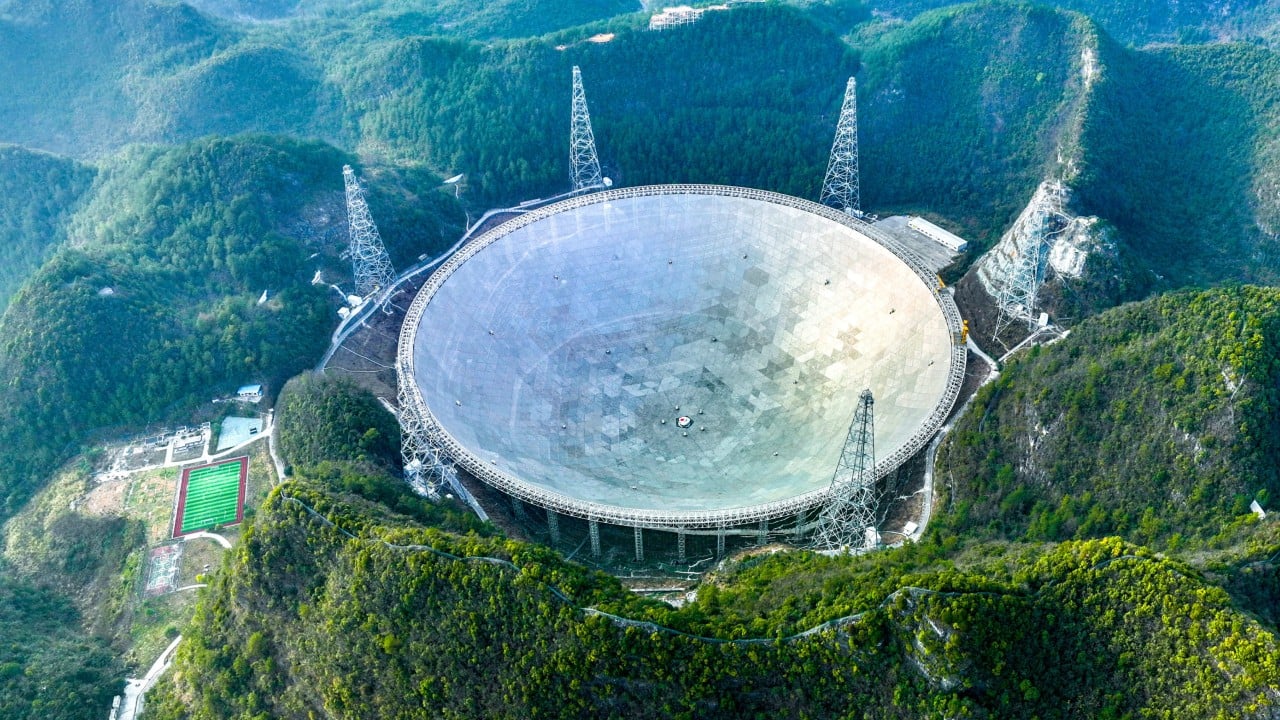
Everybody loves a big dish. When China turned on the Five hundred meter Aperture Spherical radio Telescope, the aerospace press treated the event like the opening of a cosmic IMAX theater. Headlines screamed about neutral hydrogen mapping, cosmic gas nurseries, and the grand celestial choreography of star formation. The narrative is neat, tidy, and utterly pedestrian. It comforts us with the illusion that if we just build a bigger bucket to catch stray whispers from the deep void, the universe will hand over its operating manual.
That is not how breakthrough astrophysics works. That is just expensive stamp collecting.
I have spent decades watching engineers and astronomers fall in love with their own hardware. They build engineering marvels in remote karst depressions, drape them in hyperbolic PR campaigns, and then quietly spend decades answering questions that were obsolete before the concrete even cured. Mapping neutral hydrogen via the twenty-centimeter hyperfine transition line is the astronomical equivalent of charting traffic patterns by counting every single blade of grass along the highway. It tells you where the matter sits. It does not tell you why the machine runs.
If you want to understand how stars ignite, stop staring at the static dust. The lazy consensus in modern radio astronomy is that mass accumulation equals stellar birth. Collect enough cold gas in a molecular cloud, let gravity do the heavy lifting, and boom, you get a thermonuclear furnace.
Nature laughs at that simplistic accounting.
The Hydrogen Fallacy and the Cosmic Noise Floor
Let us look at what the mainstream press gets wrong about Aperture Spherical radio Telescope data. The instrument is hailed as a supreme surveyor of neutral hydrogen, tracking the raw feedstock of galaxies. But neutral hydrogen is just the exhaust and the packaging. It is the packaging peanuts of the cosmos.
When you look at neutral hydrogen distribution maps, you are looking at where star formation failed to happen immediately. Cold gas is lazy. It stays cold, sluggish, and diffuse unless something violently kicks it into submission. The real action happens in the turbulent interfaces where magnetic fields clash, shockwaves propagate, and turbulence shreds the gas clouds apart.
Yet, institutional astronomy remains obsessed with static maps. They treat the universe like an atlas when it is actually a riotous, nonlinear furnace.
I have watched research groups blow millions of dollars of compute time on high-resolution spectral line mapping, only to produce gorgeous, technicolor posters that explain precisely zero new physics about stellar ignition triggers. They measure column densities to four decimal places while ignoring the magnetohydrodynamic turbulence that actually forces neutral atoms to compress, ionize, and collapse.
If your instrument cannot resolve the sub-parsec magnetic topology driving the gas collapse, you are not mapping star formation. You are just taking high-definition photographs of smoke while ignoring the match.
Why Big Science Prefers Big Dishes Over Hard Truths
There is a political economy to mega-science. Governments love things that are round, massive, and expensive. They look great in annual reports. A five-hundred-meter reflector sunk into a Guizhou depression is a monument to national engineering capability. It is a flex.
Because of that political weight, the science must be framed in terms of universally appealing metaphors. "Mapping the cosmic gas for making stars" is a bedtime story for bureaucrats. It implies a direct, cozy pipeline from diffuse atoms to shining suns.
The inconvenient truth is that star formation is profoundly inefficient. Galaxies contain vastly more neutral hydrogen than they will ever turn into stars over their entire lifetimes. Most of that gas just sits there, stubbornly refusing to condense because stellar feedback, galactic shear, and magnetic pressure keep blowing it apart or holding it up.
By framing the mission around passive mapping rather than active disruption, we institutionalize incrementalism. We get ten thousand papers on the HI morphology of distant dwarf galaxies, and zero papers explaining the exact threshold where magnetic reconnection overcomes thermal pressure to trigger a protostellar core collapse.
Imagine a scenario where an engineering project manager builds a multi-lane superhighway across an empty desert, and then spends five years celebrating the fact that they can accurately count every pebble sitting on the shoulder. That is what multi-million-channel correlators are doing with twenty-centimeter hydrogen hyperfine emissions when they lack correlated polarimetric data to map the magnetic field vectors tearing through those same clouds.
What Real Astrophysics Demands Now
If we are going to stop lying to ourselves about what radio astronomy can achieve, we have to change the questions we ask. We need to stop treating telescopes as passive census takers and start treating them as probes of extreme plasma physics.
First, polarization is not an optional extra. If you are mapping neutral hydrogen without simultaneously reconstructing the Faraday rotation and synchrotron polarization of the background continuum, you are driving blind. The magnetic field is the invisible hand crushing gas clouds into stars. Ignore the field, and the gas is just floating scenery.
Second, spatial resolution must trump sensitivity once you cross the threshold of detection. We do not need more hours integrating faint signals from local group clouds to get smoother contours. We need interferometric baselines that can resolve the actual filamentary webs where accretion shocks occur. Single-dish giants have unbeatable sensitivity, but their beam sizes are fat brushes trying to paint miniature portraits.
Third, machine learning inversion techniques must replace manual spectral line fitting. We are drowning in terabits of spectral cube data, yet researchers still rely on Gaussian decomposition models invented in the mid-twentieth century to parse velocity components. That is like trying to analyze climate change with an abacus.
The Uncomfortable Bottom Line
China built an engineering masterpiece. It is sensitive enough to hear a cellphone ring on Jupiter. But sensitivity without a conceptual revolution is just noise amplification on a grand scale.
Until the astronomical community drops the comforting myth that collecting more neutral hydrogen maps will automatically reveal the secret of stellar genesis, we will keep building bigger ears to listen to a conversation we refuse to understand.
The stars do not care about your dish size. They care about pressure, torque, and magnetic discipline. Stop counting the gas and start measuring the violence that shapes it.