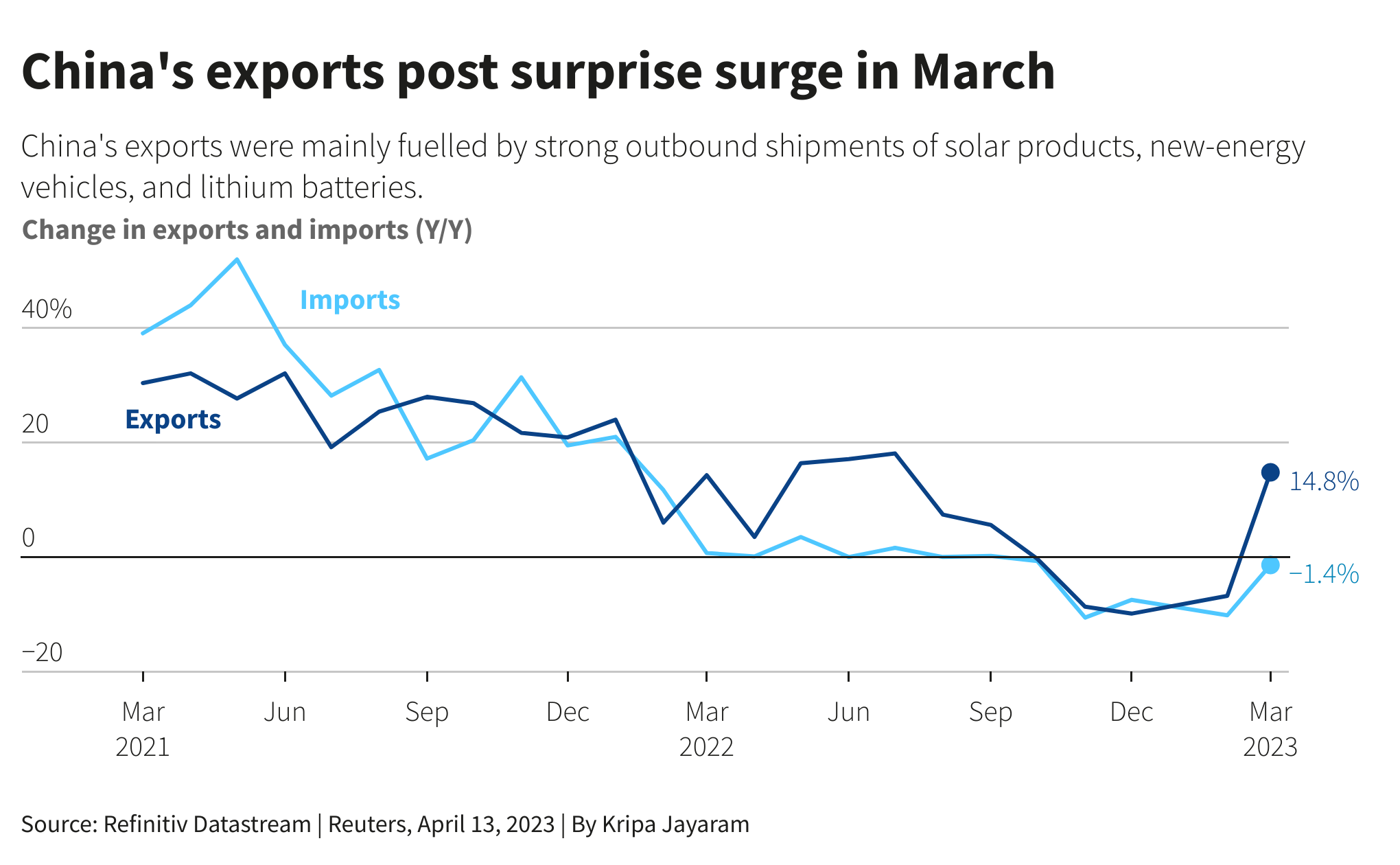
The headlines are screaming about a 14.1% jump in Chinese exports as if it’s a show of strength before the Xi-Trump summit in Beijing. It isn’t. This isn't a "rebound" or a sign of "resilience." It is the frantic, last-minute dumping of inventory by a manufacturing engine that has no domestic pulse and nowhere left to run.
If you think this data gives Xi Jinping a stronger hand when he sits down with Donald Trump on May 14, you are reading the board backward. This surge is the economic equivalent of a "going out of business" sale. China is frantically shoving its overcapacity through the world’s mail slots before the door slams shut for good.
The Mirage of High End Manufacturing
Mainstream analysts at firms like Guotai Junan are pointing to "high-end manufacturing" in chips and EVs as the driver. They are missing the desperation. I have watched supply chains for two decades, and when you see a 14% spike in a period of cooling global demand and rising trade barriers, you aren't looking at "organic growth." You are looking at front-loading.
Exporters are terrified of what comes after the summit. They know the "Liberation Day" tariffs of 2025 were just the opening act. They are shipping every semiconductor, EV, and robot they can build right now because they suspect that by June, a 60% baseline tariff might be the optimistic scenario.
The Trade Surplus is a Symptom of Rot
China’s trade surplus just hit $84.8 billion. In the "lazy consensus" of financial journalism, a massive surplus is a win. In reality, it is a flashing red light for a structural disaster.
A surplus this wide means the Chinese consumer is essentially dead. While the world buys Chinese ships and cars, the Chinese people are hoarding cash because they don't trust their own property market or their social safety net. You cannot run a modern superpower on a "produce but don't consume" model forever.
- Logic Check: If your neighbor is selling all his furniture to the rest of the street while his own house sits empty and dark, you don't call him a "retail titan." You wonder when the bank is coming for the keys.
The 25.3% jump in imports sounds healthy until you look at what they are importing. It isn't consumer goods for a thriving middle class. It’s raw materials and energy. Beijing is stockpiling oil and petrochemicals to insulate itself from the fallout of the war in Iran and the closure of the Hormuz Strait. This isn't an economy growing; it's a fortress bunkering down.
Why Trump Holds the High Ground
The common narrative suggests Trump needs a deal to keep US markets "scorching." Wrong. The US economy has already begun the painful, necessary process of decoupling. Exports to the US are down 11% year-on-year.
Trump doesn't need Chinese chips; he needs to prove to his base that he can dictate the terms of the "interregnum" before he leaves office in 2029. Xi, meanwhile, is presiding over a "strong supply, weak demand" trap that his own economists are starting to admit is a dead end.
Imagine a scenario where the US simply refuses to absorb the excess. China has spent the last year redirecting its flood of goods to Africa, ASEAN, and the EU. But those markets are not infinite. You cannot replace the American consumer with the African infrastructure market. Eventually, the world hits "peak China," and the inventory has nowhere to go but back to the factory floor to rot.
The Involution Trap
Beijing uses the term "involution" to describe the inward-turning, hyper-competitive race to the bottom. That is exactly what this 14% growth represents. Chinese firms are selling at a loss just to keep the lights on and the workers from rioting.
When value growth lags behind volume growth—as it has for most of the last three years—you aren't looking at a "high-tech leader." You are looking at a commodity pusher. Even with the slight price recovery mentioned in recent data, the margins are razor-thin. This is a survival strategy, not a dominance strategy.
The Real Summit Goal
Xi isn't coming to this summit to brag about his 14% growth. He is coming to beg for a release valve. He needs Trump to stop the "snap back" of tariffs that the Supreme Court cleared the way for in February.
If the US doesn't blink, China’s "export machine" becomes a liability. It creates a mountain of products that nobody can afford to buy, funded by debt that can no longer be serviced by a shrinking, aging domestic population.
The 14% surge isn't a sign that American tariffs have "done little to slow China." It's proof that the tariffs are working so well that the Chinese industrial base is in a state of absolute panic.
Stop celebrating the surplus. Start watching the cracks in the furnace.
The door is closing, and the 14% is just the sound of everyone trying to squeeze through at once.