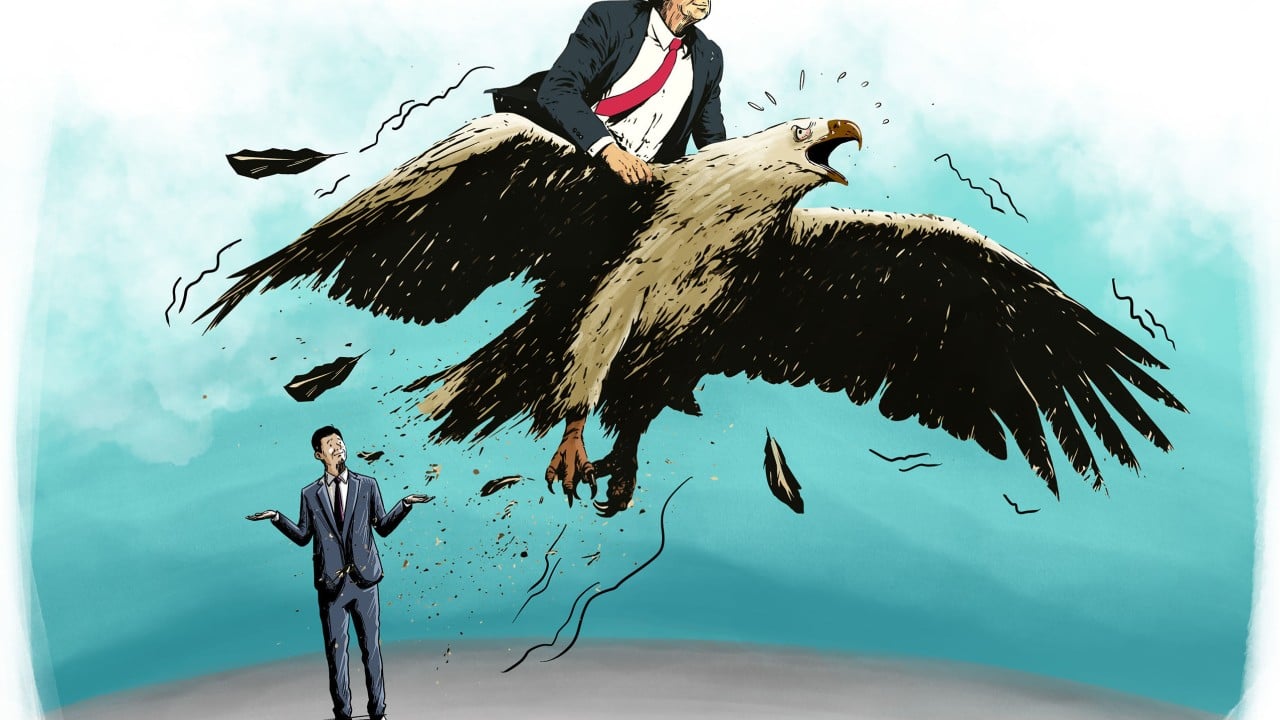
The lazy consensus floating through foreign policy columns claims that Beijing has shifted from sheer panic to an indifferent shrug regarding Washington's erratic trade bluster. Analysts love to paint Chinese leadership as stoic grandmasters casually drinking tea while American political theater burns itself out. It is a comforting narrative for Western headline writers who want a clean, cinematic script.
It is also dangerously wrong. Recently making waves in related news: The Unseen Thread Binding Tokyo and New Delhi Together.
Beijing is not shrugging. They are weaponizing the chaos. What looks like a casual shoulder-roll from the outside is actually a calculated, high-speed restructuring of global supply chains designed to render American economic leverage obsolete. When commentators mistake tactical composure for apathy, they fundamentally misunderstand how authoritarian state capitalism operates under external pressure.
The Myth of the Beijing Indifference
Step onto the streets of Beijing or talk to mid-level bureaucrats, and you will hear plenty of wisecracks about American political volatility. Pundits take these offhand comments as proof of public nonchalance. This confuses street-level gallows humor with strategic policy. Further insights on this are explored by Reuters.
Behind closed doors in Zhongnanhai, nobody is yawning. The Chinese Communist Party treats American unpredictability not as noise, but as a structural stress test. Every tariff threat, export control, and technology ban serves as a diagnostic tool. It tells Beijing precisely where its domestic vulnerabilities lie.
Imagine a stress test on a multi-trillion-dollar financial system. You do not shrug when a stressor hits; you measure the fracture lines. That is what Chinese industrial planners have been doing relentlessly.
Weaponizing the Trade War
The conventional take suggests that because retaliatory tariffs and trade threats have become routine, China has simply learned to tune them out. The opposite is true. The recurrence of aggressive trade measures has provided Beijing with the political capital required to force domestic state-owned enterprises and private tech giants to decouple from American dependencies.
For years, reformers within China argued for continued integration with Western tech stacks and financial systems. Washington's hostile posture silenced those reformers overnight. When the White House threatens astronomical tariffs, it validates the hardline faction's core premise: reliance on the United States is an existential threat.
The result is not a shrug, but a massive mobilization. Domestic chipmakers accelerated legacy semiconductor production. Local software designers captured substantial domestic market share precisely because external pressure eliminated corporate complacency. When Western analysts look at this and call it a "shrug," they are confusing the calm execution of a contingency plan with a lack of concern.
The Global South Realignment
Another blind spot in the mainstream narrative is the assumption that trade friction isolates Beijing. Washington’s transactional approach to diplomacy has gifted China an unprecedented diplomatic opening across the Global South.
When American foreign policy swings wildly between isolationism and aggressive unilateralism, traditional allies and emerging economies look for a steady anchor. Beijing fills that vacuum with long-term infrastructure funding, bilateral currency swaps, and industrial export surges. Electric vehicles and solar panels that face barriers in Western markets find eager buyers from Latin America to Southeast Asia.
This is not a defensive reaction. It is an aggressive expansion of an alternative economic orbit. Every time American leadership signals disengagement or transactional hostility, Beijing accelerates its integration into developing markets.
Why the Misconception Persists
Western media outlets crave tidy arcs. A story where Beijing panics makes for good short-term drama; a story where Beijing shrugs makes for a convenient counter-narrative. Both miss the reality of quiet, relentless state execution.
To understand modern great power competition, stop listening to superficial expressions of calm and start watching capital allocation. Beijing is spending billions to insulate its economy, secure raw materials, and rewrite the rules of international trade. That is not the behavior of a nation that is shrugging. That is the behavior of a nation that intends to outlast the storm by building an entirely new shelter.
China Trying to 'Run Out the Clock' on Trump Presidency, Says Shehzad Qazi
This video provides an expert analysis on how Chinese economic strategists view the timeline of American political shifts and long-term planning.
http://googleusercontent.com/youtube_content/1