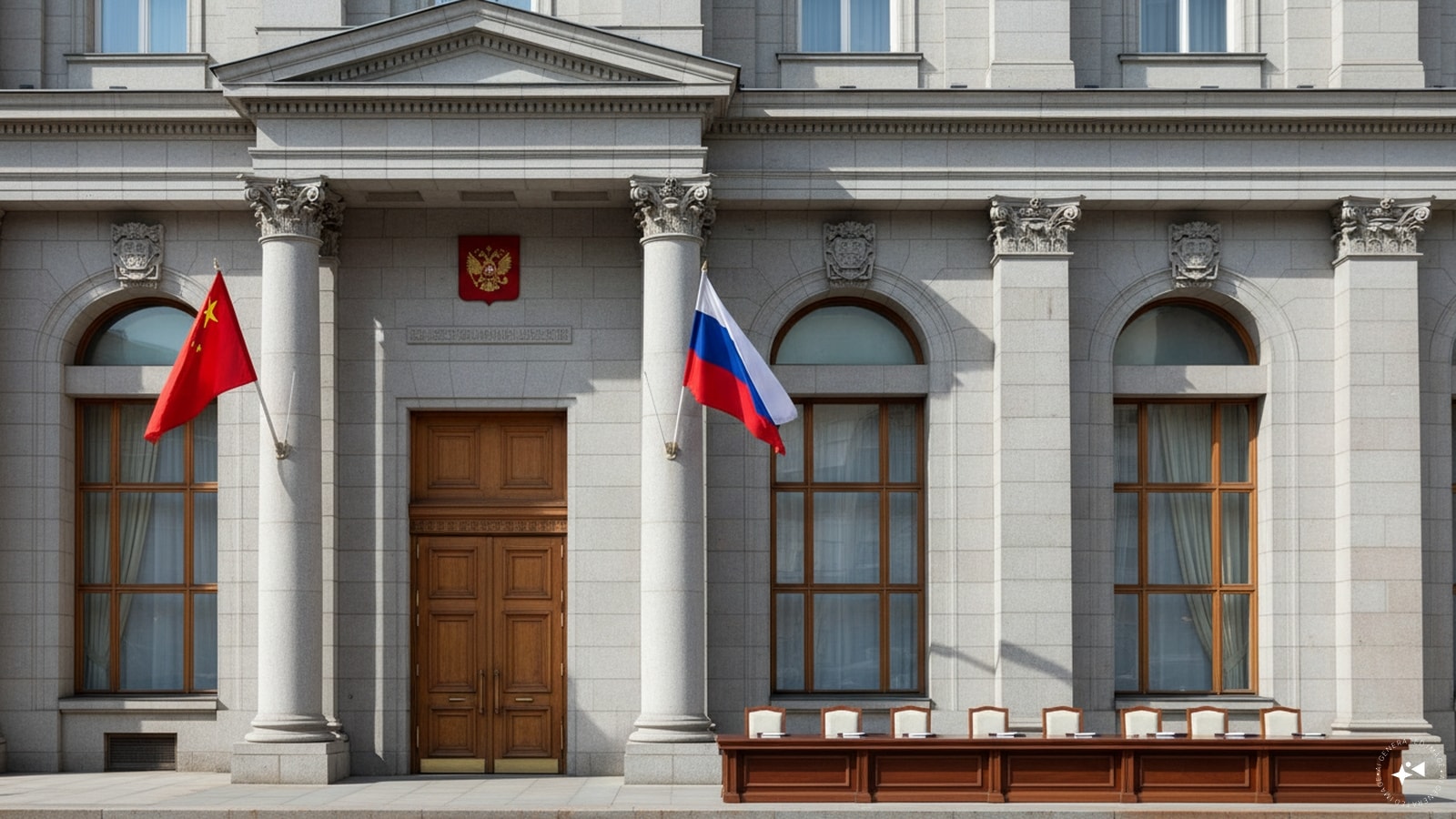
Every time Beijing and Moscow release a joint statement condemning "destructive external interference" in Eurasia, half the pundit class treats it like a tectonic shift in global security. Headlines repeat the line. Think tanks draft emergency memos. Analysts nod solemnly about an "axis of resistance" defending regional sovereignty against outside meddling.
Spare me. That reading is lazy, superficial, and backward.
When China and Russia complain about outside interference in Eurasia, they are not defending a sacred principle of non-intervention. They are complaining about competition inside a backyard they want to monopolize. Worse, they are masking their own quiet friction behind a shared talking point. Standard diplomatic coverage treats a joint statement as proof of unified purpose. In reality, diplomatic joint statements are often a cover story for disagreement, asymmetry, and turf anxiety.
Anyone who has spent years watching cross-border capital flows, infrastructure deals, and security arrangements across Central Asia and the wider Eurasian landmass knows how this movie plays out. I have watched governments and corporate boards pour millions into "Eurasian integration" narratives only to get blindsided by local politics, customs bottlenecks, and competing spheres of influence. They read the communiques instead of the balance sheets, rail gauges, and border disputes.
Let us get the vocabulary straight before we go any further. "Eurasia" is not a single political bloc with a shared identity. Geographically, it is the combined landmass of Europe and Asia. Strategically, in modern Kremlin and Beijing parlance, it usually centers on post-Soviet states, Central Asia, the South Caucasus, and adjacent corridors stretching toward the Middle East and South Asia. "External interference" sounds neutral and legalistic on paper. In practice, it is a political weapon. One capital's "stabilizing partnership" or "connectivity corridor" is another capital's "destructive interference."
The Lazy Consensus Around Joint Statements
The lazy consensus goes something like this: Washington or Brussels pushes influence into Central Asia or the Caucasus; Moscow and Beijing push back together; therefore, Eurasia is hardening into a closed Sino-Russian fortress.
That story is tidy. It is also wrong.
A joint statement is cheap. Signing a communique costs nothing and requires zero alignment on implementation. If two states truly share an identical vision for a region, they do not need to advertise unity every few months with boilerplate warnings against outside meddling. They just act. The louder the rhetoric about external threats, the harder the two signatories are working to keep their own friction out of the headlines.
Think about the incentives on both sides. Moscow wants security primacy, political deference, and control over legacy energy and transport routes in its near abroad. Beijing wants market access, raw materials, debt repayment, and reliable overland transit for its goods without getting bogged down in messy local military commitments. Those goals overlap just enough to produce sharp diplomatic prose aimed at Western capitals. They also clash in ways neither side wants to put in a press release.
Consider a thought experiment to test this. Imagine a scenario where outside Western diplomatic and economic engagement in Central Asia vanished overnight. Would Moscow and Beijing suddenly harmonize their interests without friction? Not a chance. Russian security planners would still worry about Chinese economic weight turning neighboring capitals into Beijing-oriented client states. Chinese planners would still worry about Russian political instability, sanctions spillover, and bureaucratic gridlock slowing down trade corridors. Removing an outside rival does not erase structural asymmetry between a capital-rich exporter and a security-obsessed former empire.
What People Actually Ask About Eurasia and Interference
When a joint statement hits the wire, search queries spike with predictable questions. Most of them start from a flawed premise.
Are China and Russia united in opposing outside influence in Eurasia?
They are aligned on rhetoric when it suits them, not fused into a single brain. Publicly condemning outside interference lets both governments signal solidarity and frame Western policy as destabilizing. Privately, each capital guards its own leverage. Saying they are "united" misses the daily tug-of-war over customs clearance, policing roles, investment terms, and diplomatic influence in capitals like Astana, Tashkent, Bishkek, and Baku.
Why do Moscow and Beijing call outside involvement "destructive"?
Because "destructive" is a label applied to rivals, not a measurement of outcomes. When outside powers fund governance reforms, offer alternative trade routes, or build diplomatic ties with smaller Eurasian states, Moscow and Beijing often treat that diversification as a threat to their own bargaining power. A smaller country with options is harder to squeeze than a smaller country with nowhere else to turn. Calling outside engagement "destructive" is a bid to shrink the menu available to regional governments.
Who actually holds the cards in Eurasia right now?
Neither a joint press release nor a single outside power decides the outcome on its own. Regional governments in Central Asia and the Caucasus are not passive chess pieces waiting to be moved by Beijing, Moscow, or Washington. Many of them practice multi-vector diplomacy precisely because they refuse to swap one overbearing patron for another. They take loans where they are cheap, sell commodities where demand is high, and hedge their security bets carefully.
The Mechanics Nobody Wants to Put in a Communique
To see why "external interference" is such a convenient scapegoat, look at the actual mechanics moving through Eurasia: trade routes, security guarantees, debt, and local legitimacy.
First, look at connectivity and trade. Overland corridors linking East Asia with Europe and the Middle East sound seamless on a map. On the ground, they run through different gauge railways, slow border checkpoints, political disputes, and uneven infrastructure quality. Russia has long cared deeply about controlling transit arteries and energy pipelines crossing its territory or neighboring states. China has poured immense effort into rail, road, and logistics links across the continent. Friction is built into the geometry. Every new route changes who collects transit fees, who sets technical standards, and who holds leverage when disputes flare up.
Second, look at security. Moscow historically treated hard security in post-Soviet space as its special domain. Yet Russia's own military bandwidth and economic clout have been strained by its war in Ukraine and Western sanctions. Meanwhile, China's footprint in the region has grown steadily through trade, technology, and security cooperation frameworks. When two powers operate in the same neighborhood with unequal strengths—one heavy on legacy security ties and political habit, the other heavy on cash, supply chains, and industrial scale—tensions simmer beneath polite diplomatic phrasing.
Third, look at domestic legitimacy. Authoritarian and semi-authoritarian governments love blaming "external interference" when protests erupt, currencies wobble, or elites fall out. It turns a domestic governance problem into a foreign conspiracy. When Beijing and Moscow echo that framing together, they validate each other's playbook. Both regimes have a strong interest in treating political pushback, independent media, or civil society activity anywhere near their borders as foreign sabotage rather than homegrown grievance.
Classic scholarship on international politics has made this point for decades. Realists like Kenneth Waltz and John Mearsheimer focused heavily on balance of power, security competition, and great-power rivalry, while regional specialists on post-Soviet politics—figures like Richard Sakwa and Rajan Menon—have repeatedly shown how complicated, contested, and non-monolithic Eurasian politics really are in practice. Heavyweight analysts in this space rarely buy the idea that a joint statement equals total harmony. Yet headlines keep recycling that exact shortcut because it is easy to write and easy to sell.
Where My Contrarian Take Can Go Wrong
If you push a contrarian argument too hard, you can swing into a different kind of error. Let us be honest about the blind spots here.
Underestimating a joint statement is just as dangerous as overreading it. Even when Moscow and Beijing have competing instincts in Eurasia, coordination still happens. They can align votes in international bodies, share intelligence or diplomatic cover, coordinate messaging during regional crises, and make life harder for outside actors trying to operate in the region. Dismissing a joint statement as "just talk" ignores the real coordination that sits behind some of that talk.
There is also the risk of treating regional states as purely clever pragmatists who always outmaneuver bigger neighbors. Smaller countries do hedge, and they are far more capable than lazy commentators give them credit for. Still, asymmetry is real. When a major power controls key export routes, debt exposure, or security leverage, a smaller capital's room to maneuver has limits. Pretending smaller states hold all the cards is just another romantic myth.
What Smart Operators Should Do Instead
If you are an executive, investor, analyst, or policymaker looking at Eurasia, stop reading joint statements as a forecast. Treat them as a symptom.
- Track money, freight, and contracts instead of rhetoric. Watch where capital actually lands, which ports and rail lines see real volume growth, and what happens when loans come due. Rhetoric costs nothing; infrastructure and debt create real dependencies.
- Price in local politics and hedging. Never model a Central Asian or Caucasian country as a simple extension of Moscow or Beijing. Map local leadership incentives, domestic economic pressures, and how each capital balances multiple partners at once.
- Stress-test for friction between partners. Build scenarios where Russian and Chinese interests diverge on tariffs, border transit, sanctions evasion, or regional crises. Most observers only model alignment; smart operators model strain.
- Separate foreign meddling from local fragility. When instability hits a Eurasian state, ask what broke inside the country first. Blaming "external interference" is usually the excuse offered right after domestic mismanagement catches up.
The next time Beijing and Moscow denounce "destructive external interference" in Eurasia, read between the lines. The loudest warning in the room is rarely about the outsider they named. It is about the turf they are trying to keep—and the rivalry they cannot quite put to rest.