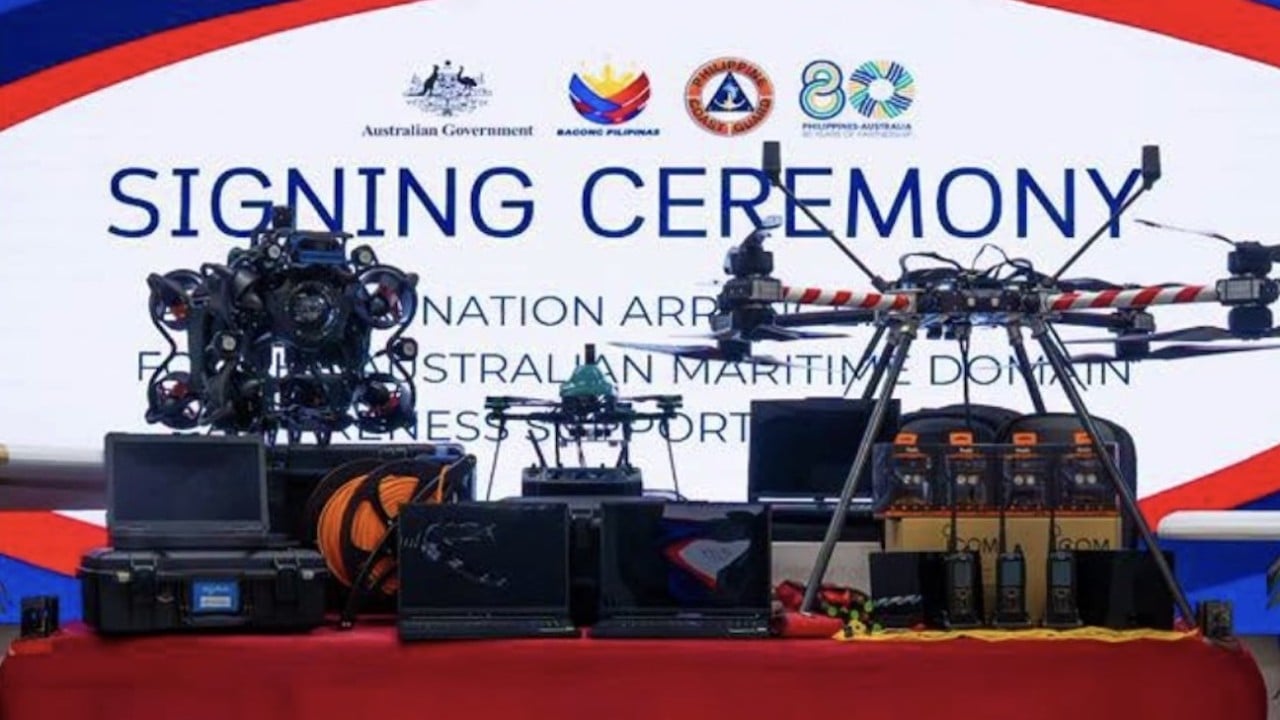
The maritime standoff in the West Philippine Sea isn't just about giant hulls, roaring water cannons, or military lasers anymore. It’s becoming a war of data, visibility, and sheer economics. For years, the Philippine Coast Guard found itself dangerously outmatched by the sheer mass of the China Coast Guard and its accompanying maritime militia. Trying to track hundreds of Chinese vessels scattered across contested reefs using a handful of aging offshore patrol ships is a losing game. It burns fuel, wears down crews, and risks dangerous physical confrontations every single day.
Manila is completely rewriting its playbook. Instead of trying to match Beijing ship-for-ship, the Philippines is embracing asymmetric tech. The latest move involves deploying smarter, highly cost-effective aerial drones supplied by Australia. This isn't just a minor tech upgrade. It represents a massive shift in how smaller nations can push back against heavy-handed maritime expansion without triggering an outright shooting war.
If you want to understand how a small fleet of uncrewed aircraft can disrupt deep-sea intimidation tactics, look at the cold math of gray-zone conflict.
The Asymmetric Math of Maritime Defense
When a massive nation decides to push its borders outward, it usually relies on bulk. Beijing utilizes enormous hulls, some weighing over 10,000 tons, to physically crowd out Philippine fishermen and supply boats at flashpoints like Second Thomas Shoal and Scarborough Shoal. Confronting these leviathans with traditional navy or coast guard vessels is financially ruining for Manila. A single patrol vessel costs millions of dollars to maintain and thousands to fuel for an extended deployment.
Drones flip that equation upside down.
Australia handed over a package of 20 world-class aerial drones to the Philippine Coast Guard, valued at roughly 34 million Philippine pesos. That is less than one million US dollars. For the price of a single naval repair job, Manila suddenly gained a distributed eyes-in-the-sky network. These uncrewed platforms operate at a fraction of the cost of a manned flight or a ship deployment. They don't sleep, they don't eat, and they don't risk human lives if they get knocked out of the sky.
This is pure asymmetry. When a drone spots a Chinese maritime militia fleet from three miles away, it does so for a few dollars an hour. The Chinese ships, meanwhile, are burning thousands of gallons of diesel just to sit on a reef and assert dominance. By forcing a massive adversary to spend heavily to counter a cheap, expendable asset, the Philippines is creating a long-term economic drain on the aggressor.
How Real-Time Exposure Neutralizes Gray-Zone Operations
The entire premise of gray-zone warfare is to stay just below the threshold of open military conflict. It relies heavily on deniability and shadows. Chinese maritime militia boats frequently claim to be simple fishing vessels experiencing mechanical difficulties when they swarm a reef. They rely on the isolation of the open ocean to bully smaller craft when nobody is looking.
Drones destroy that isolation.
The Australian-supplied drone package includes short, medium, and long-range variants. Each serves a very specific tactical purpose on the water.
Short and Medium-Range Variants
These platforms handle immediate localized operations. They monitor port facilities, track near-shore movements, and guard regional coastlines. They allow local commanders to spot approaching hulls long before they reach territorial limits.
Long-Range Platforms
These are the true strategic assets in the West Philippine Sea. They deploy far over the horizon to document illegal actions directly inside the Philippine exclusive economic zone. They carry advanced optics that capture high-definition video and thermal imagery under almost any weather condition.
When these long-range units record a foreign coast guard ship ramming a wooden supply boat, that footage doesn't sit in a military vault. The Philippine government pushes it straight to global media outlets within hours. This rapid public exposure strips away any possibility of deniability. It forces the international community to witness the aggression firsthand. You can't claim your ship was acting peacefully when a high-resolution drone feed shows your crew firing high-powered water cannons at an unarmed vessel.
Bridging the Maritime Domain Awareness Gap
The real struggle for the Philippine Coast Guard has always been maritime domain awareness. It's a fancy term for a simple concept: knowing exactly who is in your waters at any given moment. The Philippine archipelago features over 7,000 islands and a sprawling coastline that is notoriously difficult to police.
Traditional radar networks have blind spots. Satellite imagery can be delayed or obscured by heavy tropical cloud cover. Manned surveillance aircraft are incredibly expensive to keep in the air and require intensive maintenance schedules.
Uncrewed systems bridge these gaps. Thirty members of the Philippine Coast Guard Aviation Command Unmanned Aerial Vehicles Squadron underwent intensive operational training led by Australian drone specialists. They didn't just learn how to fly the units; they mastered troubleshooting, field maintenance, and real-time data integration.
By launching these uncrewed platforms directly from the decks of existing coast guard vessels, operators can extend their vision by dozens of miles. They see over the horizon. They map out the positions of foreign fishing fleets, track illegal entry routes, and identify transponders that have been intentionally turned off to evade tracking. This data flows directly to command centers ashore, allowing the Philippines to deploy its limited physical ships precisely where they are needed most, rather than wasting time searching empty stretches of ocean.
The Strategic Network Behind the Hardware
No nation can stand entirely alone in a theater as complex as the South China Sea. The delivery of these drones highlights a deepening strategic partnership between Canberra and Manila. Australia has a vested interest in keeping these vital trade routes open, stable, and governed by international maritime law.
This isn't an isolated donation. It's a central pillar of an expanded civil-maritime cooperation program. Australia is doubling its financial investment in this partnership to 649 million pesos through 2029. The funding covers far more than just aerial tech; it finances vessel remediation, operational training, marine environment protection programs, and intensive courses on the Law of the Sea.
This coordinated approach builds real institutional strength. It allows the Philippines to modernize its maritime forces systematically rather than relying on sporadic, mismatched equipment donations. By syncing their operational training with Australian standards, Philippine operators are learning how to maintain a high operational tempo, ensuring these drones stay in service for years rather than breaking down after a few months of harsh saltwater exposure.
Common Misconceptions About Uncrewed Defenses
A lot of people look at drone transfers and assume they are a magic fix for national security. They aren't. It's vital to be entirely realistic about what these platforms can and cannot do on the water.
- They don't hold physical territory. A drone can watch a reef, but it cannot physically stop a foreign vessel from anchoring there. Physical ships and personnel are still required to enforce sovereignty.
- They are vulnerable to electronic warfare. Cheap drones don't always carry the heavily shielded, anti-jamming communication arrays found on multi-million dollar military platforms. A sophisticated adversary can disrupt their GPS signals or hijack their data links if they choose to escalate.
- Weather is a massive factor. Tropical storms, high winds, and torrential downpours can ground smaller uncrewed aircraft completely, leaving blind spots during major weather events.
The value isn't in the hardware itself. It’s in how the data collected by the hardware is utilized to drive diplomatic, legal, and strategic responses. The drone is simply the eye; the real power lies in the communication network behind it.
The Reality of Cost-Effective Security
The transition to uncrewed surveillance is a clear indicator of where regional defense is heading. True security doesn't always require purchasing the most expensive, flashy fighter jets or heavy destroyers. For developing nations, true security comes from smart procurement, rapid deployment, and maximum visibility.
Manila's next steps must focus heavily on scaling this capability domestically. While foreign donations provide an incredible jumpstart, building a resilient defense posture means establishing local assembly, maintenance, and software development pipelines. The Philippine military is already experimenting with 3D-printed components and domestic drone designs near its northernmost islands. Combining these domestic efforts with world-class international systems creates a multilayered surveillance grid that is incredibly difficult for any adversary to blind.
Expanding the training pipeline is equally critical. Every single offshore patrol vessel in the Philippine fleet should carry a dedicated uncrewed systems team. By turning every ship into a localized drone carrier, the coast guard can establish an unbreakable chain of observation across the West Philippine Sea, ensuring that no aggressive act occurs in the dark.