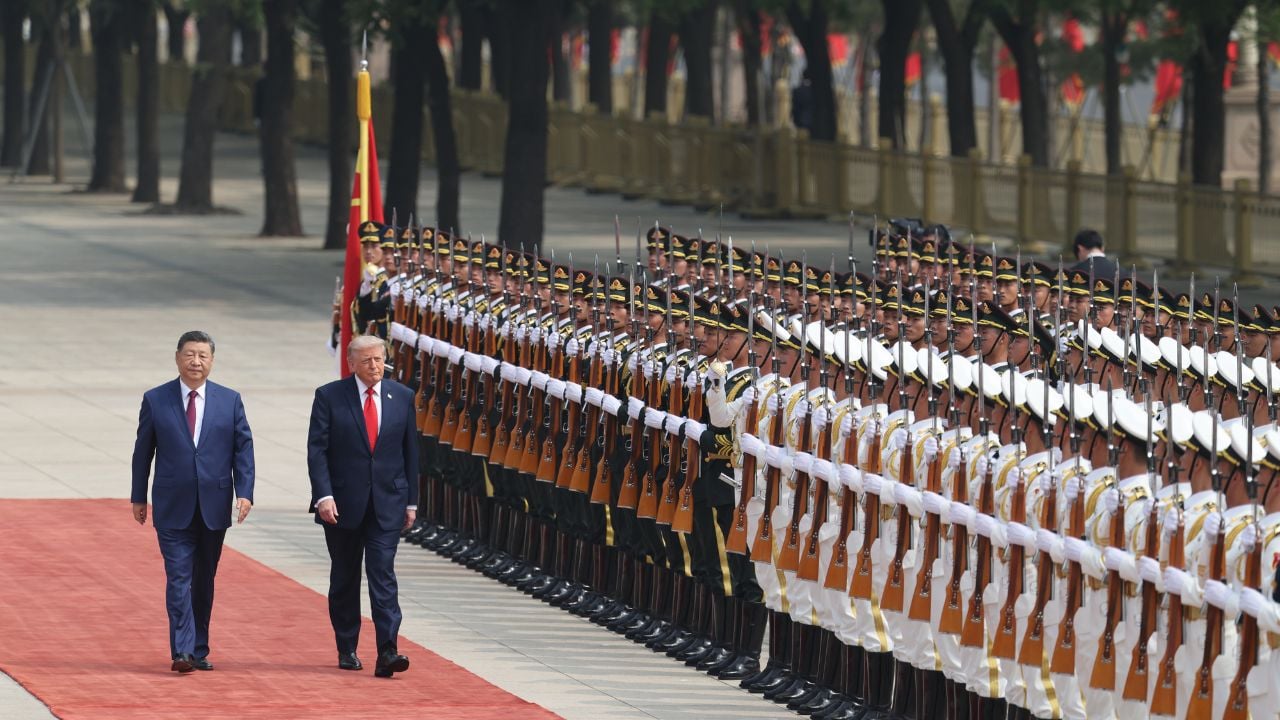
While the world watches the smoke rise over the Middle East, a very different kind of power play just went down in Beijing. You've probably seen the headlines about the US-Iran war updates, but the real story isn't just on the battlefield. It's inside the Great Hall of the People. President Xi Jinping just sat down with a who’s who of American capitalism—Elon Musk, Tim Cook, Jensen Huang—and the message was blunt. China isn't just open for business; it's positioning itself as the only stable port in a global storm.
It’s a wild split screen. On one side, you’ve got the 75th day of a conflict that’s already drained $29 billion from US taxpayers. On the other, you have the CEOs of Apple and Nvidia smiling for cameras in Beijing. If you think these two things aren't connected, you’re missing the forest for the trees.
The CEO Delegation and the Great Hall Diplomacy
Trump brought the heavy hitters. We’re talking about the architects of the modern tech economy. When Jensen Huang boards Air Force One at the last minute, you know the stakes involve more than just a few trade tariffs. Xi’s "reciprocal cooperation" isn't a friendly suggestion. It's a strategic lifeline.
China knows the US is bogged down. Operation Epic Fury—the joint US-Israel campaign—has turned the Strait of Hormuz into a chokepoint that’s strangling global energy. China, as the world’s biggest buyer of Iranian oil, is feeling the pinch. But instead of retreating, Xi is using this moment to pull American tech giants closer. He’s betting that while Washington talks war, Wall Street wants wealth.
Who was in the room?
- Elon Musk (Tesla): Looking to protect his massive manufacturing footprint.
- Tim Cook (Apple): Managing a supply chain that still breathes through Chinese ports.
- Jensen Huang (Nvidia): Ensuring AI chips don't become the next casualty of trade restrictions.
- Larry Fink (BlackRock): Tracking the flow of trillions in a volatile market.
Xi told them the door would "only open wider." That’s a calculated jab at the idea of "decoupling." He’s telling these CEOs that while their own government is busy with a stalemate in West Asia, China is ready to be the adult in the room.
The Iran Shadow Over the Summit
You can't talk about Beijing without talking about Tehran. The war with Iran has reached a frustrating plateau. The initial strikes on February 28 took out high-level targets, but the "quick win" never materialized. Now, it’s a game of chicken in the Persian Gulf. Iran is blocking the Strait of Hormuz, and Trump is blockading Iranian ports. It’s a "dual blockade" that’s sent gas prices screaming upward.
Trump’s goal in China is simple, even if it's hard to execute. He needs Xi to lean on Iran. China is the only country with enough economic leverage to make Tehran blink. But Xi isn't going to do it for free. Every ounce of pressure China puts on Iran will cost the US a concession in the South China Sea or a rollback on tech tariffs.
The US military is currently burning through munitions that were originally meant to deter China. This isn't lost on anyone in Beijing. Experts are already pointing out that the Middle East focus makes a Pacific confrontation much harder for the US to manage.
Why This Matters for Your Portfolio
If you’re a business owner or an investor, the "Live Updates" that matter aren't just about troop movements. They’re about the shifting center of gravity.
- Energy Volatility: Until the Strait of Hormuz reopens, expect "transitory" inflation to become permanent. Logistics routes are already shifting overland through Saudi Arabia and the UAE to bypass the water, but that’s an expensive fix.
- Tech Interdependence: The presence of Nvidia and Qualcomm in Beijing proves that "de-risking" is easier said than done. The AI revolution still needs Chinese assembly lines and market access.
- The New Neutrality: Regional players like Iraq and Pakistan are already making side deals with Iran to move oil. The US-led order is being tested, and China is happy to offer an alternative.
The Real Power Dynamic
Xi isn't just welcoming CEOs; he’s auditioning. He wants to show the world that while the US is prone to sudden military shifts, China offers "stability." It’s a bit rich coming from a regime that has its own history of crackdowns, but in a world where the Strait of Hormuz is closed, "predictable" looks very attractive to a CEO.
The summit is a high-wire act. Trump wants to look tough on Iran but needs China's help to end the war before the 2026 midterms. Xi wants to jumpstart a cooling Chinese economy but won't give up his leverage over Iran too easily.
Stop looking for a clear winner in the daily briefings. The real victory is being negotiated in the quiet rooms of the Great Hall, far away from the drone strikes. The CEOs aren't there for the tea; they're there because they know that in 2026, the road to global recovery doesn't run through Tehran—it runs through Beijing.
If you're waiting for the war to end to make your next move, you're already late. Watch the trade deals, not just the missile counts. The next phase of global business is being written right now, and it’s a lot more "reciprocal" than the hawks in DC would like to admit. Keep your eyes on the supply chain shifts coming out of this summit—that's where the real money is moving.