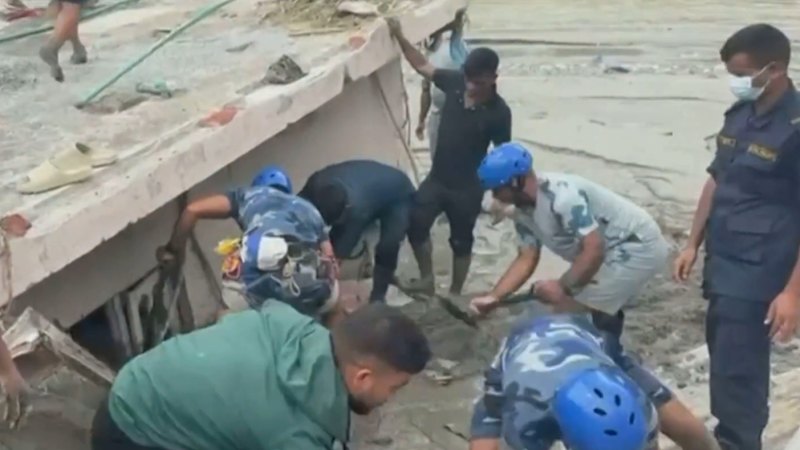
The media wants you to weep tears of joy over the miraculous extraction of workers buried for over a week in Nepal's hydropower tunnels. It makes for great television. Men emerge caked in mud, blinking against the harsh Himalayan sun, having survived nine days on pure grit and prayer.
Stop romanticizing it.
What we are witnessing is not a testament to human resilience. It is a monument to industrial negligence wrapped in geological warning tape.
When flash floods tore through the Trishuli valley, they did not just unleash mud and debris. They exposed a terrifying truth about how we build critical infrastructure in high-risk seismic and glacial zones. We treat underground worker safety as an afterthought, relying on luck and air pockets rather than engineered redundancy.
The False Narrative of the Miracle
Headlines hail these survivors as statistical anomalies defying death. They are treated like lottery winners who beat the odds. But engineering safety should never be a lottery.
Look at the mechanics of the disaster. Workers were trapped hundreds of meters deep because standard evacuation protocols failed the moment the power went out and the mud walls collapsed. When water and debris seal a subterranean facility, survival hinges entirely on whether an accidental air pocket happens to form at the highest point of an internal chamber.
That is not management. That is Russian roulette with a hard hat.
Arnold Dix, president of the International Tunnelling and Underground Space Association, noted the unprecedented nature of finding even the tunnel entrances buried beneath meters of landslide debris. If experts cannot even locate the mouth of a tunnel without old topographic maps and satellite triangulation, your emergency response plan is dead on arrival.
The Sunk Cost of Subterranean Hubris
We build massive hydropower projects along fragile river systems in the Himalayas, chasing green energy targets while ignoring the brute force of glacial lake outburst floods. Then, when the inevitable happens, we celebrate a handful of survivors out of hundreds of missing workers as a national triumph.
Let's look at the raw data of the disaster zone. Hundreds of workers remain missing across multiple projects. The focus on the few who made it out alive functions as an emotional sedative, distracting the public from demanding structural accountability.
Imagine a scenario where infrastructure developers faced mandatory capital penalties for every hour an underground egress route remained unreinforced against catastrophic flooding. The architecture of these tunnels would change overnight.
Instead, developers rely on the heroic impulses of foremen like Sanjay Sah, who stayed behind to herd colleagues toward safety instead of saving himself. We build systems that depend on individual martyrdom because engineered safety margins cost too much upfront.
Fixing the Flawed Blueprint
If we are going to extract energy from volatile mountain ranges, the engineering paradigm must shift from reactive rescue to proactive isolation.
- Mandatory secondary escape shafts completely independent of the primary water conveyance path.
- Automated pneumatic bulkhead doors triggered by rapid pressure or flood sensors before debris can choke the main control rooms.
- Independent, hardwired subsurface oxygen and communication caches that do not rely on surface grids.
We do not need more prayers chanted in the dark. We need engineers who design for the worst-case disaster, not the best-case budget. Until then, every tunnel pulled from the mud is just a reminder of how many we left behind.