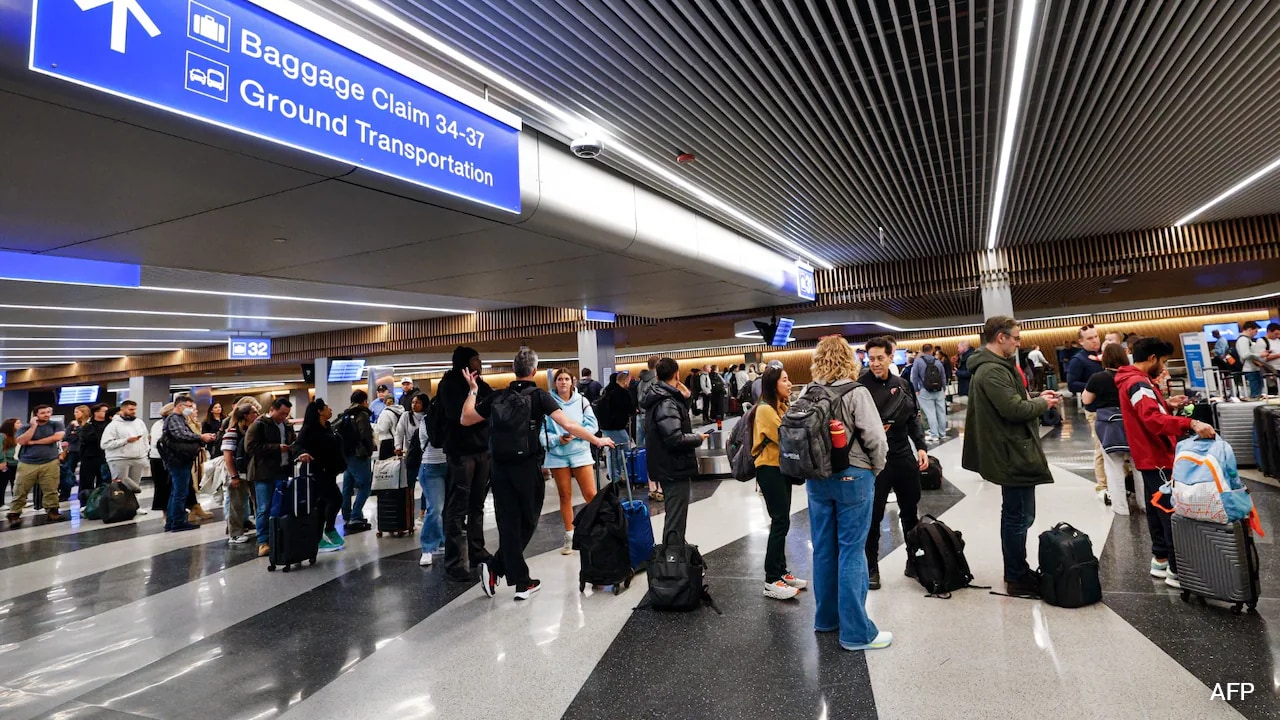
A brief ground stop in the United States national airspace system does not produce a proportional delay; it triggers a non-linear operational collapse that strands hundreds of thousands of travelers across multiple days. While surface-level reporting focuses on emotional passenger reactions inside airport terminals, the true story lies in the brittle, hyper-optimized architecture of modern hub-and-spoke aviation networks. When federal aviation authorities or airline operations centers halt departures—even for less than an hour—the resulting backlog overwhelms gate capacity, exhausts federally mandated crew duty limits, and breaks aircraft routing cycles. Understanding why a short pause strands hundreds of thousands of people requires mapping the precise operational mechanisms governing air traffic flow, fleet utilization, and regulatory bottlenecks.
The Architecture of Fragility in Modern Aviation
Commercial aviation in the United States operates on a principle of maximum asset utilization. An aircraft generates zero revenue on the ground, which forces carriers to schedule turnaround times—the window between arriving at a gate and departing for the next leg—as tightly as physically possible. In high-density hubs, this buffer often shrinks to 35 or 45 minutes for narrow-body aircraft.
This tight coupling creates a zero-slack system. Under normal conditions, high utilization maximizes capital efficiency and keeps ticket prices competitive. Under stress, the absence of slack converts localized disruptions into systemic failures. The system relies on three synchronized variables:
- Aircraft Routing Cycles: A single airframe frequently executes four to six flight legs per day across multiple cities. A delay on leg one propagates directly to legs two through six.
- Flight Crew Pairing: Pilots and flight attendants do not always stay with the same aircraft. A captain arriving from Chicago might connect to an outbound flight to Dallas, while the first officer connects to Miami.
- Terminal Gate Allocation: Major hubs operate near 95% gate capacity during peak banking windows, leaving almost no spare gates to absorb delayed arrivals.
When a ground stop is issued—whether due to a Federal Aviation Administration (FAA) telecommunications outage, severe convective weather in a major corridor, or an airline-specific dispatch system failure—these three variables decouple simultaneously.
Anatomy of a Ground Stop and the Queueing Theory Bottleneck
To understand why a 45-minute halt creates a 48-hour recovery problem, one must apply basic queueing theory, specifically the behavior of systems operating near maximum capacity. As utilization approaches 100%, wait times do not increase linearly; they increase exponentially.
During a ground stop, outbound aircraft are held at their departure gates or on taxiways, while inbound aircraft already airborne continue to land. Within 20 minutes, arriving flights consume every available gate. Subsequent arrivals must hold on the tarmac, blocking taxiways and preventing departing aircraft from pushing back even after the ground stop is lifted. This phenomenon, known as terminal gridlock, slashes an airport's effective throughput.
Once the FAA lifts the ground stop, air traffic controllers cannot simply release all held flights simultaneously. Airspace sectors have strict capacity limits to maintain safe separation between aircraft. Controllers institute Ground Delay Programs (GDPs) and metering protocols, releasing aircraft at controlled intervals. If an airport typically handles 60 departures per hour and experiences a one-hour stop, it now has 120 aircraft competing for 60 hourly slots. Because the airport cannot magically double its runway acceptance rate, the backlog bleeds into subsequent hours, eroding schedule integrity for the remainder of the operating day.
The Regulatory Cliff of Crew Duty Limits
The single most destructive secondary effect of a ground stop is the expiration of flight crew legality. Under FAA regulations—specifically 14 CFR Part 117 for pilots—flight crews are governed by strict limits on Flight Duty Periods (FDPs) and mandatory rest requirements. These rules are non-negotiable safety boundaries designed to prevent fatigue.
A pilot's duty clock starts when they report to the airport, not when the aircraft takes off. If a ground stop traps an aircraft on the tarmac or at the gate for two hours, that time counts directly against the crew's maximum allowable duty day, which typically ranges from 9 to 14 hours depending on the start time and number of flight segments.
When a flight is delayed past the crew's legal limit, the crew "times out." At that exact moment, the airline must legally remove them from the aircraft. Even if the weather clears and the airspace opens, the flight cannot depart without a replacement crew.
Carriers maintain a pool of reserve crews at major hubs to cover sick calls and minor delays. A system-wide ground stop depletes this reserve pool within hours. Furthermore, because the original crew timed out late in the day, their mandatory 10-hour minimum rest period pushes their availability into the late morning or afternoon of the following day. This creates a rolling deficit: tomorrow's morning departures lose their scheduled crews because those pilots are still legally required to be asleep in hotel rooms.
Quantifying the Passenger Stranding Multiplier
Media coverage often highlights massive passenger numbers—hundreds of thousands stranded—without explaining the arithmetic behind the scale. In the United States, approximately 2.5 to 2.9 million passengers fly daily across roughly 25,000 commercial flights.
A major disruption affecting just 10% of daily flights impacts 2,500 departures. At an average load factor of 85% on a 150-seat aircraft, each canceled flight displaces roughly 128 passengers. Multiply 2,500 cancellations by 128 passengers, and 320,000 travelers are immediately stranded.
The recovery phase is where the true passenger frustration—the sense of "losing one's mind" inside terminals—manifests. Because domestic load factors routinely hover between 85% and 90%, there are very few empty seats on subsequent flights.
Consider the math of rebooking:
- If a flight of 150 people is canceled, and the remaining flights on that route that day operate at 90% capacity on 150-seat planes, each subsequent flight can absorb only 15 stranded passengers.
- Clearing a single canceled flight requires 10 subsequent flights.
- When hundreds of flights cancel simultaneously across a hub, the rebooking queue stretches across three to four days.
Passengers are not merely waiting for the next plane; they are competing for the marginal 10% of unbooked seat inventory across a constrained network.
Structural Flaws in Airport and Airline Crisis Response
When disruptions cross a critical threshold, both physical airport infrastructure and digital customer service channels degrade rapidly. The breakdown occurs across three operational touchpoints.
Digital Rebooking Saturation
Airlines encourage passengers to use mobile applications to rebook during irregular operations. While automated rebooking algorithms handle isolated cancellations efficiently, they frequently fail during systemic ground stops. The algorithms struggle to compute complex multi-leg itineraries when downstream flights are also in flux, often locking passengers into unviable connections or throwing generic error messages that force travelers back into physical queues.
Physical Terminal Compression
Airport terminals are engineered for flow, not storage. Concourses are sized based on the assumption that passengers spend 60 to 90 minutes moving from security checkpoints to boarding gates. When departures halt, arrivals continue to dump thousands of people into the secure area. Seating capacity is overwhelmed within 30 minutes, forcing travelers onto floors, blocking pedestrian arteries, and obstructing gate agents from reaching boarding doors.
Baggage Decoupling
When passengers abandon itineraries or are rebooked onto different carriers, their checked luggage often remains trapped in the automated baggage handling systems of the original hub. Sorting systems rely on active flight tags; once a flight cancels, bags must be manually pulled, scanned, and rerouted. During mass cancellations, baggage rooms fill to physical capacity, creating a secondary logistics crisis that takes days to untangle even after passenger movement normalizes.
Limitations of Current Recovery Protocols
Airline Operations Centers (AOCs) employ sophisticated optimization software to manage irregular operations, yet these tools face hard physical and economic limitations. No software can bypass FAA air traffic separation rules, manufacture spare aircraft out of thin air, or override Part 117 crew rest mandates.
The primary lever available to an AOC during a severe ground stop is proactive cancellation. By intentionally canceling 15% to 20% of flights early in a disruption, airlines attempt to preserve aircraft and crew positions for the remaining 80% of the schedule, creating artificial slack in the network.
The limitation of this strategy is political and financial. Proactive cancellations immediately trigger customer backlash, attract regulatory scrutiny from the Department of Transportation, and incur direct costs for hotel vouchers, meal stipends, and lost ticket revenue. Consequently, airline executives often hesitate to execute deep schedule cuts until the network is already gridlocked, guaranteeing a slower, more chaotic recovery.
Strategic Execution for Travelers and Operators
Navigating high-density airspace disruptions requires shifting from passive waiting to active constraint management.
For corporate travel managers and individual flyers, the optimal response to a ground stop is immediate multi-channel execution. The moment a ground stop is announced at a connecting hub, passengers must simultaneously enter the physical customer service queue, initiate a digital chat request, and call the airline's international support line—which often has shorter wait times than domestic queues. Furthermore, travelers should immediately identify alternative routings on partner or competing carriers using flight tracking data before speaking to an agent, providing exact flight numbers rather than asking the agent to search open inventory. Booking a fully refundable backup ticket on a competing airline while waiting in queue creates an essential hedge against multi-day stranding.
For aviation operators and infrastructure planners, mitigating these cascading failures requires abandoning the pursuit of 100% peak-hour hub utilization. Carriers must build structural firebreaks into their schedules—specifically by decoupling crew pairings from aircraft routings during high-risk weather seasons and maintaining dedicated reserve crew buffers at non-hub spoke cities. Until airlines price operational resilience into their scheduling models rather than optimizing exclusively for maximum daily asset utilization, brief ground stops will continue to produce multi-day human logjams across American airports.