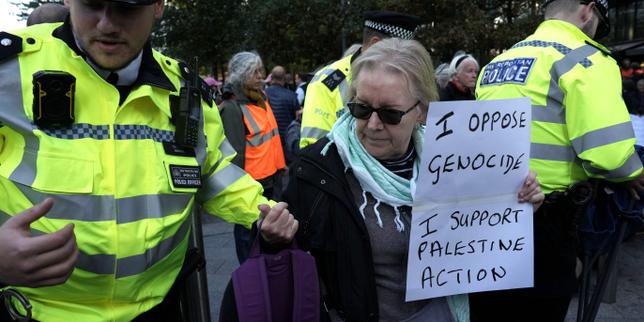
Silence.
That is the first thing you notice when a protest stops being a march and becomes a mass arrest, as the chants fade into the low, rhythmic hum of idling police vans and the sharp, metallic click of zip-ties tightening around wrists.
In central London, more than 320 people were taken into custody during a single demonstration in support of Palestine Action, a direct-action group recently proscribed as a terrorist organization under United Kingdom law. On paper, the event reads like a routine police blotter entry—a tally of public order offenses, statutory powers invoked, and custody suites filled to capacity. In the street, against the cold Portland stone of Westminster, it felt like watching the boundary between political dissent and criminal liability redraw itself in real time.
I have spent years standing at the edges of British demonstrations, watching how the state and the street negotiate the fragile space between free expression and public order. You learn to read a crowd by its footwear and its signage. You learn to read the police by the angle of their helmets and the sudden arrival of Territorial Support Group carriers. Usually, there is an unspoken choreography to these afternoons: the speeches, the slow shuffle toward Parliament Square, the kettling at dusk, the eventual dispersal.
This was different. The choreography broke before the first banner was even fully unfurled.
The Invisible Line of Proscription
To understand why more than three hundred ordinary-looking citizens ended up in the back of Metropolitan Police vans, you have to understand what happens the moment the British government adds a name to its list of proscribed organizations under the Terrorism Act 2000.
Think of proscription not as a fence built around a specific building, but as a dye dropped into a reservoir. Once the Home Secretary signs the order and Parliament approves it, the color spreads everywhere. It does not merely outlaw violent acts—those are already illegal under ordinary criminal law. Instead, it criminalizes association, expression, and display.
Under Section 12 and Section 13 of the Terrorism Act 2000, inviting support for a proscribed group, expressing an opinion or belief that is supportive of it while being reckless as to whether a person will be encouraged to support it, or even wearing an item of clothing or carrying an article in public that arouses reasonable suspicion of membership or support becomes a criminal offense. In a single legislative stroke, the legal distance between smashing a factory window and holding a hand-painted placard collapses.
Consider a hypothetical bystander—let us call her Clara, a retired schoolteacher from Kent who has spent forty years signing petitions and attending weekend rallies without ever receiving so much as a parking ticket. Clara travels to London believing she is participating in a traditional British protest against arms exports and foreign policy. She steps off the train at Charing Cross, walks toward Whitehall, and takes a printed flyer from a stranger's hand. Or perhaps she holds up a piece of cardboard bearing the name of the banned group, believing she is defending the right to protest itself.
Before the proscription order, Clara was an activist exercising a protected right under Articles 10 and 11 of the European Convention on Human Rights. After the order, in the eyes of the arresting officer standing three feet away, Clara is committing an offense under counter-terrorism legislation. Her intent—whether she opposes violence or simply objects to the ban—does not prevent the arrest. The act of display itself triggers the threshold.
Anatomy of a Mass Arrest
According to Metropolitan Police statements following the rally, officers made over 320 arrests primarily on suspicion of showing support for a proscribed organization, alongside a smaller number of public order and assault offenses. For a single afternoon in peacetime London, that number is staggering. It places the demonstration among the largest single-day arrest operations in the capital in recent years, rivaling the peak days of Extinction Rebellion's 2019 blockades.
Watching the arrests unfold from the pavement is an exercise in cognitive dissonance. There were no barricades burning. There was no looting of storefronts along Whitehall. Instead, there were clusters of demonstrators sitting cross-legged on the asphalt, many of them middle-aged or elderly, waiting calmly as teams of four or five officers moved methodically through the crowd.
You could hear the confusion in the voices of tourists stopped behind the police cordons, phones raised, trying to reconcile the tranquil posture of the seated protesters with the gravity of the legal warnings being read aloud through megaphones.
"You are under arrest under Section 13 of the Terrorism Act," an officer would say, his voice flat, practiced, and slightly breathless from the weight of his stab vest.
The arrestee would nod, offer their wrists, and be led toward the waiting line of white vans parked along the curb. One by one. Ten. Fifty. Two hundred. Three hundred and twenty.
The logistics alone tell a story about how modern policing adapts to mass civil disobedience. London does not have 320 spare cells sitting empty in a single Westminster station. When arrests hit that scale, the Metropolitan Police activate dispersal protocols that send detainees fanning out across the city—to Lewisham, to Brixton, to Acton, to Wembley, to custody suites as far out as the M25 ring. Each arrest requires two officers to escort, process, book, and document the detainee, pulling hundreds of frontline personnel off regular duties for hours at a stretch.
How Britain Reached This Threshold
To see how the United Kingdom arrived at a moment where anti-terror powers are deployed en masse in Parliament Square, you have to look at the trajectory of both direct action and British public order law over the past decade.
Founded in 2020, Palestine Action built its campaign around targeted direct action against the UK facilities of Elbit Systems, an Israeli defense manufacturer, as well as financial and logistics firms connected to the defense supply chain. Rather than relying solely on permitted marches, the group used tactics rooted in the tradition of British civil disobedience—occupying rooftops, spraying red paint across building facades, locking themselves to factory gates, and damaging equipment.
For years, the British legal system treated these incidents through the conventional framework of criminal damage, aggravated trespass, and conspiracy. Juries in several high-profile trials even acquitted activists after hearing defenses centered on preventing greater harm—a phenomenon that frustrated prosecutors and defense industry executives alike.
Then came the legislative tightening. Through the Police, Crime, Sentencing and Courts Act 2022 and the Public Order Act 2023, successive UK governments steadily narrowed the legal space for disruptive protest, introducing offenses for "locking on," interfering with key national infrastructure, and lowering the threshold for what constitutes serious disruption.
Proscribing Palestine Action under the Terrorism Act 2000 represented a qualitative leap beyond public order policing. Under the statutory definition in Section 1 of the Act, terrorism includes the use or threat of action involving serious violence against a person or serious damage to property, designed to influence the government or intimidate the public, for the purpose of advancing a political, religious, racial, or ideological cause.
Successive Home Secretaries and national security officials have argued that when direct action crosses into sustained, coordinated property destruction aimed at coercing policy or shutting down defense infrastructure, it meets that legal threshold—and that the state has a duty to protect lawful businesses, workers, and national security supply chains from intimidation and sabotage.
Human rights organizations, legal scholars, and civil liberties groups such as Liberty and Amnesty International have countered with a stark warning: stretching the definition of terrorism to encompass non-lethal direct action groups blurs a line that democracies cross at their peril. Once the label of terrorism is detached from violence against human life and applied to property damage and protest movements, they argue, the extraordinary powers designed to stop bombers and armed militants inevitably spill over into everyday political life.
The Friction Between Security and Speech
It is tempting to look at a statistic like 320 arrests and reduce it to a simple binary: either the protesters were reckless lawbreakers who knew the rules and chose to break them, or the state is sliding into authoritarianism. Reality, as anyone who has stood in the rain outside the Royal Courts of Justice knows, is far messier and far more unsettling.
Both truths sit side by side in the same square mile of London.
On one side stands the principle of the rule of law in a parliamentary democracy. Parliament debated and approved the proscription order. The courts exist to review whether the Home Secretary acted lawfully, and judicial review mechanisms remain active. Police commissioners do not write the Terrorism Act; they are legally bound to enforce the statutes passed by elected lawmakers. From the perspective of senior policing officials, allowing hundreds of people to openly defy a parliamentary proscription order in the heart of the capital without intervention would render the law unenforceable and invite selective policing—a charge every Metropolitan Police Commissioner dreads.
On the other side stands the lived experience of democratic citizenship. When the law criminalizes not just breaking into a factory, but holding a sign in a public square questioning the ban itself, the chilling effect reaches far beyond the people sitting on the tarmac.
Think about what happens in the days after a mass arrest like this. A university student wonders whether sharing an academic article about the history of direct action on social media could be misconstrued as "reckless support." A journalist double-checks whether photographing a banner counts as displaying a prohibited symbol. A local councilor hesitates before speaking at a community meeting about protest rights.
Fear does not need a policeman on every corner to do its work. It only needs ambiguity.
What Happens Inside the System After the Vans Pull Away
For the more than 320 people arrested in London, the end of the demonstration was only the beginning of a long, bureaucratic ordeal.
Once a detainee arrives at a custody suite, the clock starts ticking. Under PACE—the Police and Criminal Evidence Act—officers have an initial 24 hours to question a suspect, gather evidence, and decide whether to charge them, release them under investigation, or bail them with conditions. In cases involving potential Terrorism Act offenses, custody procedures carry added weight. Fingerprints, DNA swabs, and photographs are taken. Phones and electronic devices are routinely seized for digital forensics, a process that in the UK's backlogged system can take months or even over a year to complete.
Many of those arrested at mass demonstrations are released on police bail with strict conditions: bans on entering certain London boroughs, prohibitions on associating with co-defendants, or restrictions on attending future protests while the Crown Prosecution Service weighs whether to bring formal charges.
Here lies one of the invisible costs of mass public order and counter-terrorism arrests. Even if the Crown Prosecution Service ultimately decides that prosecuting 320 individuals is neither proportionate nor in the public interest, the process itself functions as a penalty. Jobs are jeopardized by background checks showing pending arrests. Travel plans vanish. Legal fees mount. Months pass under the shadow of a potential criminal record carrying penalties that, under the Terrorism Act, can theoretically reach up to fourteen years in prison for membership or active support, and six months for displaying prohibited articles.
The Question Hanging Over Westminster
There is an old tension at the heart of British constitutional history—a country without a single codified written constitution, where civil liberties have always depended on a delicate balance between statutory restraint, judicial independence, and public tolerance.
Britain has banned political and militant groups before, from the Irish Republican Army and loyalist paramilitaries during the Troubles to jihadist networks and neo-Nazi organizations like National Action. In almost every historical precedent, the groups placed on the proscribed list were organizations dedicated to lethal violence, bombings, assassinations, or armed insurrection.
Applying that exact same legal machinery to a direct-action protest network—and then using it to arrest more than three hundred demonstrators in a single afternoon—marks an inflection point. It tests whether a legal framework built for existential security threats can be used to police radical political dissent without fundamentally altering the character of British public life.
Late that evening, hours after the last white van had pulled away from Whitehall and the street sweepers had cleared the discarded water bottles and flattened cardboard signs from the pavement, Westminster looked entirely normal again. Tourists posed beside the red telephone boxes. Buses rumbled past the Cenotaph. The stone facades stood washed and quiet under the amber streetlights, carrying no visible trace of what had happened hours earlier—only the faint, chalky outline on the tarmac where hundreds of people had sat waiting to find out what a piece of cardboard now costs in Britain.


