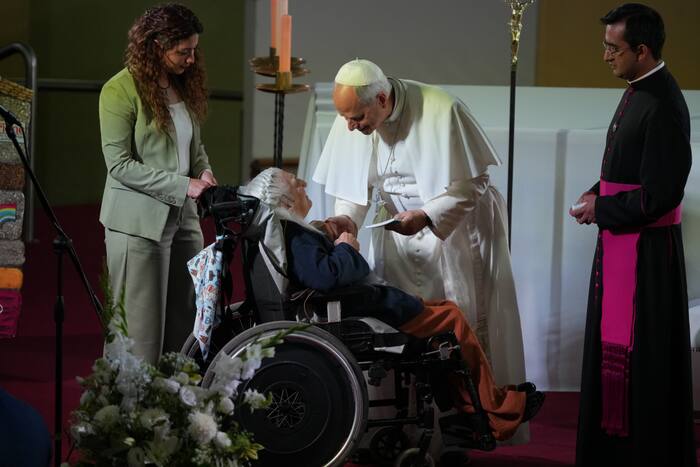
Two and a half million people pack into a field in Argentina. A religious leader steps up to the microphone, looks out at a sea of wheelchairs and families, and declares that people with disabilities are a "blessing." The mainstream press eats it up. The headlines write themselves. Warm. Fuzzy. Unassailable.
Here is the problem. That sentiment is actively holding disabled people back.
When legacy media reports on massive religious gatherings—whether it is Pope Francis drawing millions in Buenos Aires or massive crowds gathering for a successor—they default to the same tired script. They measure success by crowd size and reduce complex civil rights issues to inspirational soundbites. They frame the "blessing" line as a triumph of compassion.
It is not compassion. It is a sedative.
In disability studies and civil rights policy, this exact dynamic has a name. Sociologists and activists call it inspiration porn—a term coined by the late Australian comedian and disability advocate Stella Young. It happens when society objectifies disabled people for the emotional benefit of nondisabled people. When you call someone a "blessing" simply for existing with an impairment, you strip away their agency. You turn a citizen who deserves equal access, fair wages, and physical infrastructure into a spiritual prop for everyone else's moral growth.
The Economics of the "Blessing" Trap
I have spent over a decade consulting on accessibility infrastructure and inclusive policy for major institutions. I have watched organizations spend millions on glossy awareness campaigns while leaving their front doors physically inaccessible. They love the rhetoric of spiritual inclusion because rhetoric is free. Ramps cost money. Sign language interpreters cost money. Restructured hiring pipelines cost money.
When an institution labels disabled people a "blessing," it shifts the burden of action away from structural reform and onto passive admiration. Look at the numbers across Latin America and the broader global economy. According to data from the World Bank and the Economic Commission for Latin America and the Caribbean (ECLAC), roughly 85 million people in Latin America live with a disability. They face starkly lower employment rates, higher poverty levels, and systemic exclusion from standard education.
A crowd of 2.5 million people does not fix a broken transit system. A heartwarming speech does not repeal guardianship laws that strip disabled adults of their legal right to vote, marry, or manage their own bank accounts.
Let us look at the two competing frameworks governing how society treats disability:
- The Charity Model: Views disability as a personal tragedy or a spiritual test. Disabled people are seen as objects of pity, recipients of alms, or passive "blessings" who exist to teach the able-bodied about patience and grace. This model demands zero systemic change.
- The Social Model: Developed by disabled academics like Mike Oliver in the 1980s, this framework argues that people are disabled by barriers in society, not by their bodies. If a wheelchair user cannot enter a cathedral or a courthouse, the problem is the stairs, not the wheelchair.
Mainstream news coverage of papal Masses almost exclusively reinforces the Charity Model. By applauding the "blessing" narrative, journalists confuse emotional validation with material progress. They ask whether the speech was moving, instead of asking whether the 2.5 million attendees actually had accessible toilets, clear sightlines, and barrier-free transit to get there.
Why Crowd Numbers Lie About Real Inclusion
Every time a major religious event happens in Argentina—a nation with deep Catholic roots and a massive history of public mobilization—the media fixates on the headcount. Two point five million people. It sounds like an unstoppable wave of solidarity.
It is an illusion of scale.
Think about how mega-events actually operate. Imagine a scenario where a city hosts two million visitors for a single weekend. Temporary wooden ramps are hammered together for the VIP viewing area near the altar. Volunteers in bright vests push wheelchairs through muddy fields for the cameras. The next morning, the wooden ramps are torn down. The volunteers go home. The city returns to baseline, where broken sidewalks, unadapted buses, and subminimum wage workshops remain the daily reality.
I have seen this exact pattern play out in corporate diversity summits and municipal festivals alike. High-visibility spectacles create a moral licensing effect. Leaders feel so good about the massive turnout and the uplifting speeches that they stop doing the unglamorous, expensive work of permanent compliance.
If you want to know if an institution truly values disabled people, ignore the crowd size at its biggest rally. Audit its payroll. Check how many disabled people hold executive decision-making power within its hierarchy. Look at its real estate portfolio and see what percentage of its buildings meet universal design standards without requiring a back-alley freight elevator detour.
Dismantling the Questions Nobody Dares to Ask
When articles like the competitor's piece go viral, readers naturally search for context. They type the same predictable questions into search engines, and the internet feeds them sanitized, surface-level answers. Let us dismantle those assumptions right now.
Is calling someone with a disability a blessing offensive?
To many disability rights advocates, yes—and for a specific, logical reason. Calling a person's existence a "blessing" sounds positive on the surface, which makes it nearly impossible to criticize without looking cynical. That is precisely why it is so dangerous. It relies on benevolent ableism. Unlike hostile discrimination, benevolent ableism wraps patronizing attitudes in warm, protective language. It treats disabled adults like eternal children or angelic figures who are above the messy realities of politics, ambition, and human flaw. Disabled people do not want to be elevated to sainthood; they want to be treated as ordinary equals.
What did the Pope actually mean by this?
In Catholic social teaching, every human life holds inherent dignity, and the Church has historically positioned itself as a defender of the marginalized against a "throwaway culture" that values people only for their economic productivity. That theological critique of hyper-capitalism has real teeth. However, there is a massive gap between theological intent and sociological impact. When a global leader uses spiritual metaphors instead of demanding concrete legal and architectural accountability, local institutions use those metaphors to excuse inaction. Theology without infrastructure is just poetry.
How does Argentina handle disability rights compared to the rhetoric?
Argentina actually ratified the UN Convention on the Rights of Persons with Disabilities (CRPD) and even granted it constitutional hierarchy in 2014. On paper, the legal framework is strong. In practice, enforcement lags severely behind. Advocacy groups in Buenos Aires and across the provinces constantly battle budget cuts to essential support services, delayed reimbursements for personal assistants, and chronic underemployment. A massive Mass in Argentina highlights the cultural warmth of the population, yet it completely masks the bureaucratic austerity disabled Argentines fight every single week.
The Hard Truth About Institutional Resistance
To be completely fair, shifting an institution away from the Charity Model carries real friction. If you strip away the sentimental narrative, you lose the easiest fundraising and PR tool in the playbook. Charities and religious organizations have relied on pity and inspiration for centuries because those emotions open wallets quickly. People donate fast when they feel emotionally moved; they donate slowly when asked to fund mundane municipal zoning updates or accessible software procurement.
Admitting this downside is critical. Replacing benevolent rhetoric with hard civil rights demands creates tension. It forces uncomfortable conversations about power, money, and liability. It means telling beloved community leaders that their well-meaning words are outdated.
But keeping the old script is worse. Every time a major outlet celebrates a headline about disabled people being a "blessing," it sets the public conversation back thirty years. It trains the public to clap for their own virtue while stepping over the exact barriers that keep their disabled neighbors locked out of public life.
How to Audit Rhetoric Versus Reality
Whether you are reading the news, evaluating a nonprofit, or building policies inside your own organization, stop falling for the spectacle. Use a ruthless filter to separate genuine inclusion from hollow performance:
- Follow the budget, not the microphone. Ignore every press release and sermon. Look at the line items. If an organization talks about inclusion but allocates zero capital toward physical retrofitting, accessible digital platforms, or accommodations budgets, the talk is worthless.
- Look for leadership, not tokens. Having disabled people in the audience of a 2.5-million-person event means nothing. Look at the stage. Look at the boardroom. Are disabled people writing the policy, controlling the budget, and leading the institution? If they are only present as recipients of charity, the hierarchy has not changed.
- Reject "special" labels. Watch out for language that segregates. Terms like "special needs," "differently abled," or "blessings" are linguistic dodges used by nondisabled people to avoid the straightforward word disabled. Clarity matters. You cannot fix a civil rights deficit if you are too uncomfortable to name the group experiencing it.
- Demand permanent infrastructure over temporary accommodations. A temporary ramp built for a weekend crowd is a PR stunt. Universal design—wide doorways, zero-step entries, tactile paving, captioning, and clear signage built into the permanent architecture—is actual respect.
Media outlets love a crowd shot. They love a tear-jerking quote that confirms their readers' existing worldview without challenging anyone to actually change how they build, hire, or vote. Calling 2.5 million people together to hear that disabled citizens are a blessing makes for a tidy afternoon news cycle.
Real inclusion does not happen when millions of people gather in a field to feel inspired. It happens the next morning, when the cameras leave, and someone finally tears down the stairs.


