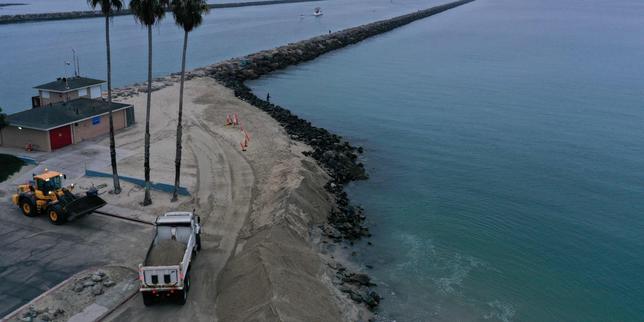
Every few years, the coastal doom industry treats us to another predictable panic attack. The latest headlines blaring across French and American media outlets warn that California's coastline is bracing for a temporary thirty-centimeter surge in sea levels. Panic ensues. Real estate columnists hyperventilate. Environmental action committees draft another round of breathless press releases about impending aquatic catastrophe.
It is lazy journalism built on a foundational misunderstanding of how fluid dynamics actually operate on a rotating sphere. If you found value in this piece, you should check out: this related article.
Let us look past the sensationalist math. The thirty-centimeter bump is real enough, driven by cyclic oceanic oscillations, El Niño phases, and regional atmospheric pressure anomalies. But treating this transient meteorological flex as a permanent watermark of structural doom is an exercise in scientific illiteracy. Worse, it completely distracts planners from the quiet, insidious failure mode actually chewing up the Golden State's shores.
I have watched public agencies blow millions of dollars constructing rigid sea walls to fight predictable tidal adjustments, only to watch the foundational cliffs collapse from groundwater saturation six months later. We are treating a dynamic coastal fluid system like a static bathtub, and wondering why the water keeps splashing over the edge. For another look on this event, see the latest coverage from Al Jazeera.
The Flawed Physics of the Panic
To understand why the standard sea level narrative falls apart, you have to look at what oceanographers call steric and dynamic sea level variability. A thirty-centimeter spike does not mean the global ocean volume has suddenly inflated like a dropped balloon. It means local wind stress, thermal expansion, and regional current shifts have temporarily stacked water against the North American continental shelf.
When these multi-year atmospheric cycles reverse, that water sloshes back. Yet, municipal adaptation plans act as though the ocean has permanently claimed another foot of tarmac.
This creates a dangerous feedback loop of capital allocation. Cities rush to pour concrete barriers designed to hold back a static line, ignoring the subterranean hydrology. Coastal erosion in places like Pacifica or Del Mar is rarely caused by gentle, uniform inundation from rising global volumes. It is driven by high-energy wave action combined with cliff-face saturation from heavy winter rains and compromised inland drainage.
If your cliff is draining water outward while ocean waves hammer it from the base, no amount of offshore breakwaters or beachfront riprap will save your multi-million-dollar foundation. You are fighting the wrong war.
Stop Trying to Hold the Line
The traditional approach to coastal management is rooted in stubborn engineering hubris. For decades, the dominant playbook has been simple: see erosion, dump boulders, build a seawall, cross your fingers.
It fails every single time over a long enough horizon.
Rigid armoring of a dynamic coastline starves down-drift beaches of sand. When you lock a cliff or a shoreline in place with concrete, you disrupt the natural sediment budget. The waves that would normally deposit sand on a forgiving beach instead bounce off your expensive wall, scouring the sand away entirely and deepening the nearshore trough. Within a generation, your protective barrier stands isolated in the surf, surrounded by deep water, requiring even more desperate engineering interventions.
We are bankrupting local municipalities to protect beachfront properties that never should have been zoned for permanent habitation in the first place.
The contrarian truth is uncomfortable: retreat is not a failure of will. It is a mathematical necessity. The sooner local governments stop subsidizing high-risk coastal development through disaster relief loops and federally backed flood insurance, the sooner we can pivot toward managed realignment.
The Real Estate Reckoning Nobody Wants to Name
Look at the property market along the California coast. It operates on a collective delusion. Buyers continue to pay premium prices for homes perched precariously on marine terraces, fueled by the implicit assumption that the state, the Army Corps of Engineers, or taxpayers will bail them out when gravity finally wins.
This is where the standard reporting commits its worst omission. The thirty-centimeter temporary increase is not the cliff edge. The cliff edge is insurance market retreat.
Major property insurers are already quietly pulling out of wildfire zones across the interior. It does not take a crystal ball to see what happens when actuarial tables catch up to coastal erosion realities. When private insurers refuse to write policies for homes within a hundred feet of a eroding bluff, property values will not experience a gradual, polite decline. They will experience a sudden liquidity freeze.
Trying to engineer your way out of a geological inevitability with temporary sea level bumps is like rearranging deck chairs on a sinking platform while ignoring the gaping hole in the hull.
What Actually Works
If we want to survive the coming decades without bankrupting public coffers, we need to abandon cosmetic defenses and embrace radical structural adaptation.
First, stop building permanent infrastructure in high-hazard zones. If a road or a sewage line requires constant emergency shoring after every winter storm, stop repairing it. Abandon the alignment and move it inland.
Second, re-engineer the sediment pathways. Many California rivers and streams are choked behind concrete flood-control dams that trap the very sand and silt needed to replenish beaches naturally. Rebuilding natural sediment flow from interior watersheds to the coast does more to protect shorelines than a thousand truckloads of imported quarry rock.
Third, price risk honestly. As long as property owners are insulated from the true cost of living on an unstable margin, they will continue demanding public bailouts.
The ocean does not care about your municipal zoning laws, your property tax base, or your sentimental attachment to an ocean view. It is an indifferent, thermodynamic engine operating on scales we can manage only if we stop pretending we can negotiate with it.
Stop panicking over the temporary thirty-centimeter blip on the tide gauge. Start preparing for the permanent reality of a shifting coast.



