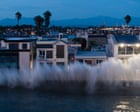
Every coastal bureaucrat in Sacramento has a favorite bedtime story. It involves a massive, rogue swell dubbed the Kelvin wave crossing the Pacific, slamming into the Golden State, and turning beachfront real estate into modern-day Atlantis. Panic sells, urgency funds budgets, and emergency declarations justify nine-figure engineering contracts before the morning commute even clears.
Let us look past the press releases and the computer models calibrated to produce maximum terror. The entire narrative surrounding California's impending coastal catastrophe relies on a fundamental misreading of coastal hydrology, geology, and economic reality. The state is spending billions preparing for a dramatic Hollywood disaster while ignoring the slow-moving, unsexy engineering physics actually shaping our shoreline.
The Myth of the Sudden Ocean Takeover
For years, the lazy consensus in environmental journalism has painted sea level rise as a liquid bulldozer. The script is predictable. Polar ice melts, ocean volumes swell, and waves swallow Pacific Coast Highway by next Tuesday. Headlines scream about the Kelvin wave as if it were a rogue tsunami marching across the basin to swallow Santa Monica.
Here is what the hydrodynamic textbooks actually say. Kelvin waves are equatorial ocean phenomena driven by wind stress changes in the western Pacific. By the time they propagate eastward and poleward, their energy disperses across vast expanses of deep water. When they interact with coastal boundaries, they manifest as minor, temporary sea level anomalies—centimeters, not meters. They are routine oceanographic breathing, not tidal executioners.
Yet, local planning commissions treat every seasonal El Nino cycle and atmospheric river as an existential apocalypse. Why? Because fear unlocks state grants. I have watched municipal engineers trade rigorous data for catastrophic computer simulations because panic secures funding faster than a cost-benefit analysis. When you design public
Why California is Panic Buying Sea Walls While Ignoring the Real Coastline Collapse
news, business
The headlines are running on pure hysteria again. State planners are flashing red lights over an incoming mythical deluge, painting a picture of coastal communities drowning under relentless brine while bureaucrats scramble to pour billions of dollars into concrete barriers. The narrative is always the same simplistic disaster porn. Rising oceans swallow the shore, real estate crashes, and state agencies heroically rush in with engineering band-aids to hold back the tide.
It is a comforting script for pencil-pushers. It turns a complex geophysical reality into a simple hero-versus-nature movie.
It is also completely wrong.
I have spent years watching municipal budgets hemorrhage cash on shoreline armor that gets ripped apart by winter storm surges within five years. The catastrophic failure of current coastal management is not that we are underestimating the rising water. The failure is that we are treating a dynamic, morphing coastline like a fixed estate line on a 19th-century map. We are spending fortunes trying to lock an eroding shore in place, and in doing the exact opposite of what physics demands, we are accelerating the destruction.
The Fatal Flaw of the Static Shoreline
Let us look at the mechanics of what the state is actually funding. When planners talk about defending the coast against extreme sea level rise, they default to structural protection. Seawalls, revetments, groins, bulkheads. They sound robust on paper. They look impressive in environmental impact reports.
They are ecological and financial suicide.
When you armor a beach, you starve the littoral cell of sand. Waves crash against the concrete wall, scour the base, and drag whatever remaining sediment is left down into the offshore trough. The beach disappears. That is not a side effect; it is a direct hydraulic consequence. You protect a multimillion-dollar bluff-top mansion by sacrificing the public strand beneath it, ensuring that the next storm hits with even greater kinetic energy because there is no shallow slope left to absorb the blow.
State agencies love to project decade-by-decade sea level curves as if water rises like coffee filling a mug in a quiet kitchen. Real hydrodynamics do not work that way. Coastlines change via punctuated equilibrium. Nothing happens for a decade, and then a single El Nino season combined with a king tide and a localized atmospheric river reshapes forty miles of beach in seventy-two hours.
Building a taller wall against that kind of raw energy is like putting a screen door on a submarine.
The Economics of Denial
Why do local governments keep doubling down on failing infrastructure? Follow the balance sheets. Property tax revenues on coastal parcels fund municipal services inland. If a city admits that a neighborhood is structurally unviable over a thirty-year mortgage horizon, bond ratings drop, valuations plummet, and the tax base evaporates overnight.
So they lie to the bondholders. They commission studies that assume idealized sediment replenishment programs that everyone in civil engineering knows are logistically impossible at scale. They pretend that dredging millions of cubic yards of offshore sand and pumping it onto eroding beaches is a permanent fix, rather than an expensive temporary sandbox game paid for by taxpayers miles inland who will never see the ocean.
I have seen developers pitch shoreline stabilization projects that cost more than the total market value of the structures they are supposedly saving. It is public subsidy for private folly wrapped in green-tinted rhetoric about climate resilience.
The Counter-Intuitive Playbook
If the current approach is an expensive dead end, what is the alternative that nobody in power wants to utter out loud?
Stop defending lines that nature has already reclaimed.
Managed retreat is treated like a dirty word in Sacramento planning meetings because it sounds like surrender. But real engineering is about working with the grain of natural systems, not fighting them with brute force. A resilient coastline is a migratory coastline. It requires giving rivers room to flood, allowing bluffs to slough off naturally to feed down-coast sand supplies, and relocating infrastructure out of harm's way before the ocean makes the decision for you.
This means rewriting local coastal programs to penalize hard armoring instead of incentivizing it. It means decoupling property insurance from state-backed bailout funds that reward building in high-risk erosion zones. If you want to plant a multi-million-dollar estate on a crumbling marine terrace in Pacifica, that is your financial prerogative. But the moment you demand public funds to build a fifty-foot rock revetment to save your driveway, you are externalizing private risk onto the public commons.
The transition will be bruising. Real estate markets will reprice. Speculators will lose shirts. But the alternative is sinking half the state budget into maintaining a sinking ship of concrete and false hope.
The water is coming. But our greatest threat is not the height of the tide. It is the stubborn refusal of planners to admit that you cannot negotiate with physics.