The map in the bunker does not bleed. It only changes color.
A blue arrow pushes forward. A red line shifts backward. To the men and women peering down at the illuminated glass tables hundreds of miles away from the mud and the shrapnel, it is an exercise in geometry. Distance divided by time. Force applied against resistance. But in the trenches carved into the frozen earth of eastern Ukraine, geometry is measured in heartbeats.
Listen closely.
You can hear the low, rhythmic thrum of a generator that has not been turned off in months. You can smell the stale scent of damp wool, cold metal rations, and cheap tobacco. In this dim reality, every shift on that distant glass table means something heavy. It means a roof gone. A cellar crowded with shivering children. A friend who walked out into the gray dawn and did not return before dark.
For a long time, the war had a predictable rhythm. It was a grinding, brutal contest of attrition, measured in meters and millimeters, governed by a grim set of unwritten rules. Both sides knew the boundaries. Both sides understood the cliffs they dared not approach.
That architecture of caution is fracturing.
Consider what happens when a player stays too long at a high-stakes table. At first, every move is weighed, calculated, second-guessed. Every chip pushed forward represents a piece of security risked. But as the hours bleed into days, and the days into years, exhaustion takes hold. The mind adapts to the danger. The edges of fear wear smooth. What once looked like an absolute precipice now looks like just another ridge to cross.
That is the psychological transformation occurring inside the highest circles of Moscow.
According to senior NATO commanders whose daily work is the cold assessment of adversary behavior, Vladimir Putin is undergoing a profound shift. The man who once obsessed over every geopolitical chess piece, calculating the exact trajectory of Western reactions before making a move, is becoming markedly more cavalier. The caution born of unpredictability has given way to a dangerous, hardened appetite for risk.
This is not a sudden madman's pivot. It is the natural, terrifying evolution of a protracted conflict.
When a war drags on past all initial estimates, it ceases to be a policy instrument. It becomes an atmosphere. It becomes the weather. Leaders trapped inside its gravity well stop asking what the long-term cost will be because the short-term survival of their regime depends entirely on the next tactical gamble.
Think of it like driving through a blinding mountain blizzard. In the first mile, your knuckles are white on the steering wheel. You creep along at twenty miles per hour, terrified of the drop-off just beyond the snowbanks. By the fiftieth mile, numb to the cold and desperate to be home, you find yourself pressing down on the accelerator. The danger hasn't decreased. Your fear has. And that is precisely when the black ice catches you.
The warning from NATO military leadership carries this exact weight. As Western resolve wobbles, as political cycles turn, and as economic sanctions are absorbed and bypassed, the incentives for restraint begin to evaporate. If you believe time is running out, caution becomes a luxury you can no longer afford.
We have watched this play out in the air above Ukrainian cities.
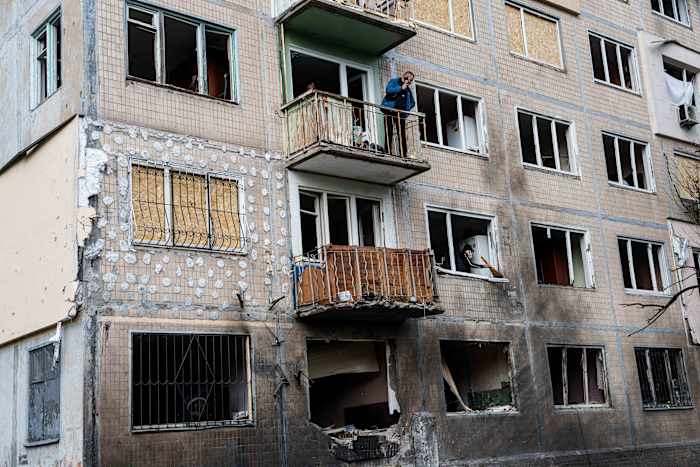
In the early months of the invasion, missile strikes were calibrated messages, aimed primarily at military infrastructure, designed to coerce without completely severing diplomatic exit ramps. Today, the strikes are broader, deeper, and more frequent, hitting civilian energy grids with the calculated cruelty of an executioner trying to freeze an entire population into submission. Drone swarms cross international borders with a casual disregard that would have triggered immediate, catastrophic escalation assessments three years ago.
Every time a boundary is crossed and the response falls short of total deterrence, the psychological threshold shifts. The adversary looks across the table, sees no immediate lightning bolt, and concludes that the ceiling for reckless behavior has just been raised.
This is the hidden hazard of a war of endurance.
It invites escalation not through grand, cinematic decisions, but through the quiet accumulation of desensitization. A commander approves a riskier flanking maneuver because the safe options failed. A leader signs off on a saboteur mission in a neighboring European capital because the conventional front lines are deadlocked. Each step is small enough to avoid a massive, systemic rupture, yet together, they march the world steadily toward the edge of an abyss.
We often talk about war in terms of steel, oil, and microchips. We count tanks, artillery shells, and air-defense batteries as if they were pieces on a spreadsheet. But the most volatile element in any conflict is human psychology under extreme, prolonged pressure.
Weariness is an active combatant.
When an autocrat has staked his entire legacy, his political survival, and his historical narrative on a single, catastrophic gamble, he stops fearing the worst-case scenario. The worst-case scenario has already happened: he is locked in a quagmire he cannot easily win and cannot afford to abandon. Once you cross that psychological Rubicon, risk is no longer a deterrent. It is currency.
The implications for the alliance supporting Ukraine are sobering. For years, the strategy has been managed escalation—slowly boiling the frog, providing just enough aid to keep Kyiv in the fight without crossing arbitrary red lines that might provoke a wider conflagration. But that calculus assumes a rational actor who still fears the fire.
If the man across the table is no longer counting the cost of the burn, then managing the escalation becomes an illusion. You cannot deter someone by threatening them with a fire they have already decided to walk through.
The map in the bunker still glows. The blue arrows and red lines continue their silent dance. But the hand moving them is steady in a terrifying new way. It belongs to someone who has looked at the worst possible outcomes, made peace with them, and decided that rolling the dice one more time is the only move left worth making.
The snow continues to fall over the eastern plains. In the trench, a soldier pulls his wool coat tighter against the wind, waiting for the whistle overhead. He does not know what the commanders are saying in Brussels or Washington. He only knows that the night is getting colder, and the man pulling the strings in Moscow has stopped caring about the morning.



