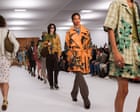
When creative director Daniel Lee partnered with textile legend Celia Birtwell to close London Fashion Week, the media framed it as a charming exercise in British nostalgia. They called it a humanising touch for a corporate giant. They missed the entire point. This was not a sentimental afternoon tea between two national treasures; it was a calculated survival strategy executed by a heritage house desperately trying to remember how to breathe.
Burberry does not have a nostalgia problem; it has an identity panic. For years, successive leadership teams treated the brand's iconic check like an interchangeable asset, slapping it onto everything from baseball caps to dog leashes in an exhausting bid for volume. Profit margins fluctuated, leadership turnover became routine, and the core consumer grew tired of buying overpriced corporate spreadsheets disguised as raincoats. Enter Birtwell, the octogenarian textile artist immortalised by David Hockney and defined by the free-spirited bohemianism of 1960s London. By inviting her to warp, redraw, and playfully subvert the sacred corporate check with hand-painted vines and fragmented faces, Lee did something radical. He cracked open the corporate vault and allowed a bit of chaos inside.
The financial pressure underlying this runway stunt is immense. Burberry has spent the past several quarters restructuring, trimming global headcount, and desperately trying to anchor its average selling price in the upper echelons of luxury. Yet high-end shoppers do not buy trench coats because they are functional protection against damp weather; they buy them for cultural currency. When a brand becomes too clinical, too obsessed with quarterly earnings reports and standardized retail footprints, it loses the raw, messy texture of real life. Birtwell’s hand-drawn florals and quirky motifs injected an antidote to sterile mass production right into the heart of the luxury house.
Consider the fabric choices on that runway. Moving away from rigid, heavily treated gabardine, the collection leaned heavily into slinky silk taffeta with puffball hems and ruched collars. These garments possessed a natural fluidity that fought against the stiffness historically associated with British outerwear. Lee deliberately left details imperfect, championing creased surfaces and washed finishes as features rather than manufacturing defects. In an industry obsessed with laser-cut perfection, celebrating a wrinkle is a dangerous commercial gamble. It tells the consumer that luxury does not need to be kept behind glass; it is meant to be worn, lived in, and creased.
This strategy mirrors a broader shift across the luxury sector. Consumers under forty are deeply cynical about traditional status symbols. They can spot an engineered trend from a mile away, and they reject brands that take themselves too seriously. By bringing in Birtwell—someone entirely outside the predictable corporate design machinery—Burberry bypassed the traditional marketing playbook. They substituted manufactured hype with actual artistic lineage. It is an approach that acknowledges a simple truth: heritage cannot be manufactured in a boardroom, but it can be re-energised by letting go of control.
Of course, a runway collaboration alone cannot balance a ledger. The real test for Burberry lies in whether these artistic risks can translate effectively into retail sales across flagship stores from London to Shanghai. Beautiful silk taffeta coats with hand-drawn prints look spectacular under runway lights, but they require a consumer willing to pay top tier prices for a product that deliberately looks relaxed and lived-in. The brand is betting heavily that the market is ready for a softer, more idiosyncratic definition of luxury—one that values artistic collaboration over uniform perfection.
The closure of London Fashion Week offered a rare glimpse of a major luxury house choosing vulnerability over corporate armor. Whether this cultural pivot is enough to secure long-term stability remains to be seen. For now, the stitches hold, the checks have been redrawn by hand, and Burberry has proven it can still surprise an industry that thought it had seen everything.