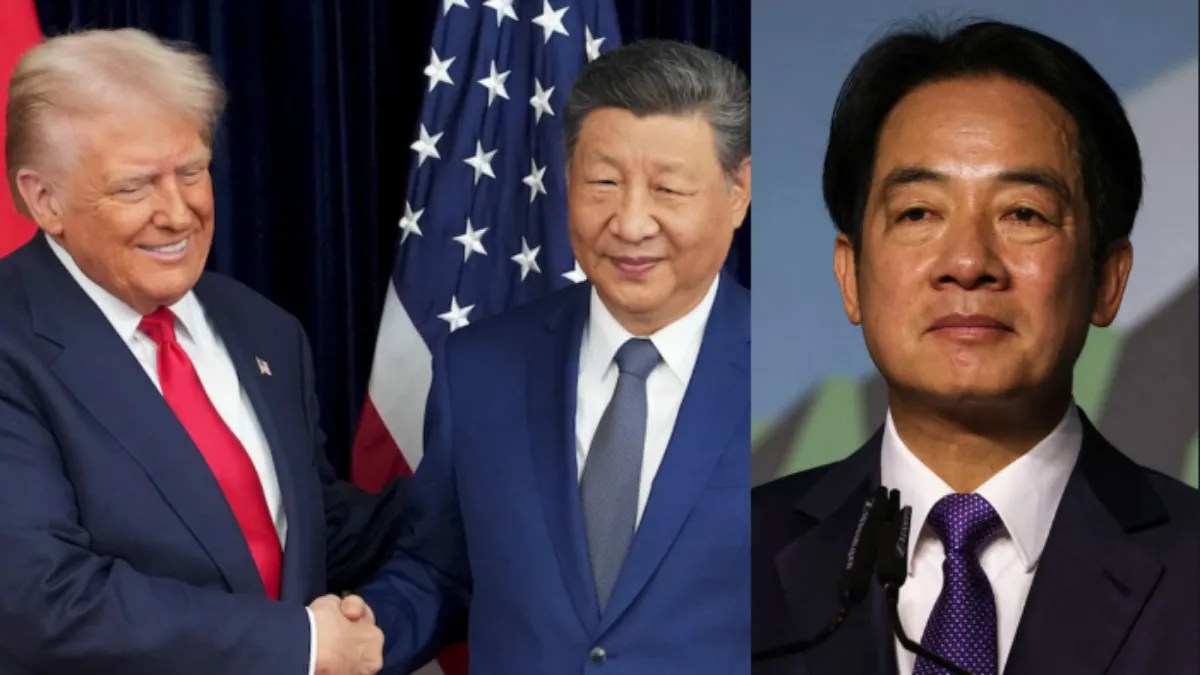
The sudden freeze on America's promised 14 billion dollar arms package to Taiwan is not a temporary bureaucratic delay. It is a calculated geopolitical pivot. While public narratives point to recent diplomatic summits and shifting trade negotiations as the primary catalyst, the reality involves a much more complex calculation. Washington has quietly halted the transfer of advanced missile systems, radar equipment, and naval hardware not out of sudden pacifism, but because the underlying strategy of cross-strait deterrence is undergoing a forced rewrite.
For months, defense contractors and policy analysts expected the massive backlog of hardware to finally ship. Instead, the administration pulled the emergency brake. This decision leaves Taipei scrambling for answers while Beijing claims a quiet victory. To understand how a multi-billion-dollar state department approval vanishes overnight, one must look past the press releases and examine the structural collapse of the existing security framework.
The Illusion of the Porcupine Strategy
For a decade, American defense doctrine mandated turning Taiwan into a porcupine. The theory was simple. Equip the island with enough anti-ship missiles, sea mines, and mobile anti-air batteries to make a cross-strait invasion too costly for the People's Liberation Army to attempt. The 14 billion dollar package was supposed to be the spine of this strategy.
It failed before it even left the factories.
The defense industrial base in the United States is buckling under the weight of simultaneous global commitments. Production lines for critical munitions are backlogged by years. By freezing the sale, Washington is masking a grim reality. The weapons do not exist in the quantities required. Promising hardware that cannot be delivered for seven years does not deter an adversary operating on a much shorter timeline. It creates a dangerous security mirage.
Furthermore, Beijing altered its tactics. A porcupine strategy only works against an outright amphibious assault. It is useless against a gray-zone blockade, quarantine maneuvers, or sustained cyber-warfare targeting undersea cables and power grids. The weapons sitting in the frozen 14 billion dollar ledger—heavy tanks and traditional fighter jet upgrades—are legacy platforms designed for a twentieth-century war. They are essentially targets in a modern, drone-saturated conflict theater.
Behind the Closed Doors of the Beijing Summit
The timeline of the freeze correlates directly with high-level diplomatic engagements in Beijing. Observers assumed the suspension was a concession, a bargaining chip traded away to secure concessions on fentanyl trafficking or currency stabilization. That interpretation is shallow.
Diplomacy is rarely about trading a pawn for nothing. Washington used the suspension of the arms package to buy time.
The Technological Chokepoint
The real negotiation centers on semiconductors and electronic supply chains. Taiwan produces over 90 percent of the world's most advanced microchips. If Beijing gains control of those fabrication facilities, the global tech economy stalls instantly. The United States is racing to build its own domestic chip foundries, but those facilities will not be fully operational for several years.
By pausing the weapons transfer, Washington signaled a willingness to slow down Taiwan's militarization in exchange for a temporary freeze on Beijing's aggressive gray-zone operations. It is a high-stakes delay tactic. The administration is trading hardware today for the precious months needed to reshore critical technological manufacturing.
The Fiscal Friction in Taipei
There is also growing resentment within the American defense establishment regarding Taiwan's own defense spending. For years, Washington pressured Taipei to reform its conscription system, fortify its civil defense, and transition away from expensive, prestige military platforms toward cheap, asymmetric weapons.
- Taiwan's military budget remains below three percent of its GDP.
- Conscription reforms are met with domestic political resistance.
- The island’s strategic reserves of energy and food are dangerously low.
The freeze serves as a blunt message to Taipei. Washington will not underwrite the defense of a nation that refuses to fully mobilize its own society for its survival. The pause forces Taiwan's leadership to confront their internal vulnerabilities rather than relying on the assumption that American tech will always arrive to save the day.
The Supply Chain Nightmare No One Admits
The defense sector likes to project an image of unstoppable industrial might. The truth is much more fragile. The suspension of the 14 billion dollar sale exposes severe bottlenecks in specialized component manufacturing.
[Rare Earth Elements Processing] ➔ [Advanced Sensor Production] ➔ [Missile Guidance Assembly]
               ▲                                                            │
               └─────────────────── Supply Chain Bottleneck ────────────────┘
A modern missile is not just steel and explosives. It requires highly specialized optical sensors, solid-fuel rocket boosters, and radiation-hardened microchips. The supply chains for these components run through a labyrinth of global sub-contractors, many of whom rely on raw materials controlled by China itself.
The United States cannot easily build thousands of precision-guided munitions when the processed neodymium and antimony required for their guidance systems originate in Chinese mines. The halt on the Taiwan sale allows the Pentagon to quietly divert the existing, limited production runs to replenish its own depleted stockpiles. National security officials realized that arming an ally at the expense of America's own baseline readiness was becoming an unacceptable risk.
The Counter Argument What If Delay Escalates War
Proponents of immediate strategic clarity argue that this freeze is a catastrophic mistake. They believe that any sign of hesitation from Washington invites aggression. History shows that vacuums are filled quickly. By withholding the 14 billion dollars in hardware, the United States might inadvertently signal that its commitment to Taiwan is conditional and fleeting.
This viewpoint assumes that Beijing reads American actions in a vacuum. It does not. The Chinese leadership understands industrial capacity perfectly. They track shipping manifests, factory outputs, and congressional budget allocations. They know the weapons are delayed because of manufacturing limits, not just political whims. A weak America trying to posture with empty promises is far less intimidating than an America that candidly stops, reassesses, and restructures its Pacific posture.
The Emergence of the Drone Doctrine
The frozen weapons package represents the old way of war. While politicians argue over the delivery dates of traditional sub-surface naval assets and anti-air batteries, the nature of denial capability has shifted to autonomous systems.
The conflict in Ukraine demonstrated that cheap, mass-produced drones can neutralize multi-million-dollar armor and naval vessels. The Pentagon's focus is shifting toward the Replicator initiative, an effort to field thousands of low-cost, attrition-tolerant autonomous systems in the Indo-Pacific within a short timeframe.
The 14 billion dollar package was structured before these lessons were fully integrated into military doctrine. Continuing to pour capital into outdated procurement contracts is an inefficient use of leverage. The suspension allows for a quiet re-allocation of resources toward swarming drone technologies, artificial intelligence integration, and decentralized command networks that are far harder for an invading force to target.
Taiwan must adapt to this shift. The island does not need more vulnerable airfields or massive naval vessels that can be spotted from space and targeted by long-range ballistic missiles. It needs thousands of hidden, mobile drone launchers, decentralized communications networks like Starlink, and deep stockpiles of man-portable munitions. The freeze forces a pivot toward this reality, cutting off the supply of legacy hardware to make room for the systems that actually matter in a modern theater.
The era of relying on massive, single-installment arms shipments to secure the Taiwan Strait is over. The frozen 14 billion dollars is the first major casualty of a deeper, far more chaotic restructuring of global power dynamics, where industrial capacity and supply chain security matter far more than political rhetoric. Taiwan must realize that its defense cannot be bought off an American shelf that is currently empty.