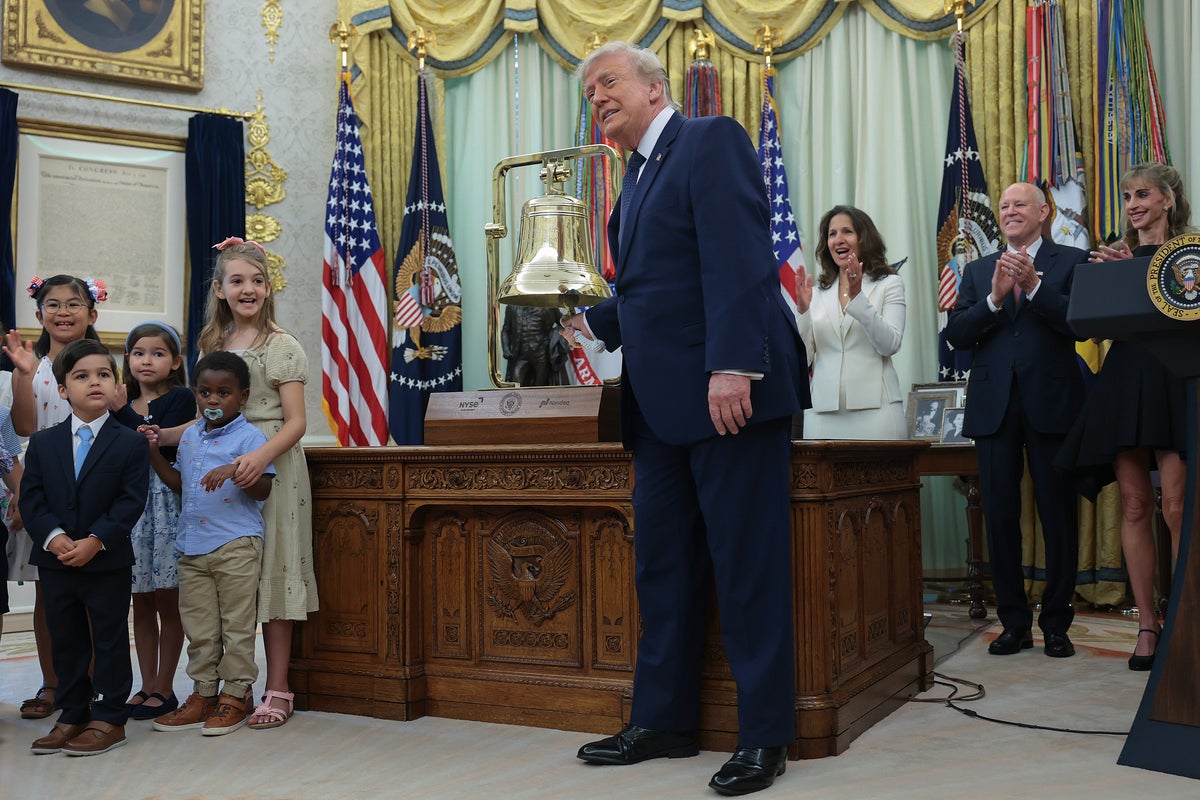
President Donald Trump rang the opening bells for both the New York Stock Exchange and NASDAQ directly from the Oval Office to celebrate the official trading launch of Trump Accounts. Within minutes, his public exhortation for citizens to buy Dell Technologies computers sent the company's shares climbing over 7%, continuing a highly profitable pattern of presidential stock promotion that blurs the lines between public policy and private portfolio gains.
The immediate market reaction reflects a broader, more complicated mechanism than a mere presidential endorsement. Beneath the populist rhetoric of turning every American child into a corporate shareholder lies an intricate network of massive corporate pledges, timely defense contracts, and personal stock acquisitions by the commander-in-chief himself. This is not just a story about helping children save for the future. It is a case study in how political power can reshape equity markets in real time. For a more detailed analysis into this area, we recommend: this related article.
The Oval Office Stock Ticker
Market veterans have long understood that words spoken from the White House have economic weight. Yet the explicit directive to purchase products from a specific, publicly traded corporation represents a distinct departure from historical norms. When the president tells the public to purchase a Dell computer, algorithmic trading systems and retail buyers react instantly. The stock moves.
This particular movement follows a clear trail of financial disclosures. Financial records from the Office of Government Ethics show the president purchased between $1 million and $5 million in Dell stock during the first quarter of the year. Shortly after these personal investments were finalized, public praise for the hardware giant began to intensify. For the average investor trying to ride the wave of these announcements, the reality is often less lucrative than the headlines suggest. By the time a retail trader processes a televised statement and executes an order, institutional high-frequency trading platforms have already priced in the news, leaving the public to buy at the absolute peak. To get more details on this topic, in-depth reporting can also be found on Financial Times.
The cross-ownership of policy and personal wealth extends beyond consumer hardware. Similar patterns have emerged around other domestic technology firms, including major semiconductor manufacturers and cloud enterprise providers. Each public nod serves as a temporary catalyst for share prices, raising fundamental questions about the mechanics of modern market manipulation and the responsibilities of the executive branch.
The Trillion Dollar Cradle
The underlying vehicle for this market activity is the Trump Accounts initiative, a cornerstone of recent tax legislation. Under the program, children born between 2025 and 2028 receive a one-time $1,000 seed contribution from the U.S. Treasury, which is automatically placed into low-cost index funds. Administration officials project that the program could channel up to $4 trillion into the equities market over the next fifteen years.
On paper, the initiative addresses a real structural issue. Roughly 38% of American families have no exposure to the stock market, missing out entirely on the long-term compounding effects of corporate growth. By forcing participation through federally backed accounts, the state is effectively manufacturing a new class of investors. Parents can add up to $5,000 annually to these accounts, tax-deferred, until the child reaches adulthood.
However, the injection of hundreds of millions of dollars of new capital into specific market sectors creates artificial demand. When huge volumes of capital are mandated by law to flow into domestic equities, the valuations of the largest companies in those indexes become disconnected from traditional metrics like price-to-earnings ratios. The market is no longer just evaluating a company's balance sheet; it is factoring in a permanent, government-mandated capital inflow.
A Billionaire Alliance and the Defense Windfall
The operational scale of the initiative relies heavily on a public-private partnership anchored by tech billionaire Michael Dell and his wife Susan. The Dells pledged $6.25 billion to seed accounts with $250 each for the first 25 million children who sign up but do not qualify for the full federal baseline. This massive philanthropic commitment forms the backbone of the administration's claims of a unified national economic effort.
Yet the timeline reveals overlapping events that demand scrutiny. Shortly before the official rollout of the accounts and the subsequent public praise from the Oval Office, Dell Technologies secured a massive five-year, $9.7 billion contract with the Pentagon to supply Microsoft software and infrastructure to the U.S. military. The awarding of a near-ten-billion-dollar defense contract to a corporation whose founder is bankrolling a signature administration policy creates an undeniable optics problem.
White House representatives maintain that the president's effusive praise is rooted entirely in the Dells' multi-billion-dollar charitable contribution to working-class children. They argue that Dell has maintained a deeply entrenched relationship with the Department of Defense for decades, rendering the contract a routine bureaucratic renewal. Even if the procurement process was entirely independent, the convergence of personal stock ownership, massive federal contracting, and policy partnerships creates a circle of influence that is unprecedented in modern governance.
The Myth of the Level Playing Field
Wall Street is fundamentally an asymmetric information environment. The idea that a regular citizen can build sustainable wealth by acting on real-time pronouncements from the Oval Office ignores the structural design of modern trading. Institutional asset managers do not wait for the evening news. They utilize direct data feeds and predictive models to position themselves ahead of the public.
Consider the actual mechanics of the trades. The president's financial disclosures from last year revealed two dozen separate transactions involving technology equities across multiple accounts. These portfolios are managed through discretionary accounts held by third-party institutions. While the administration points to this arrangement as a barrier against conflicts of interest, the reality remains that public policy decisions—such as authorizing specific artificial intelligence chip sales to foreign markets or awarding major defense infrastructure contracts—directly impact the bottom line of these exact corporations.
The true beneficiaries of these sudden spikes are the institutional holders who use the temporary influx of retail liquidity to exit or rebalance their positions. A retail investor buying stock after a televised ceremony is frequently absorbing the shares that sophisticated funds are looking to unload. Long-term wealth creation relies on systematic diversification and cost-averaging, not the volatile momentum generated by political theater.
The Regulatory Void
Under existing legal frameworks, the president is largely exempt from the strict insider trading statutes that govern ordinary corporate executives or secondary federal employees. This statutory exemption was designed to prevent the executive branch from being paralyzed by constant financial litigation, but it leaves an enormous regulatory gap when a president actively discusses individual stock tickers in public forums.
The Securities and Exchange Commission possesses clear mandates to prosecute market manipulation, yet its authority over statements made by an elected commander-in-chief performing official duties is legally ambiguous. If a corporate executive gathered reporters to announce a major government partnership while holding millions in company stock, it would trigger an immediate federal investigation. When the same action occurs inside the Oval Office, it is framed as economic patriotism.
This structural loophole changes the risk calculus for corporate leaders. Engaging with signature administration initiatives can yield substantial public relations benefits, protection from regulatory scrutiny, or a direct lift in equity valuation via presidential commentary. The risk is that corporate survival becomes increasingly dependent on political alignment rather than product innovation or operational efficiency.
The long-term health of an economy depends on transparent rules that apply equally to all participants. When the highest office in the nation operates as a primary driver of specific corporate valuations, the integrity of the broader market is compromised. Investors seeking to protect their capital must learn to look past the immediate euphoria of the ticker tape and analyze the structural undercurrents driving the policy. True financial independence is built on cold, data-driven realities, not the shifting winds of executive favor.
For a deeper look into the financial debates surrounding these transactions, see this CNN NewsNight Analysis which examines the ethical questions raised when a sitting president invests in corporations that subsequently secure multi-billion-dollar government defense contracts.