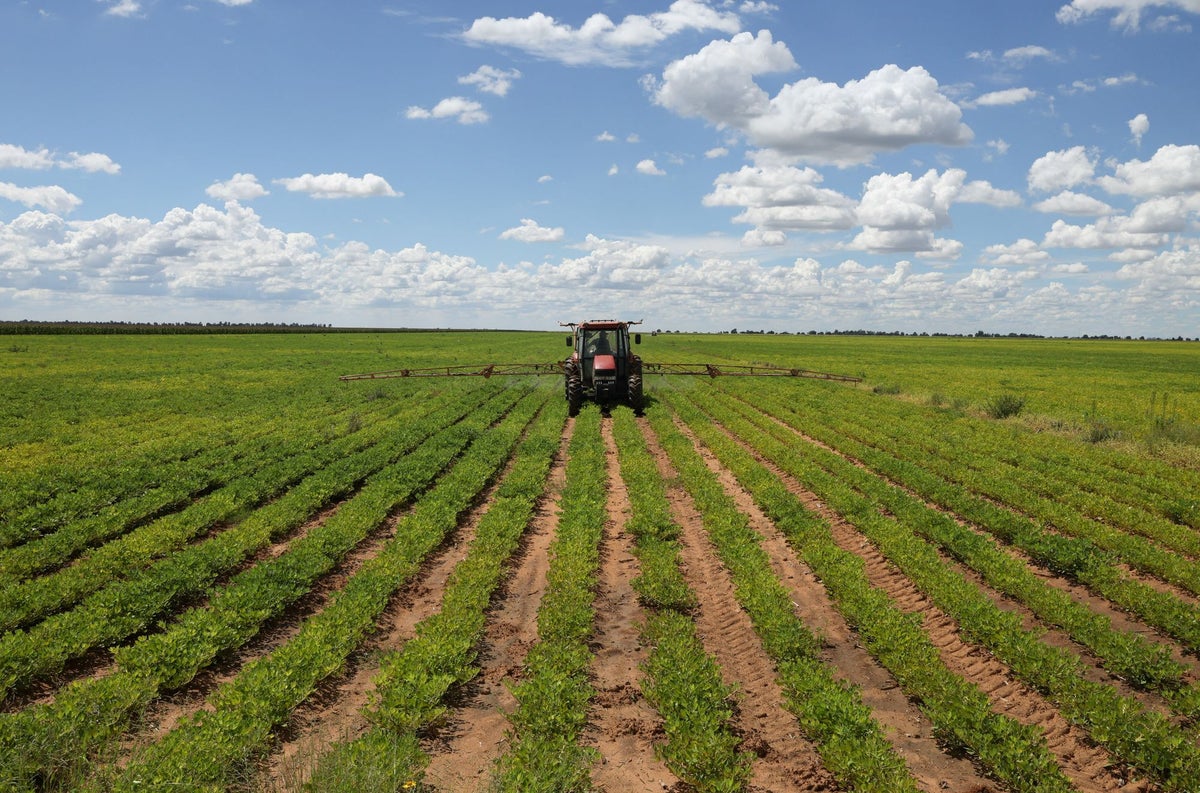
The modern farm is no longer defined by the fence line. It is a node in a hyper-fragile global network where a drone strike in the Persian Gulf can effectively bankrupt a citrus grower in Limpopo. As South African farmers prepare for a critical harvest season, they are finding that the biggest threat to their survival isn't drought or local infrastructure decay, but the escalating military confrontation between Israel and Iran. This conflict has ignited a chain reaction of soaring input costs and maritime chaos that is systematically eroding the profit margins of the country’s agricultural backbone.
South Africa's agricultural sector exports roughly half of its total production. When the Strait of Hormuz or the Red Sea becomes a combat zone, the ripple effects are immediate. Shipping companies reroute vessels around the Cape of Good Hope to avoid missile fire, which sounds like a boon for South African ports. It isn't. Instead, it creates a logistical nightmare where local produce sits rotting on docks because the global shipping schedule has been thrown into total disarray. Meanwhile, the cost of the chemicals and fuel needed to bring the harvest in has reached a breaking point.
The Fertilizer Trap
Most observers focus on fuel prices when war breaks out. That is a mistake. The real silent killer for the South African farmer is the price of nitrogen-based fertilizers.
The manufacturing process for these fertilizers relies heavily on natural gas. Because the Middle East is a central hub for global energy production and transit, any credible threat of a full-scale war between regional powers sends gas futures into a frenzy. South Africa imports the vast majority of its fertilizer components. When the cost of production in energy-heavy regions spikes, the South African farmer pays the "war premium" at the local co-op months before the first seed even hits the ground.
We are seeing a situation where the cost of nourishment for the soil has outpaced the market value of the crop itself. A maize farmer who locked in prices six months ago is now looking at input costs that have doubled. This isn't just a dip in profits. This is a liquidation event for family-owned operations that have survived for generations.
Maritime Chaos and the Cape Route Illusion
There is a persistent myth that the Red Sea shipping crisis—driven by the Iran-backed Houthi rebels—is a benefit to South Africa because ships are being forced to sail around our coast. The reality on the ground tells a much bleaker story.
South African ports, specifically Durban and Cape Town, were already struggling with deep-seated inefficiencies, aging equipment, and bureaucratic paralysis. The sudden influx of diverted global traffic has not brought "business"; it has brought congestion that the current infrastructure cannot handle.
Perishable Goods and the Clock
For a fruit exporter in the Western Cape, time is the only currency that matters. Grapes and citrus have a hard shelf life. When a vessel is delayed by ten days because it had to bypass the Suez Canal, or because it is stuck in a queue behind thirty other diverted container ships in Durban, the quality of the produce drops.
Lower quality means lower prices on the shelves in London or Rotterdam. In many cases, it means the entire shipment is rejected upon arrival. The farmer bears 100% of that risk. The shipping line still gets paid. The insurance company might fight the claim for years. The farmer simply loses the season.
The Fuel Surcharge Sting
Shipping companies have introduced "Emergency Risk Surcharges" to cover the cost of the longer journey around the Cape. These fees are passed directly down the chain. While the world watches the geopolitical maneuvering in Tehran and Tel Aviv, the South African exporter is watching an additional $1,000 to $2,000 being tacked onto every container. When you are moving thousands of tons of low-margin produce, those numbers are a death sentence.
Currency Volatility as a Weapon of War
The South African Rand is a "risk-on" currency. Whenever global tensions rise—especially when those tensions involve a potential nuclear power like Iran or a Western-aligned military powerhouse like Israel—investors flee to the safety of the US Dollar.
A crashing Rand makes South African exports look cheaper and more attractive on the global market, which is the traditional silver lining. However, this advantage is completely neutralized by the fact that almost all farming inputs are priced in Dollars.
- Diesel: Required for tractors, harvesters, and the generators needed to bypass "load shedding" (rolling blackouts).
- Pesticides: Highly specialized chemicals mostly manufactured abroad.
- Machinery Parts: High-tech components for modern combines.
The farmer is buying in Dollars and selling in a weakened Rand that is being battered by headlines it cannot control. It is a mathematical pincer movement.
The Failure of Domestic Policy to Provide a Buffer
If the global situation is the hammer, South Africa’s internal failures are the anvil. A country with a robust rail system and world-class ports could perhaps weather a global shipping crisis. South Africa does not have that luxury.
The dependence on road freight to move grain and fruit to the ports means that every cent added to the price of a liter of diesel due to Middle Eastern tension is an immediate tax on the harvest. We are seeing a massive shift in the viability of certain crops. Farmers in the interior are increasingly questioning whether it is even worth planting for export when the logistical gauntlet is so expensive and so prone to failure.
The Credit Crunch
Banks are not blind to these risks. As the "war premium" makes farming more dangerous, credit becomes tighter. Agriculture in South Africa runs on seasonal credit. If the bank decides that the risk of a regional war in the Middle East makes your 2026 harvest too volatile to back, the farm stops. We are already seeing a tightening of lending criteria that is hitting the medium-sized players the hardest—those too big to be ignored but too small to have the massive cash reserves of corporate mega-farms.
Disrupted Trade Agreements and Geopolitical Alignment
South Africa’s political stance on the conflict adds another layer of complexity that many industry analysts are afraid to touch. The government's vocal position on the international stage regarding the Gaza-Israel conflict has created friction with traditional Western trading partners.
While there have been no formal sanctions, "soft" trade barriers are a very real phenomenon. Inspections become more rigorous. Certification processes slow down. In a business where a three-day delay turns a profit into a loss, these subtle shifts in diplomatic temperature can be devastating. South African agriculture is caught between its government’s foreign policy ambitions and the cold reality of where its biggest customers actually live.
Why Diversification is Not a Magic Bullet
The standard advice is to diversify—find new markets, grow different crops. But you cannot pivot a citrus orchard that took ten years to mature in the same way a software company pivots its app. These are long-term biological investments.
Furthermore, new markets like China or India have their own complex phytosanitary requirements and geopolitical baggage. Moving away from the European or American markets is a process that takes decades, not months. The war in the Middle East is happening now, and the harvest is coming whether the markets are ready or not.
The Strategy for Survival
The farmers who will survive this period are not the ones hoping for peace in the Middle East; they are the ones aggressively de-risking their operations from global volatility.
This means a radical shift toward on-site energy independence. Moving away from diesel-powered generators and toward large-scale solar and battery storage isn't about being "green" anymore; it’s about removing a variable that is tied to the price of Brent Crude. It means investing in precision agriculture to cut fertilizer waste by 30% or 40%, ensuring that every gram of imported chemical is used with maximum efficiency.
It also requires a collective demand for the privatization or radical overhaul of port management. The agricultural sector can no longer afford to be held hostage by state-owned enterprises that cannot keep the cranes moving when the world's ships show up at the door.
The conflict between Iran and Israel is often discussed in terms of missiles, ideologies, and grand strategy. For the person standing in a dust-covered field in the Free State, it is much simpler and much more brutal. It is a question of whether the cost of the fuel in the tank and the fertilizer in the soil will leave enough money at the end of the month to plant again next year.
Stop looking at the harvest as a local event. It is a casualty of a global war that is being fought with oil prices and shipping lanes as much as it is with ballistics. If you aren't calculating the cost of a closed Strait of Hormuz into your 12-month budget, you aren't really farming; you're just gambling on a world that no longer exists.