Statistics Tell Only Half the Story in the Amazon
When Luiz Inácio Lula da Silva reclaimed the Brazilian presidency, international headlines declared a triumph for the lungs of the planet. Early satellite data from the National Institute for Space Research brought immediate relief. Deforestation alerts plummeted, environmental agencies reclaimed their budgets, and official reports praised a sharp reduction in illegal burning across critical biomes.
The policy works on paper. Rebuilding enforcement agencies, restoring fines for illegal clearing, and deploying armed task forces into the rainforest produced measurable results within months.
Yet relying on raw satellite counts creates a dangerous optical illusion.
Beneath the headline drop in deforestation lies a far more volatile crisis. Decades of forest fragmentation, compounding global warming, and shifting agricultural tactics have altered the fundamental nature of South American wildfires. Preventing illegal land clearing with military-style raids addresses the human spark, but it ignores the dry powder keg created by historical degradation. Understanding the actual efficacy of Brazil fire prevention requires looking past the political victory laps to examine the structural friction between federal policy, local economic survival, and an increasingly hostile climate.
Restoring the Enforcement Machine
To comprehend why the current administration achieved fast early wins, one must look at the mechanical destruction of the country's environmental apparatus under the previous government. Between 2019 and 2022, inspectoral bodies were systematically disarmed. Field operations by the Brazilian Institute of Environment and Renewable Natural Resources lost funding, field agents faced explicit political interference, and impunity became the standard operating procedure for land grabbers along the agricultural frontier.
Reversing that damage required immediate administrative muscle rather than novel legislative frameworks.
The Return of IBAMA and Fines
The first phase of the updated plan relied on administrative resurrection. Federal authorities reinstated remote embargoes, a legal mechanism that freezes the financial assets and land deeds of property owners caught clearing virgin forest via satellite monitoring.
- Budget Reallocation: Federal funding for environmental inspection surged, allowing field agents to return to high-risk zones in Pará, Mato Grosso, and Amazonas.
- Seizure of Equipment: Operations target the heavy machinery used to pull down old-growth trees. Burning chains and bulldozers on site removes the capital equipment required for large-scale clearing.
- Credit Blacklisting: Properties under active environmental embargoes are automatically cut off from state-subsidized agricultural loans, starving illegal operators of working capital.
This strategy targeted the high-end commercial actors who drive systematic clearing. Land clearing in South America is rarely a subsistence operation. It requires heavy capital, diesel fuel, and transport infrastructure. By cutting off access to legal supply chains and commercial credit, federal enforcement hit the economic engine behind environmental crime.
The Flaw in the Satellite Narrative
Satellite imagery measures canopy loss and active heat anomalies. It struggles to capture the insidious degradation occurring beneath the canopy before a burn occurs.
Years of selective logging and edge-effect degradation have dried out forest interiors that historically resisted fire. Rain forests do not burn naturally. They require two conditions to catch fire: prolonged drought that lowers ambient humidity beneath the tree line, and an ignition source provided by human hands.
While the administration successfully reduced the total acreage of pristine forest cleared by heavy machinery, it faced a far harder challenge with secondary fires. When cattle ranchers set fire to existing pasture land to clear invasive weeds, those controlled burns now spill into surrounding, drought-stressed reserves with unprecedented speed.
A Tale of Two Biomes
The policy focus has historically leaned heavily toward the Amazon basin, leaving surrounding biomes vulnerable to catastrophic blazes.
| Biome | Primary Ignition Trigger | Key Enforcement Barrier | Systemic Risk Level |
|---|---|---|---|
| Amazon Rainforest | Heavy machinery land clearing and pasture management | Massive geographic expanse and hidden canopy degradation | High |
| Pantanal Wetlands | Agricultural border clearing and extreme drought | Private landownership dominance and dry biomass accumulation | Extreme |
| Cerrado Savanna | Permitted agribusiness expansion and pasture rotation | High legal deforestation quotas under the Forest Code | High |
The Pantanal presents a stark warning. The world's largest tropical wetland experienced historic drying cycles that turned marshland into dry fuel beds. Even as Amazon deforestation figures improved, the Pantanal broke records for burning, exposing a critical flaw in federal strategy. Protecting the dense northern canopy while adjacent savannahs and wetlands dry out creates a regional imbalance that ultimately feeds global carbon feedback loops.
The Manejo Integrado do Fogo Strategy
Recognizing that pure prohibition fails in regions dependent on seasonal land clearing, federal authorities pivoted toward integrated fire management, known locally as Manejo Integrado do Fogo.
For decades, official government doctrine treated all fire as an illegal act that required absolute suppression. This zero-fire approach produced unintended consequences. By suppressing every small blaze, authorities allowed massive volumes of dry leaves, dead timber, and underbrush to build up on the forest floor over years. When a fire eventually broke through defenses during an exceptional drought, this accumulated fuel fed uncontainable megafires that destroyed healthy, mature trees.
Indigenous Knowledge as Infrastructure
The new doctrine shifts from total suppression to controlled, strategic burning during the early wet season.
Traditional indigenous populations across the Cerrado and Amazon have used controlled burns for generations. They set low-intensity fires early in the year when soil moisture remains high. These cool fires burn away dead brush in narrow corridors, creating natural firebreaks that prevent summer blazes from spreading across millions of hectares.
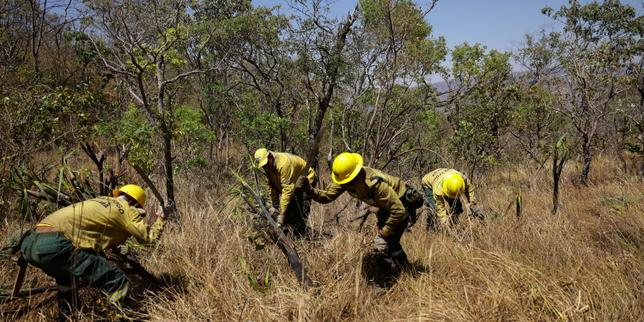
Federal agencies now hire and train indigenous fire brigades directly. IBAMA hires local residents, equips them with professional gear, and coordinates controlled burns months before the dry season hits its peak.
This program works because it aligns environmental policy with local economic realities. Hiring local residents transforms communities from passive observers or opportunistic land clearers into paid stewards of the territory.
Structural Friction with the Agribusiness Lobby
Policy execution in Brasilia eventually runs into political realities inside the National Congress. The powerful agricultural bloc, known as the bancada ruralista, holds immense legislative leverage and views stringent environmental enforcement as an ideological attack on national sovereignty and economic growth.
The conflict centers on the Brazilian Forest Code. The law mandates that private landowners in the Amazon reserve 80 percent of their property as native forest. In the Cerrado, that requirement drops to 20 or 30 percent.
Agribusiness leaders argue that legally permitted clearing must be clearly separated from criminal land grabbing. When federal agencies apply broad sweeping restrictions or delay environmental permits for legal clearings, they provoke fierce political retaliation in the capital.
Congress has repeatedly pushed back against executive decrees by attempting to weaken the authority of environmental ministries, strip funding from indigenous land demarcation, and pass legislation that pardons historic land seizures. This political tug-of-war creates institutional instability. Every time a new administration takes power, enforcement agencies face radical shifts in direction, budget freezes, or structural reorganizations that disrupt long-term field strategies.
The Missing Economic Infrastructure
You cannot police an area larger than Western Europe using ranger patrols and satellite feeds alone. Lasting success depends on creating a viable economic alternative for the 28 million people who live in the Amazon region.
Right now, an intact tree pays almost nothing to the local resident living next to it. A cut tree converted into pasture land provides immediate cash flow for smallholders and cattle operators.
Federal programs aimed at supporting the bioeconomy remain small compared to traditional credit lines. Subsidies for sustainable harvesting of acai, rubber, and native nuts are dwarfed by the billions poured into conventional livestock financing. Until standing forests offer higher returns per hectare than low-efficiency cattle pasture, enforcement officers will spend decades playing an endless game of whack-a-mole against illegal clearers.
The Land Titling Bottleneck
Unclear land ownership remains the primary driver of illegal burning. Millions of hectares in the Amazon basin exist as unallocated public land.
Criminal syndicates exploit this legal vacuum. They invade public forest, slash the understory, set fire to the remaining timber, and drop cattle onto the ash-fertilized grass. After a few years of grazing, they present forged land titles to claim legal ownership under historic squatter provisions.
Resolving land tenure requires digitizing property registries, verifying claims on the ground, and officially designating unallocated public lands as protected reserves or indigenous territories. Without clear land titles, federal agents cannot determine who to fine when a satellite detects a fire anomaly on a specific plot of land.
Climate Offsets and Global Accountability
International observers praise reform efforts, yet foreign consumption patterns continue to drive the economic pressures behind land conversion.
Global demand for beef, soy, and leather provides the financial incentive for pasture expansion. While European legislation now restricts the import of commodities linked to recent deforestation, execution remains fraught with supply chain loopholes.
Cattle laundering is widespread. A rancher can raise calves on illegally cleared, burned forest land in an embargoed zone, then truck those animals to a legal, registered property weeks before sale. The final meatpacking processor scans the legal farm's paperwork, marks the product clean, and exports it to global markets.
Plugging these gaps requires full supply chain traceability from birth to slaughter, a standard that major commercial meatpackers have delayed implementing for years due to logistical complexity and pushback from ranching suppliers.
A fragile Equilibrium Resting on Thin Ice
The current reduction in burning shows that state intervention can slow destruction when political will meets proper funding. Re-establishing law enforcement presence, empowering indigenous fire teams, and using financial embargoes neutralized the immediate threat of runaway, unchecked clearing.
Yet this equilibrium is dangerously fragile.
It relies on executive orders that can be rewritten by future administrations, operating in a region where climate change is actively reducing natural resilience. A single prolonged El Niño event can dry out the canopy so severely that even the best-funded enforcement agencies cannot stop the resulting blazes.
Brazil has demonstrated that it knows how to halt the human spark. The unresolved question is whether it can fix the underlying economic and legal systems before the drying climate renders human efforts irrelevant.