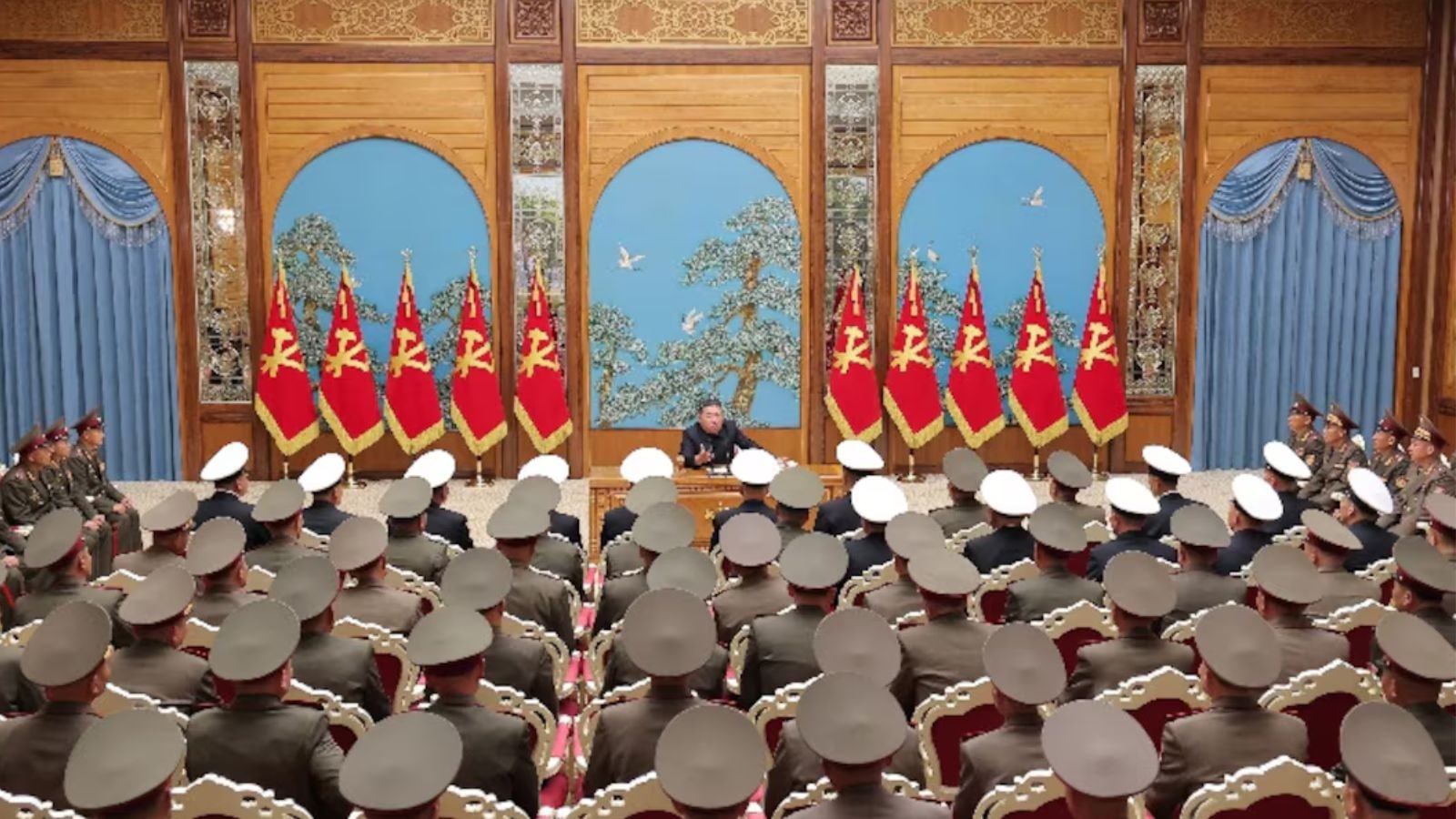
North Korean leader Kim Jong Un has ordered his military to transform the country’s southern border into an impregnable fortress, signaling a permanent break from decades of nominal reunification policy. In a rare, high-stakes gathering of division and brigade commanders in Pyongyang, Kim demanded a complete restructuring of frontline combat doctrines to prepare for a multi-domain war. This directive follows months of physical wall-building along the Demilitarized Zone. By framing South Korea as the permanent archenemy, the regime is transitioning from a defensive posture into an active, modernized state of confrontation shaped by lessons from contemporary global battlefields.
The First Line Reconstruction
The meeting in Pyongyang marks the first time Kim Jong Un has gathered battlefield commanders at this operational level since he took power. This was not a routine ideological lecture. It was a tactical reset for the officers who control the actual firepower on the ground.
For decades, the Korean border was defined by the threat of massed artillery and conventional infantry breakthroughs. That era is over. The orders handed down to the commanders emphasize a total overhaul of the military training system to match the realities of modern conflict.
The physical reality on the border matches the rhetoric. South Korean intelligence tracking shows that North Korean troops have been building concrete walls, installing fresh barbed wire, and digging anti-tank trenches at an accelerated pace since March. This construction is happening right up to the edge of the land border, altering the topography of the world’s most heavily armed frontier.
The Ghosts of Ukraine and Gaza
The timing of this fortification effort is not accidental. Pyongyang has spent the last two years supplying artillery ammunition, ballistic missiles, and thousands of frontline troops to aid Russia in Ukraine. That deployment was not just a transactional arrangement for cash and technology. It was an educational laboratory for the North Korean military.
The phrase operations in all spheres used by Kim during the commander summit reveals a deep anxiety over how fast warfare has evolved. North Korean planners have watched the battlefields of Eastern Europe and the Middle East, noting how cheap drones can bypass massive conventional fortifications and how electronic warfare can blind sophisticated command networks.
The restructuring ordered by Kim targets these specific vulnerabilities.
- Drone Integration: Reorganizing frontline units to utilize small reconnaissance and strike drones, moving away from reliance on heavy armor.
- Electronic Warfare (EW): Hardening communication networks against GPS jamming and signals intelligence, an area where South Korea and the United States hold a massive technological advantage.
- Precision Countermeasures: Repositioning artillery and missile batteries to survive first-strike precision munitions by embedding them deeper into subterranean networks.
The fortress Kim is building is not just made of concrete. It is a digital and electronic shield designed to protect a massive, low-tech military from high-tech, precise liquidation.
The Maritime Expansion Threat
While international attention focuses on the visible walls rising along the land border, a far more dangerous escalation is brewing at sea. Security analysts in Seoul warn that Kim's directive regarding the southern border applies directly to the disputed maritime boundaries.
The Northern Limit Line (NLL) in the West Sea has long been the most volatile flashpoint on the peninsula. It is a boundary that Pyongyang has never officially recognized. By declaring the border an absolute frontier, North Korea is setting the stage for a dramatic increase in naval fortifications and coastal missile deployments near these disputed waters.
A hypothetical clash in these waters remains the highest risk scenario for open conflict. If North Korea deploys newly manufactured anti-ship cruise missiles to fortified island bases just north of the NLL, any routine patrol by the South Korean navy could trigger an immediate, lethal exchange.
Erasing the Myth of Unification
The military shift mirrors a profound political mutation within the regime. Earlier this month, North Korea quietly removed all references to peaceful unification and shared statehood from its constitution. The narrative that the two Koreas are estranged siblings destined to reunite has been formally executed.
This ideological purge serves a domestic purpose. The Kim regime cannot easily justify its extreme economic deprivation or its massive spending on nuclear infrastructure if the enemy across the border is viewed as a relative. By transforming the border into an impenetrable wall, Kim is visually reinforcing the message to his domestic population that South Korea is an alien, hostile entity.
The transition from a border of separation to an impregnable fortress removes the political ambiguity that managed the conflict for seventy years. There is no longer a diplomatic track toward integration.
The military units stationed along the border are no longer gatekeepers waiting for a political resolution. They are now permanently deployed on the front lines of an ideological and military blockade that Pyongyang intends to maintain indefinitely. The walls going up in the DMZ are the physical manifestation of a regime that has decided its survival depends on total, permanent isolation from the modern world.