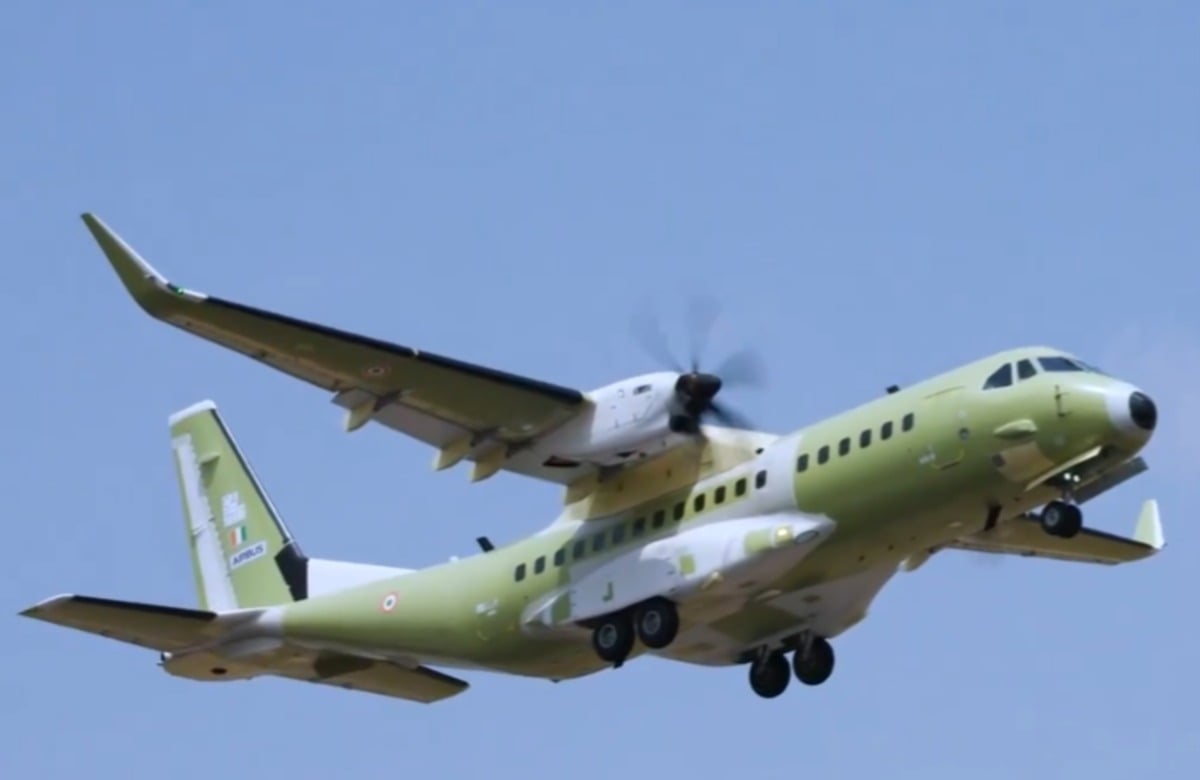
The maiden test flight of the first locally assembled Airbus C295 military transport aircraft from the Tata Advanced Systems facility in Vadodara marks a definitive structural break in how India builds military hardware. This flight from the Gujarat assembly line introduces the first military aircraft manufactured entirely within the private sector in a country historically dependent on state-run monopolies. For decades, the state owned Hindustan Aeronautics Limited held an absolute monopoly on everything from license-built MiGs to indigenous fighters, frequently resulting in bureaucratic delays and missed production timelines.
The successful flight of the twin-engine turboprop satisfies the primary industrial objective of the 2021 agreement between New Delhi and Airbus. Under the $3.5 billion contract, Airbus agreed to supply 16 aircraft directly from its Seville assembly line in Spain, while the remaining 40 units must be manufactured and integrated domestically. The local rollout, completed well ahead of the scheduled September target, demonstrates that private capital can execute complex aerospace integration under tight constraints.
Yet, looking past the official celebrations reveals a much more complicated reality. Assembling an aircraft from a kit of foreign parts is not the same as designing, engineering, and manufacturing one from scratch.
The Illusion of Absolute Autonomy
The political rhetoric surrounding the flight frequently utilizes terms like total self-reliance. The industrial reality is far more nuanced. The C295 project relies heavily on deep global supply chains for its most critical high-value components.
- Propulsion: The aircraft relies on twin Pratt & Whitney Canada PW127G turboprop engines.
- Avionics: The complex flight decks, digital displays, and primary flight management computers are sourced from specialized global original equipment manufacturers.
- Raw Materials: High-grade aerospace aluminum and specialized composite structures are largely imported to satisfy stringent international certifications.
What Tata is executing in Vadodara is a masterclass in industrial integration and assembly rather than foundational creation. Sourcing 13,400 detail parts and 4,600 sub-assemblies domestically sounds impressive. However, the intellectual property governing the aircraft design, aerodynamic profiles, and engine performance remains firmly held in Europe and North America. If those external supply chains fracture due to geopolitical instability, the assembly line in Gujarat halts.
This is the standard trajectory for developing aerospace nations. India is currently occupying the middle tier of this evolutionary ladder. It has successfully moved past importing fully built platforms to mastering advanced assembly, structural manufacturing, and local systems integration, including the implementation of domestic electronic warfare suites from Bharat Electronics and Bharat Dynamics.
Dismantling the Public Sector Monopoly
The real disruption here is structural and economic rather than purely technical. By proving that a private consortium can build, test, and fly a military transport platform on schedule, the project shatters the long-standing justification for state-run defense public sector undertakings.
Hindustan Aeronautics Limited has historically struggled with production backlogs and cost overruns. The private sector operates under different capital dynamics. Tata must answer to corporate governance, balance sheets, and strict contractual penalties. The rapid progress of the Vadodara facility proves that private management can bypass the bureaucratic inertia that traditionally slows down state-run defense programs.
This operational efficiency will inevitably spark intense institutional rivalry. The Indian Air Force is already eyeing its next major acquisition: the Medium Transport Aircraft program, which requires a platform with a 20-tonne payload capacity to replace aging Soviet-era Antonov An-32 fleets.
With the C295 infrastructure now fully operational, Tata possesses a major competitive advantage. The firm can argue that expanding the existing facility to handle larger platforms is far more economical than funding a new state-run program from scratch.
The Long-Term Maintenance and Scale Problem
Manufacturing 40 transport aircraft for the Indian Air Force does not provide enough long-term volume to sustain an advanced aerospace ecosystem on its own. Production lines require continuous orders to remain profitable once the initial contract concludes in 2031.
New Delhi is already attempting to solve this scaling problem by expanding the program's scope. The government recently approved an additional $3.1 billion procurement of 15 more C295 platforms.
+---------------------+-------------------+-----------------------------------+
| Military Branch     | Fleet Size (Est.) | Primary Operational Role          |
+---------------------+-------------------+-----------------------------------+
| Indian Air Force    | 56 Units          | Tactical Airlift & Troop Transport|
| Indian Navy         | 9 Units           | Maritime Reconnaissance           |
| Indian Coast Guard  | 6 Units           | Multi-Mission Maritime Patrol     |
+---------------------+-------------------+-----------------------------------+
This domestic expansion provides immediate breathing room, but the true test of sustainability lies in international exports and commercial services. Airbus and Tata intend to develop the Vadodara cluster into a regional Maintenance, Repair, and Overhaul hub.
An aircraft spends decades in active service. The real revenue in aerospace is not generated during initial assembly; it is made during the thirty years of subsequent maintenance, component overhauls, and structural upgrades. If the domestic partnership fails to capture the regional market for servicing foreign C295 fleets, the facility risks becoming an expensive, underutilized asset once the domestic military order book is filled.
The Hard Reality Facing Indian Aerospace
The successful flight from the Vadodara final assembly line confirms that the private sector can handle advanced military aviation logistics. It proves that local workers can drill, rivet, wire, and test sophisticated platforms to strict international standards.
However, true defense independence requires developing indigenous design capabilities. Until an Indian engineering firm can design a clean-sheet military engine or develop proprietary flight-control laws without foreign assistance, the nation remains a sophisticated assembler of other countries' intellectual triumphs. The flight in Gujarat is a major step forward, but the climb to true aerospace autonomy is still in its early stages.