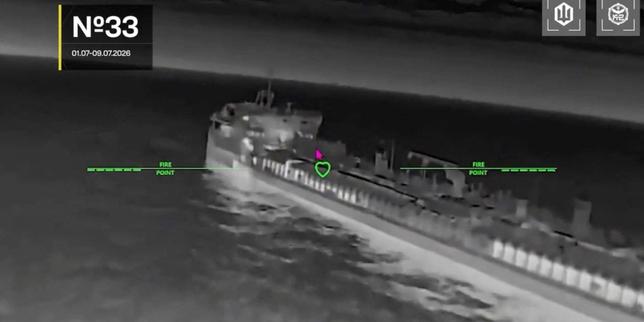
Ukraine is systematically expanding its strike zone into the Sea of Azov to sever Russia's southern military supply lines, forcing Moscow to rely on vulnerable, incomplete continental rail lines instead of secure maritime transport. This shift exposes the fragility of Russia's inland empire. By targeting port facilities, ferries, and logistics vessels in what Moscow long considered its secure backyard, Kyiv is systematically dismantling the logistics keeping the southern Russian front alive.
For nearly two years, the Kremlin treated the Sea of Azov as an untouchable sanctuary. Following the fall of Mariupol, the body of water was effectively rebranded as an internal Russian lake. Warships operated with impunity, and commercial vessels repurposed for military transport shuttled heavy armor, ammunition, and fuel between Russian ports like Yeysk and Taganrog and the occupied hubs of Berdiansk and Mariupol. That impunity has evaporated.
Kyiv has realized that neutralizing the Black Sea Fleet in western Crimea was only the first phase of a much larger maritime campaign. To truly isolate the southern front, the battle had to move east into the shallow, heavily defended waters of the Azov.
The Illusion of the Closed Russian Lake
Geography should have favored Russia. The Sea of Azov is exceptionally shallow, with an average depth of just nine meters, and its access is tightly controlled by the Kerch Strait. After the installation of heavy air defense batteries, electronic warfare jamming stations, and physical barriers around the Kerch Bridge, Moscow assumed the basin was impenetrable to Ukrainian asymmetric attacks.
They were wrong.
Ukraine began testing these defenses not with grand naval engagements, but with coordinated, multi-domain strikes using modified Neptune anti-ship missiles, long-range attack drones, and covert reconnaissance. The objective was never to sink the entire Russian fleet in a single afternoon. Instead, the strategy focuses on incremental denial of service. By making the waters too hazardous for large-scale military transport, Ukraine forces Russia to re-route its critical supplies.
This is a classic campaign of logistical strangulation. Without the ability to freely use the ports of Berdiansk and Mariupol, the Russian military is forced to depend on overland routes that run dangerously close to the front lines. The maritime shortcut is dying, and with it, the predictable flow of heavy artillery ammunition to the Zaporizhzhia and Kherson sectors.
The Crucial Maritime Arteries Keeping the Southern Front Alive
To understand why the Sea of Azov is so vital, one must look at the math of military logistics. A single medium-sized cargo vessel can carry thousands of tons of ammunition. To move that same volume by road requires hundreds of trucks, drivers, fuel, and maintenance assets that the Russian military can ill afford to spare from the front lines.
Why Port Terminals Matter Far More Than Cruisers
In traditional naval warfare, the focus remains on warships. In an industrial war of attrition, however, the target is the crane, the fuel terminal, and the railway siding. Ukraine has shifted its targeting priorities accordingly.
- Berdiansk Port Infrastructure: This port serves as the primary receiving dock for heavy military hardware destined for the Zaporizhzhia front. Attacks here do not just destroy cargo; they damage the specialized cranes required to unload heavy armor from cargo ships.
- Mariupol Harbor Siding: The connection between the docks and the regional rail network is a critical bottleneck. Disrupting this junction halts the movement of supplies before they can even leave the coast.
- The Yeysk Ferry Terminals: Situated on the eastern, Russian shore of the Sea of Azov, these terminals facilitate the movement of fuel tanker rail cars directly across the sea, bypassing the vulnerable Kerch Bridge entirely.
When Ukrainian forces struck the ferry Slavyanin in the port of Kavkaz, they were not just targeting a vessel. They were attacking a highly specialized logistics link. Russia only possessed a handful of these railway ferries capable of transporting bulk fuel and hazardous explosives across the strait. Replacing them is nearly impossible under the current sanctions regime.
The loss of these specialized vessels creates an immediate crisis for Russian quartermasters. Fuel must now be moved via the Kerch rail bridge, which remains under constant threat of strike, or through the occupied land bridge in southern Ukraine, where partisan activity and long-range rocket artillery make transit a high-stakes gamble.
The Engineering Dilemma of Shallow Water Warfare
The Sea of Azov presents a unique set of tactical challenges for both sides. It is a highly restrictive operating environment. The lack of depth means that traditional submarine operations are impossible, and even larger surface combatants must stick to dredged shipping channels to avoid running aground.
Navigating the Mud and Shallows of the Azov Basin
For Ukraine, the lack of deep water makes the deployment of its highly successful Magura V5 and Sea Baby uncrewed surface vessels (USVs) far more difficult than in the open Black Sea. In deep water, a low-profile drone can blend into the waves and approach a target undetected. In the shallow, often calm waters of the Azov, these vessels are easier to spot visually and via coastal radar.
To overcome this, Ukrainian planners have had to adapt. They use weather conditions as cover, launching operations during heavy storms that degrade Russian optical sensors. Additionally, they have integrated electronic warfare countermeasures directly onto the drones to jam the Russian thermal imaging and radio-frequency detection systems lined along the coast.
Furthermore, Ukraine has increasingly relied on air-launched and ground-launched missile systems to project power into the Azov. By using decoy drones to saturate Russian air defense systems like the S-400 and Pantsir-S1, Ukraine creates brief windows of vulnerability. It is during these precise windows that weapons like the Neptune or Western-supplied cruise missiles are slipped through the defensive umbrella to strike static port facilities.
The High Stakes Railway Race Across the Occupied South
The Kremlin is not passive in the face of these maritime disruptions. Recognizing that their maritime logistics chain is highly vulnerable, Russian engineers have spent the last year frantically constructing a brand-new railway line. This railway runs from Rostov-on-Don through the occupied cities of Mariupol, Berdiansk, and Yakymivka, eventually connecting directly to Crimea.
The construction of this railway is a direct admission of failure. It proves that Moscow no longer believes it can guarantee the security of either the Kerch Bridge or the Sea of Azov shipping lanes.
Yet, this land-based alternative is hardly a safe haven. A railway line is a static, highly visible target. It cannot dodge a missile, and its tracks can be severed by simple partisan sabotage. While rails can be repaired quickly, bridges, electrical substations, and locomotives cannot. By forcing Russia off the water and onto the tracks, Ukraine is bringing the Russian logistical tail within range of a wider variety of its strike assets, including HIMARS and precision tube artillery.
A War of Attrition Built on Concrete and Diesel
The campaign for the Sea of Azov is not about spectacular naval battles or heroic fleet engagements. It is a slow, grinding war of attrition focused on concrete, steel, and diesel fuel.
By systematically attacking the ports, ferries, and vessels that make up Russia’s maritime logistics network, Ukraine is slowly suffocating the defensive forces in the south. The strategy relies on a cold calculation. If you make it impossible for the enemy to feed their artillery and fuel their tanks, the defensive lines will eventually crumble from within, regardless of how many concrete bunkers they build.
This maritime push is a high-stakes gamble for Kyiv, consuming scarce precision munitions and drone assets that are desperately needed elsewhere. But if they succeed in permanently closing the Sea of Azov to Russian military traffic, the entire southern defensive strategy of the Russian federation will face an existential logistical crisis that no amount of infantry can resolve.