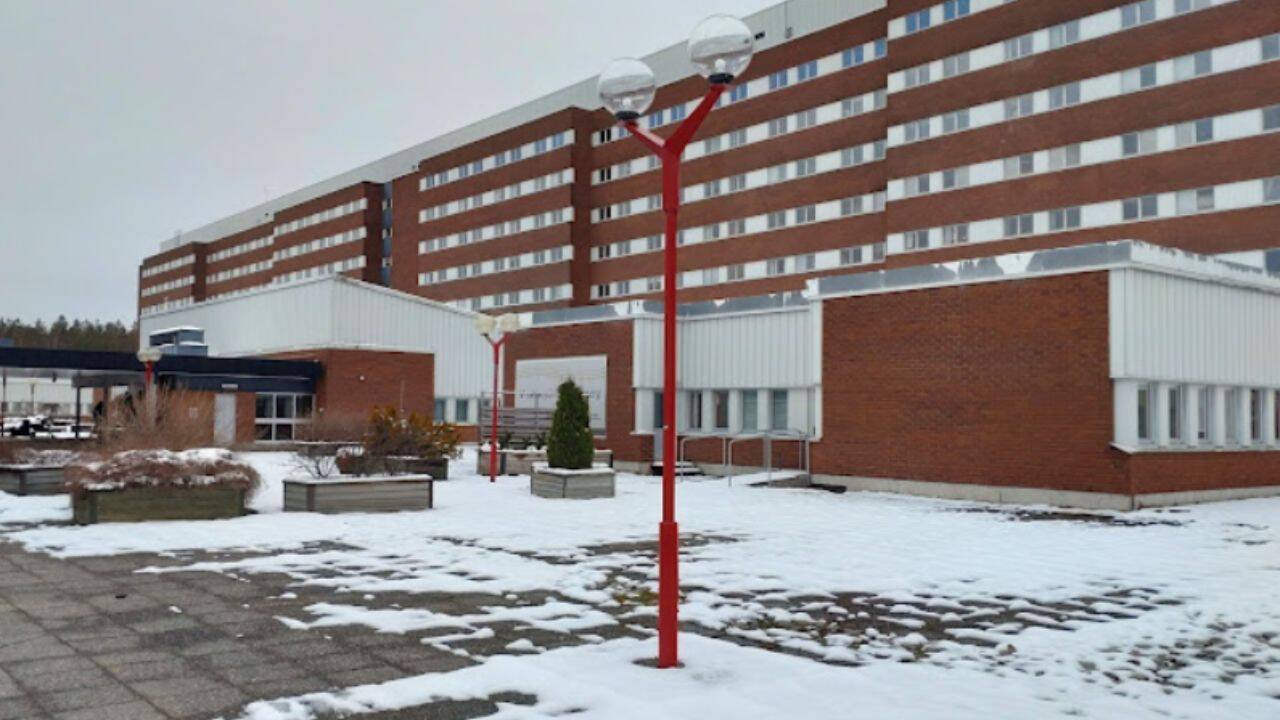
The Sundsvall Regional Hospital in central Sweden solved its summer climate control crisis by dumping tens of thousands of cubic meters of winter snow into an asphalt-lined pit and burying it beneath a heavy blanket of wood chips.
When July temperatures climb, this frozen reserve melts slowly, providing chilled water that circulates through the sprawling 190,000-square-meter facility to absorb indoor heat before returning to the pit. It is an elegant engineering feedback loop that supplied roughly ninety-three percent of the complex's total cooling demand during its initial operational phase. Yet, beneath the environmental romance of turning winter blizzards into summer air conditioning lies a punishing reality of civil engineering constraints, thermodynamic loss, and logistical limits that explain why this method remains a rare architectural anomaly rather than a blueprint for global urban planning.
Standard commercial cooling relies on vapor-compression chillers. These machines burn massive quantities of electrical power to manipulate refrigerant gases, rejecting waste heat into the local atmosphere and compounding urban heat island effects. Hospitals face an acute version of this burden. They operate continuously, house vulnerable populations sensitive to thermal swings, and require strict indoor air sanitation.
When researchers at Luleå University of Technology evaluated the Sundsvall facility, they confronted the hard numbers of the climate ledger. The hospital required roughly one thousand megawatt-hours of annual cooling energy, peaking at a power demand of fifteen hundred kilowatts. Traditional chillers would have locked the institution into decades of volatile electricity pricing and heavy grid dependence. Instead, engineers turned to the latent heat of fusion.
Phase change is the secret weapon of seasonal thermal energy storage. Water requires a staggering amount of thermal energy to transition from solid ice at zero degrees Celsius to liquid water at that same exact temperature. By exploiting this physical property, the system absorbs ambient building heat not merely by warming a liquid, but by forcing a structural phase change.
The Thermodynamics of Burial
Physics offers no free lunches. Without aggressive thermal insulation, a massive pile of snow exposed to summer air vanishes by mid-June, completely failing to cover the cooling season.
Engineers at Sundsvall tackled this vulnerability by covering a sixty-thousand-cubic-meter storage basin with wood chips. This organic blanket acts as a thermal barrier, dampening conductive heat transfer from the atmosphere while allowing moisture evaporation to help dissipate incoming thermal loads. Simulations demonstrated that uninsulated piles collapsed under their own environmental exposure weeks before peak hospital demand. A proper layer of sawdust or wood chips cuts natural melt rates down to twenty or thirty percent of the total volume.
The meltwater is pumped through plate heat exchangers, keeping the closed hospital loop separate from the raw water circulating through the dirty snowpack. The warmed water returns to the basin, accelerating the controlled melting of the remaining snow bed.
However, running a seasonal storage facility exposes deep operational friction. Logistics present the first major hurdle. Cities generate millions of tons of snow during winter plowing operations, but urban snow is rarely pristine. It comes contaminated with heavy metals, automotive rubber residue, road salt, and particulate grit. Dumping untreated urban runoff directly into a sensitive ecological basin or a closed industrial loop destroys pumps and fouls heat exchangers. Sundsvall relied heavily on clean natural precipitation and targeted artificial snow production to keep the storage pit viable, introducing secondary energy and water treatment costs that rarely make the promotional brochures.
Spatial Footprints and Urban Realities
Consider the geography. Storing forty thousand metric tons of snow requires substantial physical territory. The Sundsvall pit spans an expansive footprint, demanding dedicated land allocation right next to or within reasonable pumping distance of the facility.
In dense metropolitan cores where real estate commands astronomical sums per square meter, dedicating acres of surface land to a giant melting snow bank is an economic non-starter. Hospitals in downtown districts cannot carve out massive open-air asphalt ponds. Underground rock caverns offer an alternative, but excavation costs multiply exponentially, stretching financial payback periods far beyond what modern corporate or municipal accountants will tolerate.
Furthermore, climate volatility undercuts the reliability of the entire model. Seasonal snow storage depends on a predictable, recurring winter freeze. As global weather patterns shift toward erratic temperature oscillations, relying on consistent local snowfall becomes an operational gamble. A mild winter with intermittent precipitation leaves storage pits half-empty, forcing facility managers to scramble for expensive backup conventional chillers anyway. The infrastructure demands a cold climate heritage to function natively. Trying to retrofit this architecture onto a hospital in a temperate or subtropical zone introduces impossible thermodynamic penalties.
The Economics of Long-Term Retrospect
Skeptics often point out that traditional HVAC technology has advanced significantly in efficiency, variable-speed compressor design, and heat recovery capabilities. Modern magnetic-bearing chillers achieve high coefficients of performance without requiring football-field-sized wood-chip-covered snow storage basins.
When capital expenditure, long-term maintenance of the watertight basin liners, wood chip replacement cycles, and land opportunity costs are factored into the financial equation, seasonal snow storage rarely wins on a simple cost-per-kilowatt-hour basis. It survives primarily where municipal waste snow disposal aligns perfectly with institutional cooling loads, creating a localized loop of convenience rather than a universally scalable industrial standard.
The installation stands as a monument to clever multidisciplinary resourcefulness. It proves that humanity can step outside the closed loop of electrical refrigeration by reading the physical landscape correctly and weaponizing the phase change of water. Yet it also serves as a stark reminder that retrofitting ancient low-density energy concepts onto modern high-density infrastructure requires immense physical space, meticulous maintenance, and geographic luck.
The snow eventually melts, the wood chips rot down into mulch, and the annual cycle must begin anew under a narrowing window of reliable winter weather.