You think you know how bad child neglect can get, and then a case breaks that completely resets the baseline of human horror.
In Hamden, a tiny, quiet village of fewer than 1,000 people tucked away in rural southeastern Ohio, police walked into a house expecting to execute a routine, unrelated search warrant. Instead, they stumbled into what Ohio Attorney General Andy Wilson called "pure evil." Meanwhile, you can read other events here: Why the India Japan Strategic Alliance Just Shifted Into High Gear.
Inside a single, waste-covered 12-by-12-foot room, four adults had hidden 16 children away from the world for the better part of four years. The kids, ranging from an 18-month-old infant to an 18-year-old adult, didn't just look neglected. Authorities described them as looking like "almost feral animals." Some couldn't speak. An 18-year-old with developmental disabilities couldn't spell or write her own name.
If police hadn't walked through that door when they did, things would have turned fatal fast. Wilson bluntly admitted that if they had waited just 24 hours longer, they would likely be handling a mass death investigation. To explore the full picture, we recommend the recent article by USA Today.
This isn't just a story about monsters living down the street. It is a stark look at exactly how easy it is for an abusive family to slip through every single safety net society has built.
Inside the 12-by-12 Room in Vinton County
Let's look at the actual physics of this nightmare. A 12-by-12-foot space is roughly 144 square feet. That is smaller than a standard two-car garage. Cramming 16 growing human beings into that space means there was literally no room to move, let alone live.
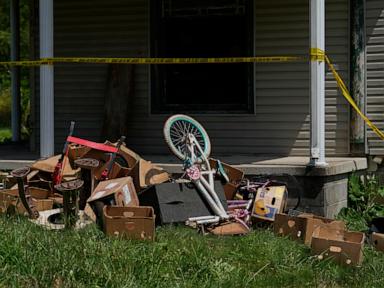
Vinton County Sheriff Ryan Cain noted that the home had an incredibly high presence of bacteria and human feces. There were no cages, but the confinement was absolute. The doors and windows of the dilapidated house stood wide open to the sweltering July heat when investigators processed the scene, revealing a yard littered with busted plastic toys, tires, and infant carriers. Inside, the stench was so overwhelming that the Attorney General reported he couldn't wash the smell off his skin a full day later.
Medical personnel had to act immediately. Seven children were rushed by ambulance to hospitals in Columbus, while two others were airlifted by helicopter to level-one trauma centers. One child had to be intubated and remained in critical condition.
The four adults responsible—Gary Siders Sr. (73), Gary Siders Jr. (36), Christina Siders (67), and Elizabeth Siders (33)—represented three generations of the same family: grandparents, a mother, and a father. They have all been hit with 16 counts of second-degree felony child endangerment, carrying a $300,000 bond each. They entered pleas of not guilty.
While internet rumors immediately started screaming about a massive human trafficking ring, prosecutors clarified this was an "intra-family situation." It wasn't an organized ring; it was a generational cycle of severe domestic abuse.
How do 16 kids completely vanish from the grid
The biggest question everyone asks when a case like this hits the headlines is simple: How did nobody notice?
Hamden is located in Vinton County, which is consistently ranked as one of the poorest, most isolated counties in Ohio. It is heavily forested, sparsely populated, and economically depressed. But geography alone isn't enough to hide 16 children.
The Siders family managed this by running a highly deliberate, off-the-grid operation. Investigators revealed that the family had moved across various pockets of southern Ohio for over two decades. Each time they relocated, they ensured they left absolutely no paper trail.
- No school records: None of the 16 children were ever enrolled in public school, nor were they registered for legal homeschooling.
- No medical footprints: The kids were never taken to doctors, clinics, or dentists. There were no birth notifications or pediatric charts for the younger ones.
- No government assistance trails: The family actively avoided programs that required home visits or verifiable dependent data.
Neighbors who lived just three houses down for years reported seeing zero children on the property. The house sat near a steep railroad embankment, shielded by thick brush and trees. The family simply kept the kids entirely indoors, out of sight, and away from any nosey neighbors or local authorities.
The terrifying reality of feral child recovery
When a child grows up in total isolation without human interaction or environmental stimulation, the damage isn't just emotional—it alters their brain biology. This is known in psychology as severe psychosocial dwarfism and environmental deprivation.
When the brain misses the critical windows for language development during early childhood, rebuilding those paths is incredibly difficult. The fact that several of the older Siders children cannot speak means therapists and medical staff are starting from less than scratch. They aren't just dealing with trauma; they're dealing with profoundly altered developmental tracks.
The state of Ohio has taken temporary custody of all 16 survivors through the Department of Children and Youth. Their immediate future looks like a long, grueling gauntlet of intensive medical care, deep psychological rehabilitation, and basic life-skills training.
The massive gaps in state tracking systems
The uncomfortable truth about the Ohio case is that our child protection systems are entirely reactive. They rely heavily on someone making a phone call.
If a child is never enrolled in school, never visits a hospital, and the parents move constantly to evade local communities, the system has no trigger mechanism to realize that child even exists. Truancy laws only kick in if a child is registered in a district and stops showing up. Mandated reporters like teachers and doctors can't flag abuse if they never see the victim.
To prevent situations like this, state agencies would need a centralized, cross-state tracking system that flags households moving frequently without any corresponding educational or medical updates. Until policy shifts toward proactive tracking rather than waiting for a tip or an accidental police discovery, isolated families will keep finding ways to stay invisible.
If you suspect a child in your community is suffering from severe neglect or abuse, don't assume someone else has already called it in. You can contact the National Child Abuse Hotline at 1-800-422-4453 to report suspicious activity completely anonymously. Your phone call might be the only lifeline a hidden child gets.