The marble of the ancient theater still catches the relentless Mediterranean sun, but the words spoken beneath the old stones carry a different kind of heat.
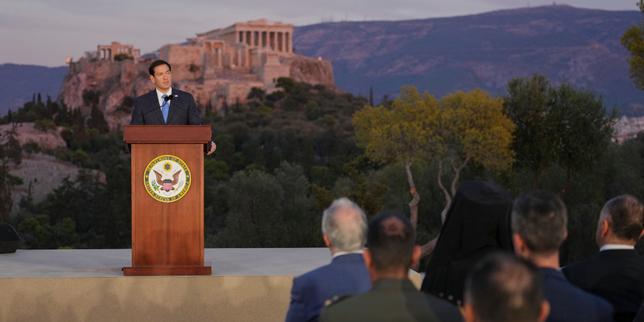
Consider the scene. A podium in Athens. American voices echoing across a continent that has spent the better part of two decades learning how to stumble in the dark. Marco Rubio steps forward, offering a lesson. A blueprint for how things ought to be done. A stern finger pointed across the Atlantic, advising unity, strength, and a steady hand.
It sounds crisp on paper. It plays well in Washington briefing rooms where power is measured in crisp bullet points and polished press releases.
But history is messy. It leaves scabs.
Walk through the streets of Madrid, Paris, or Berlin today, and you will not find eager disciples waiting to copy down the homework. You will find citizens staring at heating bills, small business owners calculating whether next month's taxes will break them, and leaders who remember twenty months of erratic diplomacy, sudden policy shifts, and a transatlantic partnership that often felt less like an alliance and more like a high-stakes weather vane spinning in a hurricane.
A lecture is easy. Consistency is rare.
The Weight of Twenty Months
Imagine standing on a factory floor in northern Italy. The machinery hums a steady, anxious rhythm. The foreman checks the ledger for the third time today, watching the cost of raw materials spike while politicians thousands of miles away trade barbs on television.
To this foreman, the grand speeches about diplomatic alignment sound hollow. Words do not pay for natural gas. Speeches do not stabilize supply chains that were fractured first by a pandemic, then by erratic trade decisions, and finally by political shifts that leave allies guessing which way the wind will blow tomorrow.
Diplomacy requires trust. Trust is built in inches and lost in miles.
When policies pivot overnight based on the domestic political calendar of a single capital, the ripple effect reaches every corner of Europe. Leaders in Athens or Brussels are left trying to glue together a shattered vase while being told they are holding it wrong.
The Rhetoric Versus the Reality
There is a profound disconnect between the high-altitude view from Washington and the cold pavement of European capitals.
The American message delivered in Greece was simple: align, secure, project strength. Yet, the past twenty months have demonstrated a government prone to sudden reversals, mixed signals, and an inward-looking focus that often treats allies as afterthoughts until a crisis forces a sudden, urgent phone call.
It is difficult to preach stability when your own house has spent months rearranging the furniture in the dark.
Think of a pilot telling passengers to remain calm while the cockpit door swings open and the crew argues over the flight plan. That is what European diplomats have felt like watching Washington bounce from one strategic pivot to another, demanding loyalty while offering unpredictability in return.
What Lies Beneath the Marble
History does not forgive amnesia.
When statesmen gather in historic cities to lecture their partners, they forget that Europe has its own scars, its own calculations, and its own hard-won skepticism. The Athenians invented democracy, but they also understood hubris. They knew that telling others how to run their city-states usually backfires when your own walls are showing cracks.
The real challenge facing the West is not a lack of lectures. It is a desperate shortage of listening.
Until leaders on both sides of the ocean can look into the mirror and acknowledge the erratic turns of recent years, no amount of polished rhetoric in ancient theaters will bridge the gap. The stage in Athens was grand. But the audience was looking past the speaker, wondering what tomorrow's headline would bring, and hoping against hope that someone, somewhere, would finally mean what they said.
The sun dips below the horizon, casting long shadows across the ancient stones. The speech is over. The applause fades. And the work of repairing what was broken begins in the quiet, unglamorous hours that follow.