Somewhere in a sun-drenched apartment in North Tehran, a young woman named Elnaz—let us call her that for the sake of the story—is boiling water for tea. The steam rises, blurring the edges of a family photo on the wall. Her father was a teacher; her mother, a nurse. They lived through the 1979 Revolution. They remember the promises of a divine justice that would replace the opulence of the Shah. But Elnaz doesn't live in the past. She lives in a present where the currency in her purse loses value between the time she leaves her apartment and the time she reaches the grocery store.
She represents the fracture.
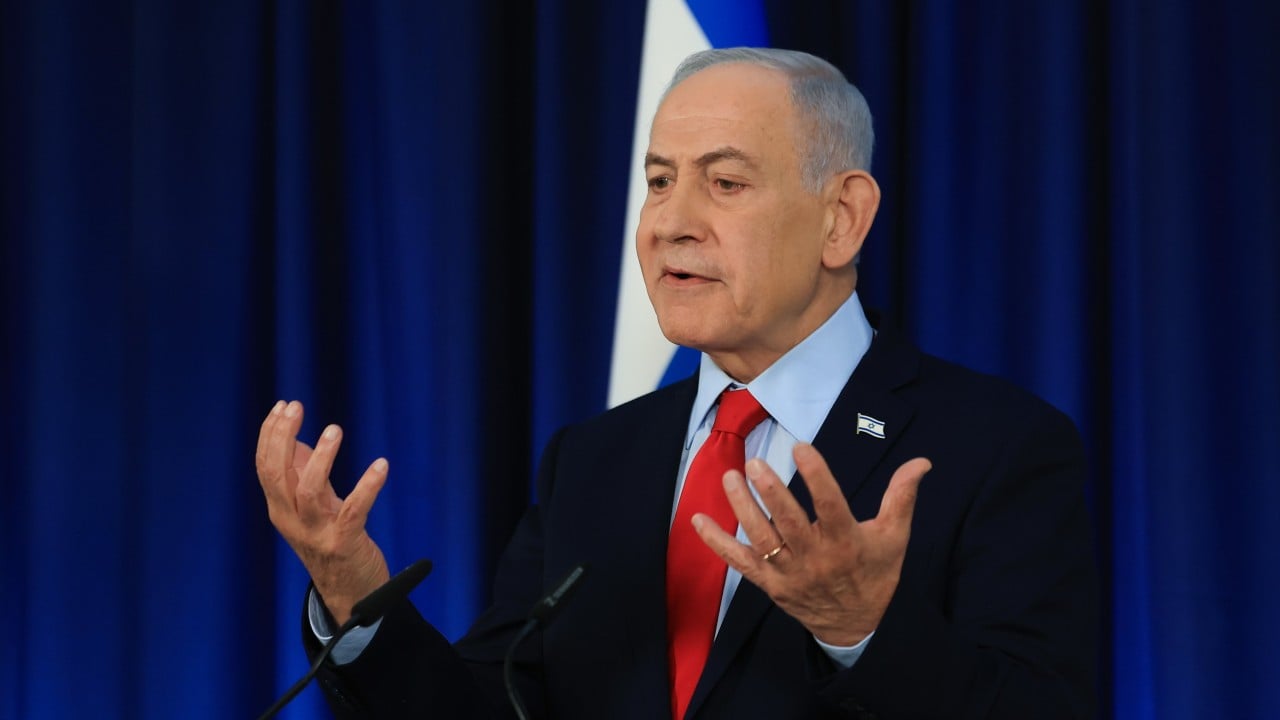
When Benjamin Netanyahu stood before a camera recently to address the Iranian people, he wasn't just delivering a geopolitical warning. He was poking at a crack that has been spreading for forty-five years. He spoke of a regime that spends billions on proxy wars and ballistic missiles while its own citizens wait in line for subsidized eggs. He spoke of a collapse that won't come from a foreign invasion, but from the inside out.
Imagine a dam. From the outside, it looks like a monolith of gray concrete, holding back millions of tons of water with indifferent strength. But deep within the structure, tiny fissures are forming. They aren't caused by the water pressure alone. They are caused by the slow, chemical rot of the rebar. The very thing meant to give the dam its spine is rusting away.
That is the internal state of the Islamic Republic as described by its fiercest regional rival. It is a house divided not just by politics, but by a fundamental disconnect between the rulers and the ruled.
The numbers tell part of the story, though they lack the sting of Elnaz’s reality. Inflation in Iran has hovered near 40% for years. The rial has plummeted against the dollar, turning life savings into the price of a modest dinner. When a government prioritizes the export of an ideology over the import of medicine, the social contract doesn't just bend. It snaps.
Netanyahu’s thesis is simple: the Iranian regime is a paper tiger with a nuclear ambition, but its legs are made of dry clay. He pointed to the "Woman, Life, Freedom" protests that erupted after the death of Mahsa Amini. Those weren't just riots. They were a collective exhale of a generation that has run out of patience. They were a sign that the ideological glue of the 1970s has lost its stickiness in the 2020s.
History is littered with empires that looked invincible a week before they vanished. Consider the Soviet Union in 1988. It had the largest army on earth, a sprawling secret police, and a seat at every major table. Three years later, it was a memory. Why? Because the people stopped believing in the story the state was telling.
The Iranian leadership tells a story of resistance against the "Great Satan." They tell a story of regional hegemony through groups like Hezbollah and Hamas. But Elnaz, watching the steam from her teapot, sees a different story. She sees a country with some of the world’s largest oil reserves where the lights flicker during summer heatwaves. She sees a brilliant, tech-savvy youth population that has to use VPNs just to see what the rest of the world is thinking.
There is a specific kind of exhaustion that sets in when a person realizes their government is more interested in the fate of a border three hundred miles away than the empty shelf in their own kitchen.
The "internal collapse" Netanyahu predicts isn't necessarily a violent coup. Often, these things happen through a process of "social desertion." It’s what happens when the police officer, the soldier, and the bureaucrat look at their own struggling families and realize they have more in common with the protesters than with the aging clerics in the high offices. When the enforcement mechanism of a state loses its will to enforce, the state becomes a ghost.
But let's be honest about the stakes. A cornered animal is at its most dangerous. As the internal pressure mounts, the regime often looks for external enemies to unify a fractured public. This is the delicate dance of the Middle East right now. Every missile fired is an attempt to change the subject. It is a loud noise meant to drown out the quiet, rhythmic tapping of a million hammers hitting the base of the regime's pedestal.
Netanyahu’s message was a psychological operation as much as it was a statement of fact. By speaking directly to the Iranian public, he attempted to bypass the censors and the hardliners. He wanted to remind Elnaz that the world sees her. He wanted to suggest that the billions of dollars currently fueling conflict in Lebanon and Gaza could, in a different world, be fueling the Iranian economy.
Critics argue that such rhetoric is a fantasy, a way for an embattled Israeli Prime Minister to project strength while his own country faces internal divisions. They point out that the Islamic Republic’s security apparatus is vast, loyal, and brutal. They have survived decades of sanctions and multiple waves of unrest. They are experts at survival.
Yet, survival is not the same as stability.
A state that must kill its own children to maintain order is not a state that is winning. It is a state that is terrified. The fear isn't of an F-35 or a cyberattack on a power grid. The fear is of the moment the Iranian people decide they have nothing left to lose.
Think about the architecture of a vault. It is designed to be impenetrable from the outside. You can blast the door, but the walls are thick. However, if the person inside the vault decides to turn the handle, the door swings open with the weight of a feather. This is the "internal collapse" scenario. It is the transition from "we must obey" to "we no longer care."
The invisible stakes are found in the silence of the Iranian majority. For every person shouting in the street, there are a thousand more sitting in their living rooms, watching, waiting, and calculating. They are weighing the risk of a bullet against the certainty of a bleak future.
Netanyahu’s gamble is that the tipping point is closer than the world thinks. He is betting on the idea that the theological passion that fueled the revolution has been replaced by a pragmatic desperation.
If he is right, the map of the Middle East won't be redrawn by diplomats in Geneva or generals in a war room. It will be redrawn by people like Elnaz. It will be redrawn by the father who can't afford his son's tuition and the student who wants to speak her mind without looking over her shoulder.
The regime's greatest weakness isn't its lack of allies or its aging air force. It is the fact that it has become a stranger to its own people. It speaks a language of martyrdom to a generation that wants to live. It offers a paradise in the afterlife to a population that would settle for a stable job and a free press in this one.
As the sun sets over the Alborz Mountains, casting long, purple shadows over the concrete sprawl of Tehran, the lights begin to flicker on. From a distance, the city looks peaceful, even permanent. But look closer.
Listen to the conversations in the taxis. Listen to the music played quietly in the cafes. There is a vibration there. It is the sound of a foundation settling. It is the sound of a structure that has been under tension for too long, reaching the limit of what its materials can bear.
The glass hasn't shattered yet. But the air is cold, and the pressure is rising, and everyone—from the Prime Minister in Jerusalem to the tea-drinker in Tehran—knows that once glass begins to spiderweb, there is no way to make it whole again.
The tea is ready. Elnaz pours a cup. She looks out the window at a city she loves and a system she fears. She isn't thinking about geopolitical chess pieces or the rhetoric of foreign leaders. She is thinking about the weight of the air. She is thinking about how long a person can hold their breath before they have to scream.