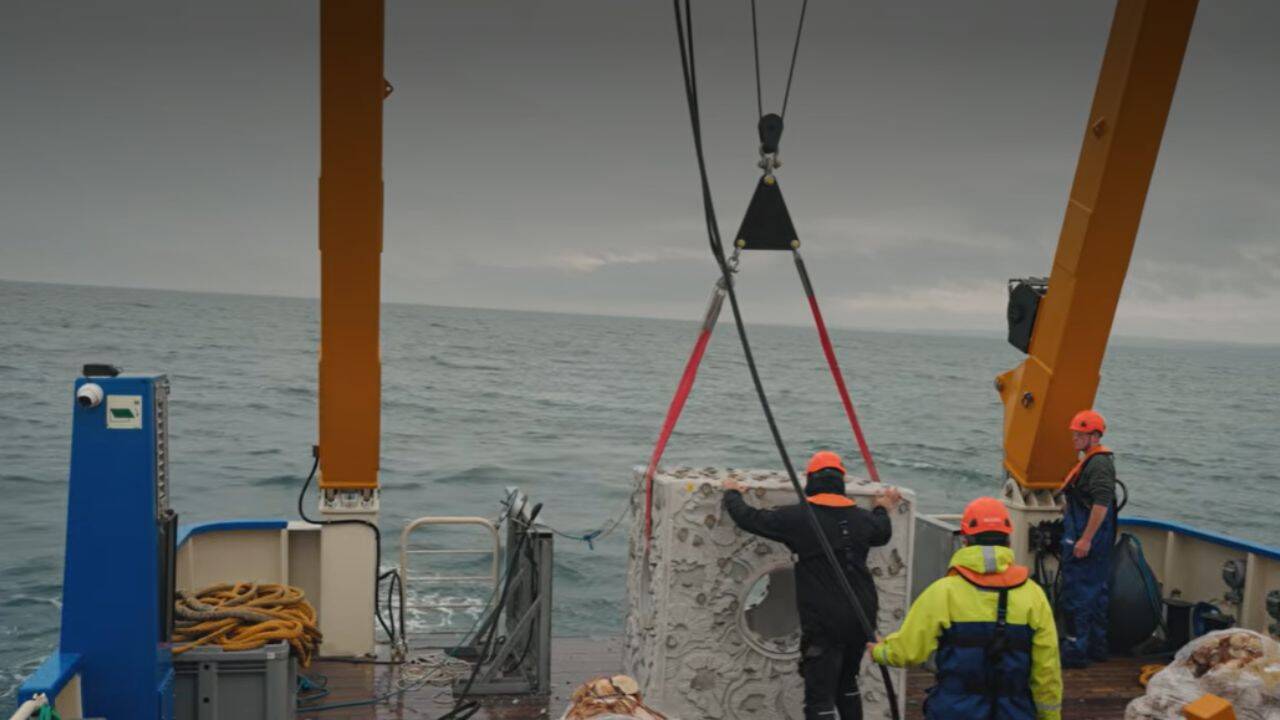
Britain is dropping 20 concrete reef cubes and 44 tons of scallop shells into the sea off its coast to resurrect a collapsed native ecosystem. It sounds like an eccentric experiment born out of desperation. It is.
Centuries ago, the European flat oyster (Ostrea edulis) formed sprawling, living reefs across British coastal waters, filtering vast volumes of seawater and stabilizing the seabed. Then came the industrial harvesting, the dredging, the diseases, and the relentless coastal degradation. Today, more than 95 percent of Britain's historic native oyster habitats are gone. They are functionally extinct in many areas where they once crowded the seabed by the millions. For a more detailed analysis into similar topics, we suggest: this related article.
This drop of 20 concrete modules and 44 tons of waste mollusk shells is not a whimsical conservation gesture. It is a calculated, heavy-duty intervention aimed at reversing an ecological collapse that most people do not even realize happened.
The Mechanics of an Underwater Desert
The modern British seabed is largely a biological wasteland compared to what it looked like before mechanized bottom-trawling took over the industry. Centuries of heavy machinery scraping across the ocean floor pulverized complex biogenic reefs. When you destroy a reef, you destroy the physical architecture that marine life depends on. For additional background on this topic, in-depth reporting can also be found on NBC News.
Oysters are not passive creatures sitting quietly in the mud. They are ecosystem engineers. A single adult oyster can filter up to 200 liters of water a day, stripping out phytoplankton, sediment, and pollutants, which dramatically improves water clarity. Clearer water allows sunlight to penetrate deeper, fueling seagrass beds and marine vegetation that serve as nurseries for commercial fish stocks like cod, bass, and herring.
Without oysters, the water turns turbid. Silt chokes out delicate benthic organisms. The seabed becomes a monotonous plain of shifting mud where few species can establish a permanent foothold.
This is why dumping heavy materials into the ocean is suddenly considered high-value conservation work. Nature needs a scaffolding to rebuild itself. Without a hard surface, microscopic oyster larvae have nowhere to settle. They drift on the currents until they die, unable to complete their life cycle.
Why Concrete and Scallop Shells Matter
Marine restoration at this scale is essentially civil engineering applied to biology. You cannot just throw vulnerable juvenile oysters onto a muddy bottom and hope for the best. They will suffocate within days.
The deployment relies on two distinct materials serving very specific purposes.
The Reef Cubes
The 20 concrete reef cubes act as the primary structural skeleton. These are engineered modules designed with complex internal cavities, rough exterior textures, and varied angles. They create localized water turbulence, which prevents sediment from settling on the structure while creating micro-habitats where fish, crabs, and lobsters can hide from predators. Concrete provides long-term stability against heavy winter storms and fierce tidal currents that would sweep lighter materials away.
The Scallop Shells
The 44 tons of waste scallop shells serve a chemical and biological function. Oyster larvae are notoriously picky about where they attach. They seek out calcium carbonate surfaces—specifically, the shells of other bivalves. By broadcasting tens of tons of cleaned scallop shells across and around the concrete cubes, conservationists are laying down a thick carpet of ideal settlement substrate.
As the larvae drift through the water column, they detect the chemical signature of the calcium carbonate below. They drop down, cement themselves to the shells, and begin to grow. Over time, living oysters will encrust both the shells and the concrete, fusing the loose material into a solid, growing reef structure.
The Commercial Blind Spot and the Regulatory Reality
The romantic view of marine conservation often portrays it as a battle between pure environmentalists and callous industrialists. The reality on the water is far messier.
Commercial fishing fleets operated in these exact waters for generations, treating the seabed as an endless agricultural field that required no fertilizer or fallow periods. When dredge-fishing targets oyster beds, it does not just catch the target species; it crushes the structural complexity of the reef, turning a three-dimensional habitat into flat rubble.
Restoring these areas requires closing sections of the sea to commercial dredging. Predictably, this triggers fierce pushback from local inshore fishermen whose families have worked the coast for decades. Telling a skipper whose grandfather dredged these bays that he can no longer drag his nets across a specific coordinate because of a microscopic bivalve larva is a fast way to start a localized economic war.
Conservationists have had to learn that you cannot bypass the fishing community. Successful restoration projects require working hand-in-hand with local fishers, often compensating them to help deploy the reef materials or shifting their efforts toward sustainable hook-and-line fishing. If the local economy starves while the oysters thrive, the project will eventually be sabotaged by public resentment or political backlash.
The Limits of Engineered Optimism
Throwing concrete and shells into the sea sounds like a definitive fix, but marine biologists know the limits of hard engineering.
Climate change presents a terrifying variable for cold-water marine species. As global carbon emissions drive up ocean temperatures, British coastal waters are warming at rates that stress native marine life. Higher temperatures can trigger fatal diseases among bivalves, such as the Bonamia parasite that has devastated European flat oyster populations across the continent for decades.
Furthermore, coastal runoff carries agricultural fertilizers, heavy metals, and raw sewage straight into the nearshore environment. An oyster filters everything in the water column. While they are phenomenal at bio-accumulating certain pollutants, high concentrations of chemical toxins can stunt their growth, impair reproduction, or render them unsafe for any future consumption.
A concrete cube cannot stop a marine heatwave. It cannot block an agricultural nitrogen plume running off nearby farmland. Restoring the physical reef is only the first step in a much longer, grinding campaign to clean up the entire watershed that feeds the coast.
The Long Game of Ecological Memory
Ecosystems possess a form of memory, though it fades with every generation of environmental degradation. When a reef dies out completely, the chemical cues, the microbial communities in the sediment, and the complex trophic webs disappear with it.
Projects like the current British deployment are attempts to jump-start that memory. By dropping 20 concrete cubes and 44 tons of scallop shells into the dark, cold waters of the North Sea or the Channel, scientists are buying time and space for a lost world to claw its way back.
It is an expensive, labor-intensive, and fundamentally artificial way to fix a natural system that humans broke in the first place. But when the alternative is a sterile ocean floor devoid of life, a few blocks of concrete and a mountain of discarded restaurant shells look like the most important architecture on Earth.
The larvae are already drifting on the tide, searching for a home in the dark.


