The sky above the old Brétigny-sur-Orge airbase isn't empty. It's screaming with invisible signals. If you walked onto the tarmac of the former Base Aérienne 217 today, your phone might struggle. Your GPS might flicker. That’s because the French drone industry has effectively turned this historic site into a massive laboratory for the messiest, most difficult part of modern combat: electronic warfare.
Military planners finally woke up. For years, the industry focused on how far a drone could fly or how high its camera could zoom. Ukraine changed that math. Now, it doesn't matter how expensive your optics are if a cheap jammer disconnects your pilot or sends your navigation spiraling into a field. Brétigny is where the French drone industry, led by clusters like Cluster Drone Paris Région, goes to prove their tech can actually survive a "contested environment." This isn't a hobbyist meetup. It's a high-stakes effort to make sure French hardware doesn't turn into expensive bricks the second a real adversary flips a switch.
Testing drones in a radio graveyard
Most drone tests happen in "clean" environments. Engineers take a prototype to a quiet field, fly a few laps, and celebrate when it lands safely. That’s useless for a modern soldier. In a real conflict, the spectrum is crowded, hostile, and constantly shifting. At Brétigny, the goal is to break the drone’s brain.
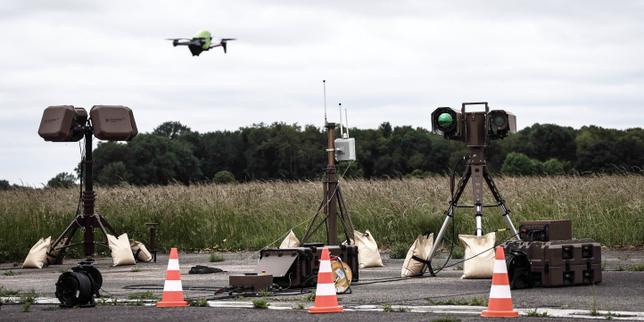
Companies are specifically looking at how their systems handle signal interference. They aren't just flying; they're fighting through layers of noise. I’ve seen how these tests work. You set up a ground station, launch your craft, and then let the electronic warfare teams try to "blind" it. It’s stressful. You see the video feed stutter. You see the latency climb from milliseconds to seconds.
The focus at the Brétigny site isn't just on raw power. It's about resilience. Can the drone automatically switch frequencies when it detects jamming? Does it have internal logic to return home without a GPS signal? If it can't do those two things, it's a toy, not a tool for the Ministry of the Armed Forces. Brétigny provides the physical space—thousands of acres of cleared land—to blast these signals without interfering with civilian flight paths or local Wi-Fi networks too much.
The end of the GPS era for drones
We’ve relied on GPS for too long. It’s a massive vulnerability. At the Brétigny airbase, the most interesting tests involve "denied-GPS" navigation.
If you’re a drone manufacturer today and you don’t have a plan for when the satellites go dark, you’re out of the game. At this testing hub, engineers are Refining visual odometry. This is where the drone uses its cameras to look at the ground, recognize patterns, and calculate its position based on movement rather than coordinates from space. It sounds simple. It’s incredibly hard to do at 80 kilometers per hour while someone is trying to hack your data link.
French firms like Parrot or smaller specialized startups are using these trials to harden their software. They use the long runways and open hangars of the old base to simulate urban canyons or open battlefields. They're testing inertial navigation systems that used to be too heavy for small drones but are now being miniaturized. It’s a race. The jammers get better every week, so the drones have to get smarter every day.
Why the old Base Aérienne 217 is the perfect spot
You can’t just do this anywhere. Try setting up a high-powered signal jammer in the middle of a business park and you’ll have the national frequency agency knocking on your door in twenty minutes. Brétigny offers a unique legal and physical "bubble."
The base has a history. It was the heart of French flight testing for decades. Reclaiming it for drones makes sense. It has the infrastructure: massive hangars for sensitive equipment, clear sightlines for long-range radio tests, and a location close enough to Paris to keep the engineers and bureaucrats happy.
But it’s the collaboration that matters. By concentrating these tests in one spot, different companies stop working in vacuums. A sensor manufacturer might realize their new radar is getting "fried" by a neighbor’s data link. They fix it there, on the tarmac, instead of finding out six months later during a military exercise. This creates a feedback loop that speeds up development. It’s about building a "sovereign" industry—making sure France doesn't have to rely on off-the-shelf Chinese or American tech that might have backdoors or weaknesses we don't control.
The technical hurdles of electronic warfare tests
Electronic warfare isn't just about "jamming" a signal. It’s more subtle. You have spoofing, where you feed the drone fake GPS coordinates to make it think it’s five miles away from its actual location. You have "meaconing," which is the rebroadcast of delayed signals to confuse the timing.
Testing for this requires specialized equipment that most startups can't afford. That’s where the Brétigny hub provides value. They provide the "red team" environment.
- Signal Analyzers: High-end gear to see exactly what’s happening in the air.
- Controlled Interference: The ability to ramp up the noise level gradually to see exactly when a system fails.
- Data Capture: Recording every packet of data to analyze why a connection dropped.
When you see a drone suddenly flip or lose its heading during a test, that’s a win. It’s better to fail in Essonne than in a combat zone.
Modern drones must be software defined
The hardware is almost secondary now. The real battles at Brétigny happen in the code. We’re moving toward Software Defined Radio (SDR) in almost every serious drone platform.
In the past, if a frequency was jammed, you were stuck. With SDR, the drone can realize it's being targeted and shift its entire communication protocol on the fly. It’s like two people talking in a crowded room who suddenly switch from speaking French to speaking a secret code they just made up, all while changing their pitch so the person trying to eavesdrop can't keep up.
The Brétigny trials are pushing these AI-driven radio systems to their limits. They’re testing how much processing power is needed to run these "anti-jamming" algorithms without draining the battery in five minutes. It’s a brutal balancing act. Every gram of weight and every watt of power counts.
Getting your tech on the tarmac
If you're developing drone tech, you need to stop testing in "perfect" conditions. It’s lying to yourself. Get involved with the local clusters and get your hardware to a site like Brétigny.
First, audit your communication links. If you're using standard 2.4GHz or 5.8GHz without any frequency hopping or encryption, don't even bother showing up. You'll be grounded in seconds. Second, invest in "vision-based" backup systems. If your drone doesn't know where it is without a satellite, it’s a liability.
Finally, talk to the electronic warfare experts. Don't treat "signals" as an afterthought. It is the primary theater of operations now. The French drone sector is growing up, and the old airbase at Brétigny is where it’s happening. If you aren't testing in the noise, you aren't ready for the real world. Go to the site, book a slot, and try to break your own system before someone else does it for you.