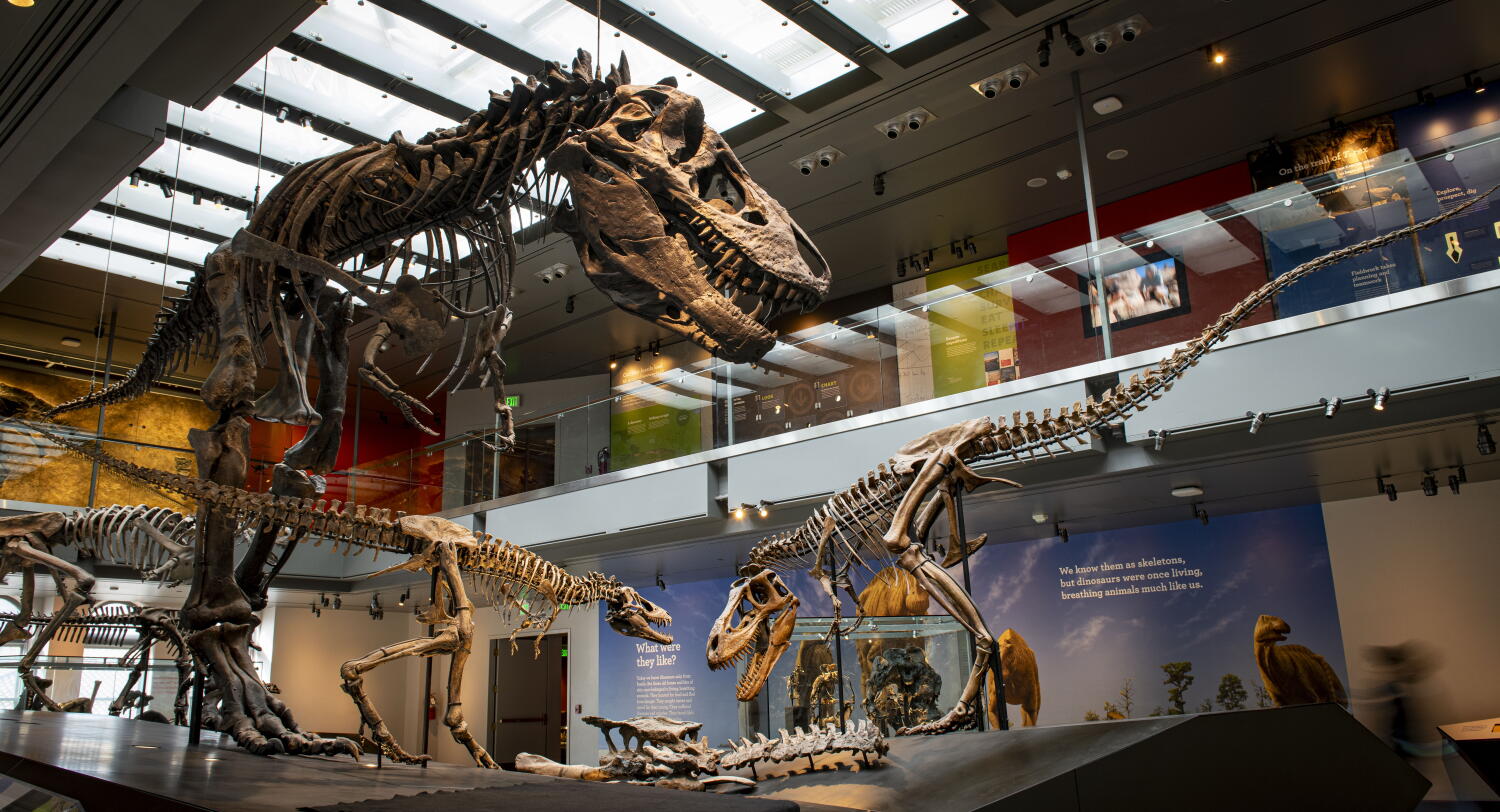
Touch your forehead right now. You feel warm. That internal furnace running at roughly thirty-seven degrees Celsius keeps you alive. Now picture a six-ton apex predator crunching bone in a Cretaceous floodplain. You probably imagine a sluggish, cold-blooded lizard sunning itself on a rock before dragging its heavy tail through the mud.
Science completely destroys that mental image.
Recent biogeochemical research proves that Tyrannosaurus rex ran at a body temperature remarkably close to your own. You are basically sharing a thermal bracket with a multi-ton terror lizard. That realization shatters decades of lazy dinosaur tropes and forces us to look at prehistoric beasts through an entirely different biological lens.
For generations, textbooks shoved dinosaurs into two rigid boxes. They were either sluggish, cold-blooded reptiles dependent on environmental heat, or they were hyperactive, warm-blooded birds and mammals. Nature rarely fits into neat human filing cabinets. Dinosaurs operated on rules entirely their own, combining physics, biology, and sheer evolutionary stubbornness.
The Rise and Fall of the Cold Blooded Reptile Myth
Early paleontologists looked at modern lizards and crocodiles and assumed ancient dinosaurs worked the exact same way. If it looks like a giant reptile, it must act like one. That assumption dictated museum exhibits for a century.
Cold-blooded animals, or ectotherms, rely entirely on external sources to regulate their body heat. They bask in the sun to warm up and crawl into the shade to cool down. A twelve-meter-long predator weighing seven tons cannot easily crawl into the shade. If a T. rex relied purely on basking, it would overheat during the day and freeze at night.
The mechanics simply do not work. An animal of that mass generates massive amounts of metabolic heat just from existing. If it were a traditional cold-blooded reptile, its internal organs would literally cook themselves inside its heavy armored skin.
Paleontologists eventually realized something had to give. Dinosaurs didn't fit the cold-blooded mold, but they didn't match modern mammalian endothermy either. They occupied a fascinating evolutionary middle ground.
Inside the Teeth What Is Clumped Isotope Paleothermometry
You can't stick a digital thermometer into a fossilized skull. The creature died sixty-six million years ago. Researchers had to get creative.
Scientists turned to a technique called clumped isotope paleothermometry. This method sounds intimidating, but the chemistry is brilliantly straightforward. Teeth grow in layers, locking in chemical signatures from the environment and the animal's body fluid at the time of formation. Specifically, researchers examine the bonds between carbon-13 and oxygen-18 isotopes within tooth enamel and eggshells.
The beauty of this method lies in thermodynamics. The clumping of heavy isotopes depends entirely on temperature. The colder the environment when the mineral formed, the more those isotopes clump together. The warmer the body, the less they clump.
When researchers extracted tooth enamel from various dinosaur species—including Tyrannosaurus rex—and ran them through mass spectrometers, the numbers told an unmistakable story. The teeth formed at internal body temperatures hovering around thirty-six to thirty-eight degrees Celsius.
Your normal oral temperature sits right around thirty-seven degrees Celsius.
The overlap is startling. A living human walking through a forest and a prehistoric T. rex roaming the ancient plains shared nearly identical internal thermostats.
Why Size Changes Everything
How did a reptile-like creature maintain a mammal-like body temperature without a high-octane mammalian metabolism? The answer comes down to pure geometry.
It's called gigantothermy.
As an animal grows larger, its volume increases much faster than its surface area. A tiny mouse loses body heat rapidly because it has a huge surface area relative to its minuscule body mass. It needs a roaring metabolism to stay warm. A massive elephant or a seven-ton dinosaur has the opposite problem. It has a tiny surface area relative to its colossal volume.
Heat gets trapped inside.
Once a dinosaur reached a certain size, it became a thermal battery. It absorbed heat from the sun and muscle activity during the day and retained that thermal energy through the cold night. The animal didn't need a costly, high-energy metabolism to stay warm. Physics did the heavy lifting.
This thermal inertia kept T. rex warm, stable, and remarkably active. They weren't sluggish swamp monsters waiting for the sun to clear the tree line. They were metabolic powerhouses driven by the simple math of mass.
What This Means for Behavior and Ecology
Knowing the body temperature of a Tyrannosaurus rex changes how we understand its daily life.
Think about hunting strategy. A sluggish, cold-blooded reptile launches into short, explosive ambushes and then collapses into exhaustion. A warm-bodied animal with a stable internal temperature can maintain sustained aerobic activity. While T. rex wasn't running marathons—its bones and massive musculature imposed physical speed limits—it was constantly warm, alert, and ready to move.
An animal operating at thirty-seven degrees Celsius possesses fast neural processing, rapid digestion, and steady physical stamina. Prey animals couldn't simply wait for the sun to go down and expect the predator to freeze in place. The terror was active twenty-four hours a day.
That thermal stability also influenced their geographic range. T. rex fossils appear in high northern latitudes, places that experienced chilly winters and prolonged darkness. A traditional cold-blooded reptile would've perished or gone into a deep hibernation during those dark months. A gigantotherm could push into colder environments, tolerating seasonal drops because its massive thermal mass buffered against environmental shocks.
Challenging Common Misconceptions
People love simple labels. We want animals to be neatly categorized as warm-blooded or cold-blooded so we can understand them instantly. Nature refuses to cooperate.
When popular science headlines declare that humans are hotter or colder than dinosaurs, they often miss the nuance. T. rex wasn't a mammal. It didn't have fur, sweat glands, or a mammalian heart. It possessed feathers, scales, and a reptilian skeletal structure. Yet its internal thermal reality aligns closely with ours.
Another misconception involves growth rates. Because T. rex maintained a high body temperature, it grew at an astonishing speed during adolescence, packing on pounds of muscle and bone every single day. That rapid growth rate resembles modern birds and mammals rather than slow-growing modern reptiles. They reached adult size in their late teens, burning through calories and dominating their ecosystems with terrifying efficiency.
Looking at Prehistoric Life Anew
Science constantly forces us to rewrite our assumptions about the past. We used to view dinosaurs as evolutionary failures, doomed to extinction because they were too big, too stupid, and too cold.
Every new fossil analysis proves that view wrong. They were sophisticated, highly adapted organisms ruling their world with precision. They mastered thermodynamics long before humans invented insulation.
Next time you check a fever or feel the warmth radiating from your own skin, remember your distant cousin in the Cretaceous. You share a temperature, even if they had a bite force capable of crushing a car. Evolution produces strange bedfellows, proving that across millions of years, nature finds remarkably consistent ways to keep the furnace burning.