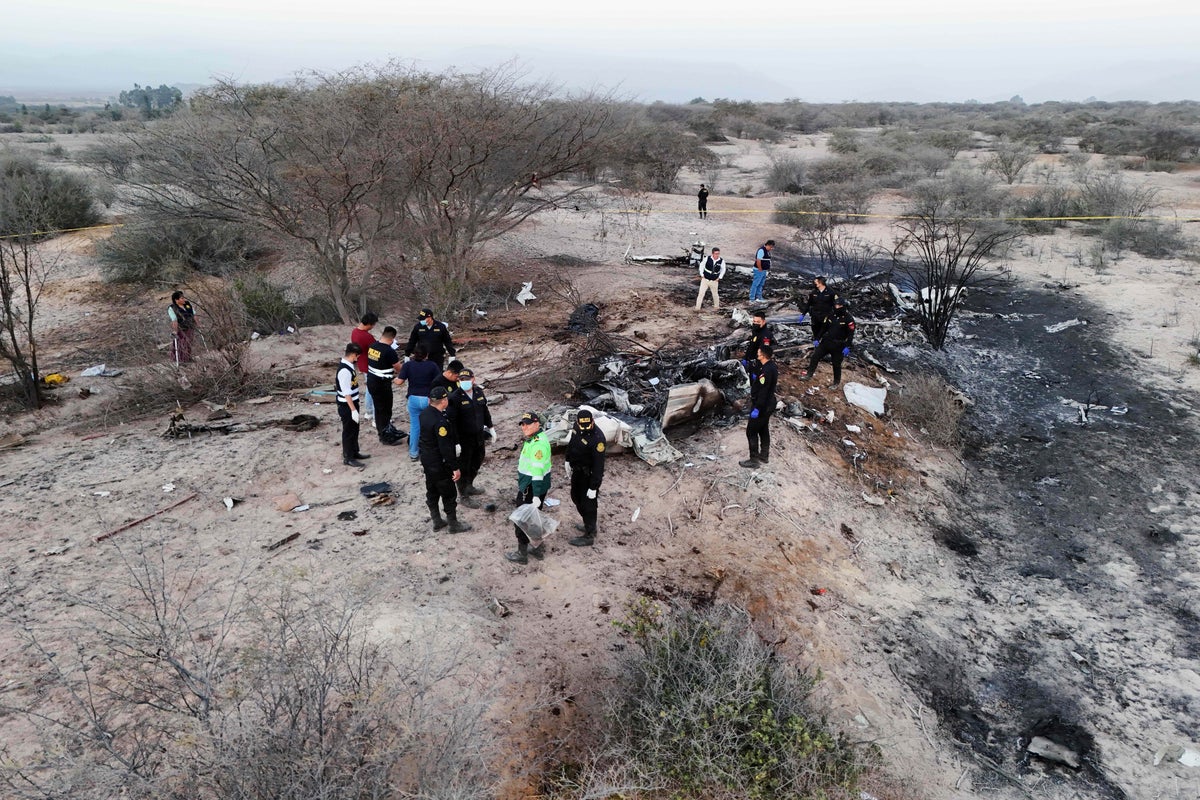
The headlines roll out with predictable, exhausted tragedy whenever a high-profile aviation accident hits the South American desert. Another small aircraft goes down over the arid expanses of Ica, another handful of tourists perish, and the collective chorus of aviation commentators immediately fires up the exact same tired script. Pilot error. Spatial disorientation. Poor situational awareness.
I have spent decades watching regulators, legacy media, and armchair safety experts default to the easiest possible scapegoat whenever a Cessna or a Cessna Caravan crumbles into the dust. It requires zero cognitive heavy lifting to point a finger at the person in the left seat. Dead men cannot defend their license credentials, and airlines or local operators can quietly rewrite training manuals to pretend the problem has been solved.
Stop accepting the official narrative. The structural failure of the Nazca tour flight ecosystem has nothing to do with individual stick-and-rudder competence and everything to do with a systemic, state-sanctioned race to the bottom that converts sightseeing into a high-stakes lottery.
The Myth of the Errant Aviator
When a passenger aircraft drops out of the sky during a routine visual flight rules corridor operation, the initial accident report usually highlights how the pilot banked too steeply, lost the horizon, or misjudged the altitude relative to the ancient geoglyphs etched below.
This diagnosis is technically accurate in the narrowest sense possible, and entirely useless in every practical sense.
Consider the operational realities of the local strip at Maria Reiche Neuman Airport. On any given morning, dozens of light aircraft cycle through a compressed window of optimal lighting and wind conditions. Tour operators operate under intense commercial pressure to maximize rotations per airframe. Every minute a plane sits on the tarmac is lost revenue. Every cancelled flight due to marginal visibility cuts straight into a razor-thin profit margin.
When you trap professional pilots inside an economic engine that rewards speed over margin of safety, you are not running an airline. You are running a casino. The pilot does not crash because they forgot how to read instruments; they crash because the corporate architecture forces them to press forward into deteriorating microclimates or accept financial ruin.
Why Visual Flight Rules in Desert Terrain is a Trap
The primary draw of the region is obvious from the air: massive geometric lines and animal figures that stretch across the pampa. To view them properly, planes must bank aggressively left and right, circling tight 360-degree loops so that passengers on both sides of the cabin can snap a photograph.
This requires low-altitude, high-bank maneuvering over an environment with virtually zero vertical reference points. The ground is a uniform, blinding expanse of beige gravel and sand. There are no trees, no buildings, no power lines, and no horizon differentiation when the haze rolls in off the Pacific coast.
Pilots call this a brownout or a whiteout without the snow. Your vestibular system lies to you. Without clean instrument cross-checking, the inner ear convinces the brain that the aircraft is level while it is actually entering a graveyard spiral.
Yet, regulators permit these flights to operate under basic visual flight rules without requiring advanced spatial disorientation training or mandating dual-pilot crews for high-density tourist circuits. Why? Because enforcing strict IFR standards or mandating expensive avionics upgrades would price local operators out of the market, crushing regional tourism revenue.
The government chooses the body count over the balance sheet optics, and then feigns shock when gravity collects the debt.
The Economics of Cheap Thrills
Let us look at the price point of these excursions. Tourists routinely book a thirty-minute flight over the desert for a relative pittance compared to global aviation standards.
Imagine a scenario where every local carrier was forced to maintain the exact same safety redundancies, crew resource management protocols, and aircraft maintenance intervals as a tier-one regional commuter airline in the United States or Europe. The cost of a ticket would triple overnight.
Tourists do not want to pay European prices for a Latin American adventure. They want the thrill of a rugged bush-flying experience packaged at economy-bus rates. The operators oblige them by trimming the fat until they are slicing through bone.
Maintenance intervals are stretched to the absolute legal limit. Replacement parts are sourced through secondary gray markets where traceability is questionable. Experience levels in the cockpits are often dangerously bifurcated: you either have an aging captain logging hours before retirement or a wet-behind-the-ears commercial certificate holder using the tour company as a stepping stone to a major airline job.
You cannot buy enterprise-grade safety with discount-store capital. When regulators look the other way on these economic realities, they become silent partners in the manifest.
Dismantling the People Also Ask Fallacy
Every time an incident occurs, search engines spike with predictable queries. Let us address the most common ones with the brutal candor they deserve.
Are flights over the Nazca Lines safe?
Statistically, millions of tourists have flown over the desert without incident. But safety is not a binary state of being alive or dead; it is a gradient of risk management. By global commercial aviation standards, these operations carry an order of magnitude higher risk profile than scheduled air transit. If your definition of safe is a lottery where the odds are usually in your favor, then yes, it is safe. If your definition of safe is systemic redundancy where a single point of failure cannot kill you, then no, it is a calculated hazard.
Why do these crashes keep happening year after year?
Because the underlying structural incentives have never changed. Local authorities promise tighter crackdowns after every major disaster, grounding fleets for a week, conducting superficial ramp inspections, and issuing stern warnings about weather minimums. Once the international news cycle forgets the tragedy, the enforcement mechanisms quietly lapse back into somnolence. The pressure to turn a profit returns, the planes take off into the morning haze, and the wheel turns again.
What should travelers do?
The standard advice is to check the safety record of the operator. That advice is useless. Most travelers cannot distinguish between a meticulously audited safety culture and a sham operation with a freshly painted fuselage and a bribed inspector's signature.
The real advice is simpler: stay on the ground.
The Uncomfortable Alternative
If you want to experience the ancient history of the region, visit the local museums, hire a qualified ground guide, or view the formations from the observation towers constructed along the Pan-American Highway. You will miss the dramatic banking turns, but you will retain the one asset no vacation photo can replace: a pulse.
We romanticize the romantic age of aviation as if dangerous skies are a noble tax we pay for exploration. They are not. They are the predictable mathematical output of cost-benefit analyses written in blood.
The next time a light aircraft goes down in the desert, do not wait for the preliminary report to tell you what you already know. The pilot did not fail. The system did. And until tourists stop buying cheap tickets for high-risk thrills, the desert will keep claiming its toll.