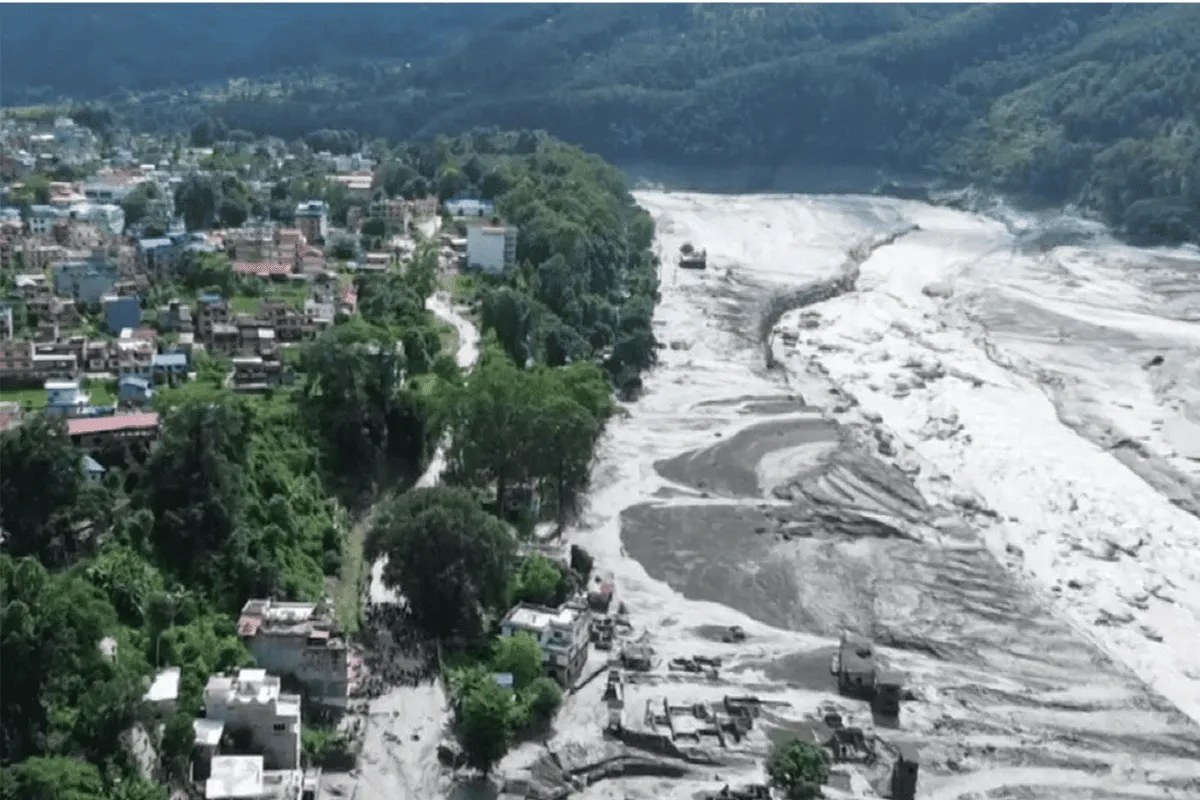
The media coverage surrounding the recent catastrophic landslide along the Nepal-China border reads like a standard weather report written by an algorithm. The headline-chasing narrative focuses entirely on the body count, the missing hundreds, and the brute force of tectonic instability in the Himalayas. It treats the disaster as a tragic act of God, a sudden fury unleashed upon an unforgiving mountain pass.
That is not just naive. It is dangerous.
I have spent the better part of two decades analyzing infrastructure resilience and cross-border trade corridors in high-altitude zones. When mountains collapse, people love to point at the monsoon, the fault lines, and the sheer verticality of the terrain. They wash their hands of human complicity. Let us strip away the comforting fiction that this was an unavoidable natural tragedy. The reality on the ground involves ignored engineering warnings, politically expedient border connectivity projects rushed past safety thresholds, and institutional myopia of the highest order.
The Lazy Consensus Of Tectonic Fatalism
Every time a slope fails in the Himalayas, the standard playbook kicks into gear. Officials express deep sorrow, emergency funds are allocated for downstream rescue operations, and commentators nod sagely about the fragile ecology of the Roof of the World.
This narrative serves a very convenient purpose. It protects bureaucrats and contractors. If a mountain gives way because of divine wrath or ancient geology, nobody goes to prison. Nobody has to refund development loans.
Look closer at the physical evidence. High-altitude mass-wasting events rarely happen in a vacuum. They are frequently triggered, accelerated, or drastically magnified by aggressive road-widening initiatives, unengineered toe excavations, and poor hydrological management. When you carve heavy transport routes through young, highly fractured sedimentary layers without investing in proper stabilization, you are not developing a region. You are rolling loaded dice against gravity.
+-------------------------------------------------------+
|                 THE DISASTER CYCLE                    |
+-------------------------------------------------------+
|  Political Urgency -> Rushed Excavation ->            |
|  Hydrological Disruption -> Slope Destabilization ->  |
|  Catastrophic Failure -> "Act of God" Narrative       |
+-------------------------------------------------------+
Gravity does not negotiate. It does not care about bilateral trade agreements or the geopolitical urgency of opening new customs checkpoints between Tibet and Nepal. When you remove the toe support of a mountainside to lay down asphalt, the mountain will eventually reclaim its angle of repose.
The Economics Of Reckless Connectivity
Why do governments keep pushing high-risk construction in active landslide zones? Follow the money.
Geopolitical competition in South Asia has turned border infrastructure into a high-stakes vanity metric. Every kilometer of paved highway connecting trans-Himalayan trade routes is touted as a strategic triumph. Billions flow into concrete barriers, dry ports, and freight terminals. But do you know where the budget gets trimmed when project costs overrun? It rarely happens in the executive suites or the procurement contracts. It happens in geotechnical instrumentation, long-term drainage maintenance, and subsurface monitoring.
I have reviewed feasibility reports for mountain passes where the risk assessment section was treated as a bureaucratic checkbox rather than an engineering constraint. Engineers on the ground know the risks. They file reports warning that the saturation threshold of local slopes is dangerously low. Those reports get buried because nobody wants to tell a minister that a flagship trade corridor has to wait three years for proper stabilization work.
The result? Catastrophe disguised as a surprise.
Dismantling The Border Logistical Fallacy
People ask: How can remote mountain communities possibly prepare for sudden geological shifts of this magnitude?
The question itself is flawed. It assumes that these shifts are sudden and unpredictable. They are not. Modern remote sensing, synthetic aperture radar interferometry, and continuous ground-movement sensors can detect micro-deformations in mountain slopes weeks or months before a major failure occurs.
The technology exists. The data is available. What is missing is the institutional accountability to act on it. If a slope shows measurable creep above a critical threshold, international protocols should mandate an immediate halt to traffic and construction. Instead, commercial pressures keep the trucks rolling until the hillside decides to swallow them.
Consider the human cost. Three dead and hundreds missing in the Tibet-Nepal border zone are not merely statistics in a tragic news bulletin. They are casualties of a system that prioritizes speed over safety, visibility over verification.
The Hard Truth About High-Altitude Engineering
We need to stop romanticizing high-altitude engineering as an heroic battle against impossible elements. It is a technical discipline governed by strict laws of physics, hydrology, and mechanics. If you violate those laws, the mountain will collect its tax in blood and rubble.
Fixing this does not require more thoughts and prayers from world leaders. It requires mandatory independent geotechnical audits for every cross-border corridor, automatic liability for contractors who cut corners on slope drainage, and the courage to shut down trade routes the moment monitoring data signals structural fatigue.
Until policymakers accept that human intervention—not just natural weathering—is the primary driver of these disasters, more families will pay the price for our collective refusal to respect the terrain.
Gravity always wins in the end. It is time we stopped pretending we did not know the rules.


