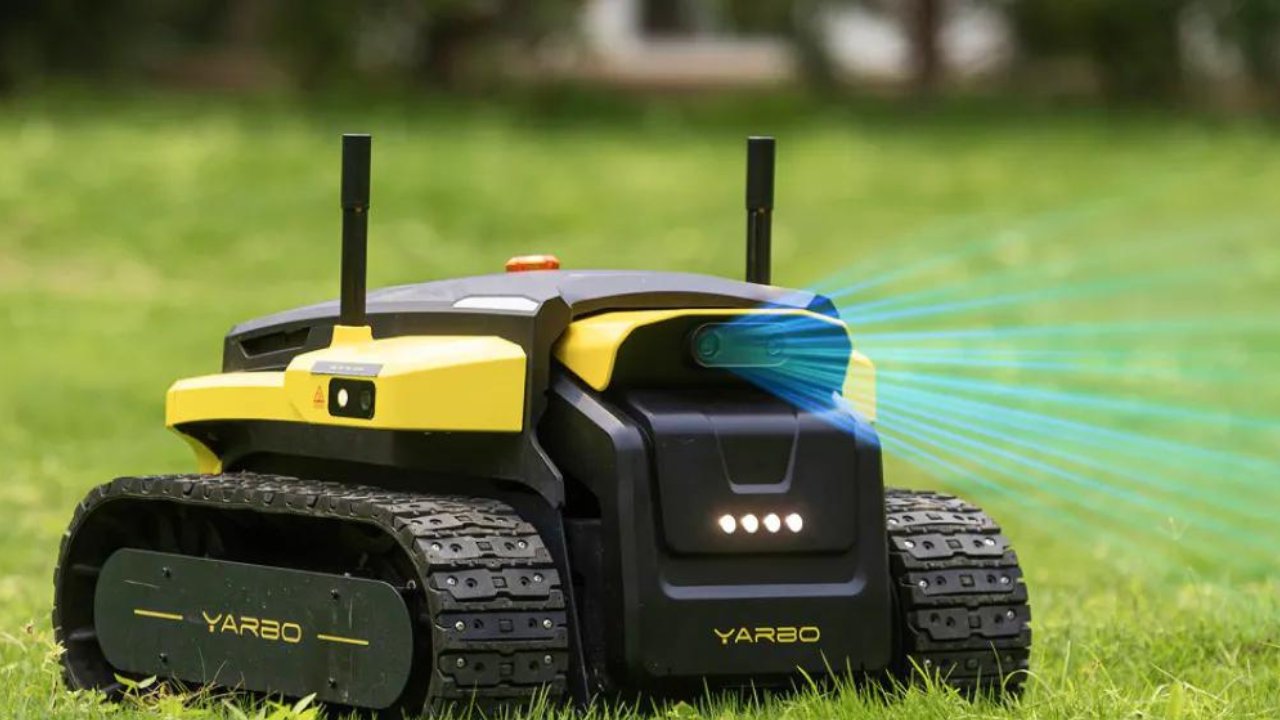
The neighborhood is silent, save for the rhythmic, metallic whir of a Husqvarna gliding across a manicured lawn. It is the sound of the modern suburban dream. We bought these machines—thousands of them—to reclaim our Saturdays. We traded the smell of gasoline and the sweat of manual labor for a silent, disk-shaped servant that lives in a plastic garage under the hydrangeas. It feels like progress. It feels like we finally outsmarted the chores.
But while you are at work or sleeping, your lawnmower is talking. And it might be talking to the wrong person.
The Invisible Doorway
Johannes Willbold, a researcher at Bochum University in Germany, didn’t look at these machines and see a convenient tool. He saw a fleet of 11,000 potential weapons. During his investigation, he uncovered a vulnerability so glaring it defies the high-tech marketing of the companies selling them. By exploiting a flaw in the way these mowers connect to the internet, Willbold discovered he could remotely hijack thousands of devices across the globe.
Imagine a hypothetical user named David. David is proud of his yard. He spent three thousand dollars on a top-tier mower because he loves the precision. He tracks its progress on an app while he’s sitting in a boardroom twenty miles away. To David, the app is a tether of control. To a hacker, that app is a wide-open window into David’s private life.
Willbold found that he could bypass the authentication requirements entirely. He didn't need David's password. He didn't need to be on David's Wi-Fi. From a laptop in Germany, he could see every mower on the network, change their settings, and—most chillingly—override their commands.
The Physics of Risk
We have spent the last decade worrying about our data. We fret over leaked emails, stolen credit card numbers, and compromised social media accounts. Those are digital ghosts. They haunt our credit scores and our reputations, but they cannot touch us.
A robot lawnmower is different. It is a sixty-pound object equipped with high-speed rotating steel blades.
When we invite "smart" devices into our physical space, we are merging the digital world with the kinetic one. If a hacker gains access to your Netflix account, they watch movies on your dime. If a hacker gains access to your mower, they control a mobile blade in a space where your children play and your pets sleep.
Willbold’s research proved that he could remotely disable the anti-theft alarms and GPS tracking. He could effectively "kidnap" the mower, or worse, keep it running when it should be docked. The safety sensors are designed to stop the blades if the mower is tilted or lifted, but when the core software is compromised, the very definitions of "safe" and "unsafe" become fluid.
The Problem with Convenience
Why is this happening? The answer is as old as the industrial revolution: speed.
Companies are in a frantic race to turn every household object into an "Internet of Things" (IoT) device. Your fridge needs to tell you when you’re out of milk. Your toaster needs an app. Your lawnmower needs to be reachable from space. To meet the demand for these features, developers often build on top of shaky foundations.
In the case of these 11,000 mowers, the flaw wasn't a sophisticated "zero-day" exploit that required a genius to crack. It was a failure of basic digital hygiene. The systems weren't properly verifying who was sending the commands. It’s the digital equivalent of a bank vault with a world-class lock but a back door that stays propped open with a brick.
We are living in an era of "functional fragility." Our tools are more powerful than ever, yet they rely on a chain of code so complex that no single person truly understands the whole thing. When one link breaks, the entire system doesn't just stop working—it becomes a liability.
A False Sense of Security
Consider the psychological impact. We buy these devices to reduce stress. We want fewer things to worry about. Yet, by adding a smart mower to our home, we’ve introduced a new, invisible anxiety.
You look out the window at your yard. Is the mower moving because the schedule told it to, or because someone in a different time zone is testing a script?
The manufacturers, when confronted with Willbold's findings, moved to issue patches. They did what corporations do: they minimized the "theoretical" risk while quietly scrambling to fix the hole. But the patches only work if the owners install them. Many of these mowers live on secondary networks or are owned by people who haven't checked the app in months. They remain "dark" nodes—active, bladed, and vulnerable.
This isn't just about lawnmowers. It’s a dress rehearsal for the future. Today it’s the grass. Tomorrow it’s the smart lock on your front door, the brakes on your electric car, or the thermostat that keeps your pipes from freezing in mid-winter.
The Cost of the Connection
There is a deep irony in our quest for total connectivity. We want to be connected to our homes so we can feel closer to them while we’re away. But every connection is a two-way street. If you can reach into your home from the outside, the outside can reach into your home.
We have been sold a vision of the future where technology serves us with invisible hands. We forgot that those hands are guided by code written by tired humans under tight deadlines. We forgot that "smart" often just means "exposed."
Willbold’s discovery didn't result in a catastrophe. No one was hurt. No neighborhood was terrorized by a rogue fleet of grass-cutting robots. But the warning shot was loud and clear for anyone willing to hear it.
The silence of the electric motor is no longer a sign of peace. It is a reminder of the invisible vulnerabilities we’ve invited onto our property. We traded the manual mower for a robot because we wanted to save time. Now, we might find ourselves spending that saved time looking over our shoulders, wondering who else is holding the remote.
The sun sets over the suburbs. The mowers return to their docks, glowing with soft LED lights like small, grounded UFOs. They look harmless. They look obedient. But beneath the plastic shell, the sensors are still pinging the sky, waiting for the next command, indifferent to whether it comes from the person who paid for it or a stranger in the dark.
The blades are sharp. The gate is open. And the grass is still growing.