The morning bell at any elementary school carries a specific, chaotic music. It is the sound of heavy backpacks hitting linoleum, the squeak of sneakers, and the high-pitched hum of seventy conversations happening at once. In a third-grade classroom in suburban Texas, a teacher named Sarah—a composite of several educators currently navigating the state’s changing educational directives—stands near her desk. She holds a new lesson plan packet. Her fingers trace the edge of the paper. She is a woman who loves history, who spent a decade helping children understand the building blocks of the world.
But this morning, her chest feels tight. For an alternative perspective, see: this related article.
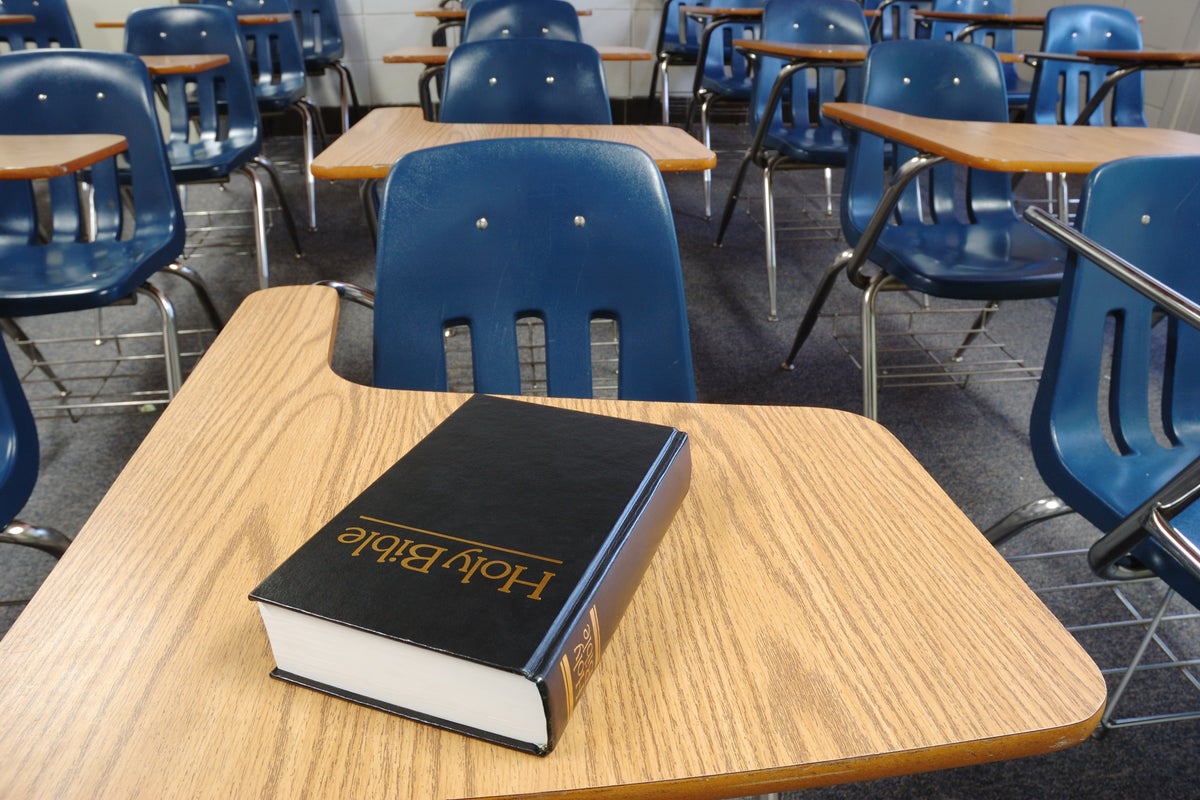
The packet in her hand contains newly approved curriculum guidelines that inject biblical stories directly into core reading and language arts lessons. On paper, it is framed as a return to cultural literacy. In reality, it represents the most significant fracturing of the line between church and state in modern American education. Sarah is not anti-religion; she attends church most Sundays. But she knows the delicate ecosystem of a public school classroom. She looks out at her students. There is Maya, whose family is Muslim. There is Ethan, whose parents are staunch atheists. There is Leo, whose family belongs to a local Baptist congregation that views the Bible through a deeply specific theological lens.
Suddenly, teaching a simple reading comprehension lesson has become a minefield. Further insight on this trend has been shared by NPR.
The Quiet Shift in the Lone Star State
For decades, the phrase "separation of church and state" operated like a heavy, invisible curtain in public school classrooms. It allowed children of every imaginable background to sit side by side without their inherent differences becoming a flashpoint before recess. That curtain is being systematically dismantled.
The Texas State Board of Education recently greenlit a state-designed elementary school curriculum known as the Bluebonnet Learning Materials. Developed by the Texas Education Agency, these resources integrate biblical narratives—such as the Good Samaritan, the Golden Rule, and the Story of Joseph—into standard reading and writing lessons for kindergarten through fifth grade.
Proponents argue that the Bible is a foundational text of Western civilization. They claim that a child cannot fully appreciate Shakespeare, John Milton, or the rhetoric of the civil rights movement without understanding the metaphors born in Mesopotamia and ancient Judea. To them, this is not preaching; it is cultural context.
But look closer at how this functions on the ground.
When a state curates which religious stories are deemed "culturally foundational," it inevitably chooses a winner. In the Bluebonnet curriculum, the emphasis sits heavily on Christian scripture. Other world religions are present, but they are treated as historical artifacts—distant, brief, and external. The biblical narratives are woven into the very fabric of character building and moral instruction.
Consider the psychological weight this places on an eight-year-old child. To a third grader, the teacher is the ultimate arbiter of truth. When the authority figure at the front of the room presents a religious narrative as part of the state-mandated curriculum, the distinction between a historical lesson and a theological truth evaporates. The child does not see a nuance of Western literary tradition. They see a rulebook.
The Illusion of Opting Out
Texas policy technically allows parents to request alternative assignments if they object to the religious content. It sounds fair. It sounds democratic.
It is an illusion.
Imagine being the only nine-year-old child required to gather your pencils, stand up in front of your peers, and walk down the hallway to the library because your family’s beliefs do not align with the state-approved lesson. Isolation is a brutal punishment for a child. The policy shifts the burden of religious freedom from the state onto the shoulders of families, forcing them to choose between their faith and their child’s social survival.
The systemic pressure goes deeper than social discomfort. The state of Texas offered financial incentives to school districts that adopted these materials—specifically, an additional twenty dollars per student. For cash-strapped public school districts struggling to fund basic maintenance, counselors, and special education programs, that incentive feels less like a choice and more like economic coercion.
Money speaks. It whispers into the ears of school boards facing deficit budgets. It tells them that perhaps a few Bible stories in reading class are a small price to pay to keep the lights on and the buses running.
The Invisible Stakes of a Fractured Foundation
We often treat these political battles as abstract debates happening in pristine state capitol buildings. We look at the headlines, file them away under "culture wars," and move on with our day. But the real cost is measured in the quiet erosion of trust.
Public schools have long been one of the few remaining spaces where Americans of all walks of life are forced to figure out how to live together. They are the crucibles of a pluralistic society. When the state steps into that space and elevates one specific religious tradition above all others, the foundational contract of the public school changes. It ceases to be a neutral ground where everyone belongs by right. It becomes a house owned by one group, where everyone else is merely a guest, staying on good behavior.
What happens to a community when its public institutions begin to take sides? The cracks form quickly. Neighbors look at neighbors with suspicion. Parents who once chatted amicably in the drop-off line begin to wonder who is pushing what agenda. Teachers, terrified of misstepping and facing parental wrath or administrative discipline, retreat into a defensive crouch, sanitizing their classrooms or burning out entirely.
The irony is that this policy satisfies no one deeply.
Devout families are rightly concerned that government bureaucrats are butchering sacred texts, stripping them of their theological nuance to make them digestible for a standardized curriculum. Secular families are horrified by the state-sponsored proselytization. Religious minorities feel the walls closing in.
The Classroom at Three O’Clock
Back in her classroom, the afternoon sun cuts across Sarah’s desk, illuminating the dust motes dancing in the air. The children have left for the day. The room is silent, save for the hum of the air conditioner trying to fight off the Texas heat.
On the board, a few vocabulary words remain from the morning lesson. Sarah sits down and looks at the Bluebonnet packet again. She thinks about the weeks ahead, about the questions her students will ask when these stories are introduced. Children do not understand the subtle legal boundaries between cultural literacy and religious indoctrination. They ask direct, piercing questions: Is this story true? Do I have to believe it? What happens if I don't?
She realizes she will have to find a way to navigate those questions entirely on her own, balancing on a wire stretched over a canyon.
The separation of church and state was never about protecting the government from religion, nor was it solely about protecting religion from the government. It was about protecting people from the inevitable friction that occurs when the two are forced into an uneasy marriage. Once that boundary is blurred, it cannot easily be restored. The ink bleeds into the paper, changing the entire page, until the original text is lost entirely.