The ink is faded to the color of dried earth, scratched hastily into the back of a military notebook in 1757. The handwriting belongs to a twenty-five-year-old colonel named George Washington. He was not yet a myth, not yet a marble statue, and certainly not yet a president. He was just a stressed, exhausted young officer leading a ragtag Virginia militia through the dense, unforgiving woods of the Seven Years' War.
Among pages detailing officer commissions, orders, and the names of pack horses, sits a curiously domestic entry. It is a recipe.
The Survival Fluid of an Empire
We look back at the eighteenth century through a romantic lens of tavern songs and frosty mugs clinking in warm candlelight. The reality was much bleaker. Water was an enemy. Rivers and shallow wells near military encampments were notorious breeding grounds for deadly bacteria. If an entire garrison drank from the wrong creek, dysentery could wipe out an army faster than British muskets.
To survive, everyone drank beer. Even children.
But this was not the crisp, golden lager you reach for at a summer barbecue. Washington’s notebook outlines the instructions for "Small Beer." It is a beverage born entirely out of scarcity.
Consider the baseline ingredients available to a young colonel out in the field. Malted barley, the backbone of standard brewing, was a luxury. It had to be imported from Britain at exorbitant costs, and what little made it across the Atlantic was strictly reserved for distilling high-value whiskey. So, Washington adapted. He used what was cheap, local, and abundant: wheat bran and molasses.
The original recipe reads like a desperate kitchen experiment:
"Take a large Siffer full of Bran Hops to your taste – Boil these 3 hours. Then strain out 30 Gall. into a Cooler put in 3 Gall. molasses while the Beer is scalding hot... let this stand till it is little more than Blood warm then put in a quart of Yest."
If the weather was freezing, Washington noted, you had to tuck the entire boiling mixture into bed, covering it with a literal blanket to keep the yeast alive.
The Shock to the Modern Palate
To understand what this actually tasted like, you have to shed every modern expectation of a craft brew. Small beer was low-alcohol, quickly fermented sustenance. The boiling process killed off the lethal water-borne pathogens. The bran provided vital caloric nutrition for soldiers marching on empty stomachs. The molasses provided the fermentable sugars that the missing barley couldn't.
But the flavor?
"He didn't have much to work with," explains LeAnn Darland, co-founder of TALEA Beer Co., a New York City brewery that recently partnered with the New York Public Library to revive the document from its archives. "It is quite sweet, tastes very much like molasses. Maybe like a funky syrup."
Imagine a hot, bitter, herbal tea mixed with heavy, unrefined baking syrup, then left to sit until it bubbles. It was thick. It was intensely sweet, cut only by whatever wild hops could be scavenged to add a harsh, protective bitterness. It was a liquid designed to keep a man standing, not to help him unwind after a long day.
It was, by all accounts of modern taste, nearly undrinkable.
Yet, this funky syrup was the literal fuel of early America. When the New York Public Library decided to unearth this artifact from its Manuscripts and Archives Division to mark the upcoming 250th anniversary of the United States, they faced a dilemma. History is a beautiful thing to look at, but sometimes it tastes terrible.
Reimagining the Founding Flavor
If you brew Washington's recipe exactly as written, you end up with a dark, syrupy, low-alcohol beverage that tastes like liquid molasses and wet grain. It belongs in a museum, not a taproom.
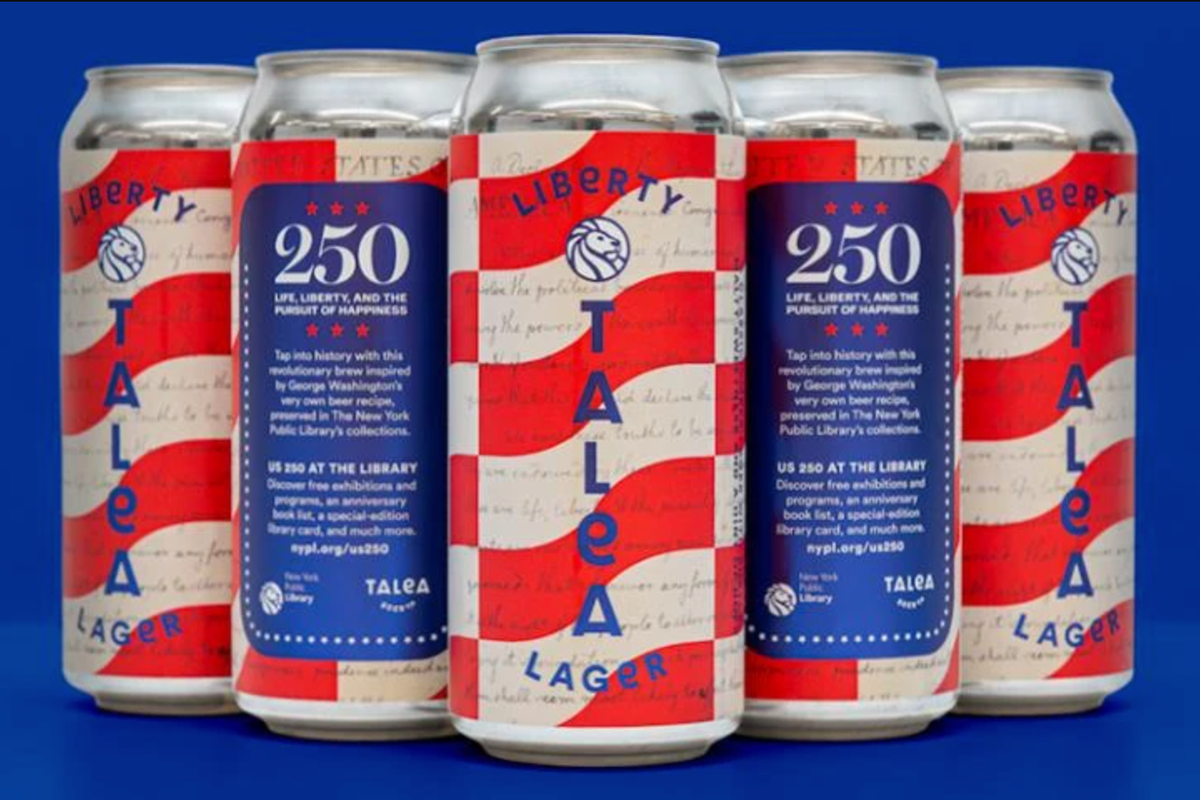
The brewers at TALEA wanted to create something that honored the spirit of 1757 without punishing the drinker. They took a dual approach. They brewed a tiny, historically accurate batch to understand the raw reality of Washington's world. Then, they set to work creating an homage that modern humans would actually enjoy.
They call it Liberty Lager.
Instead of heavy, overpowering molasses, the modern version dials the sweetness back into a subtle, warm maltiness. It swaps the rough wheat bran for a clean, refreshing grain profile, keeping just a whisper of the original formulation's color and weight. Coming in at 6.5% alcohol, it is a far cry from the weak, hydrating "small beer" of the militia camps, offering instead a crisp bitterness that fits perfectly at a modern trivia night or a backyard gathering.
"We wanted to honor the recipe while also making something that people would want to serve at a barbecue," says Tara Hankinson, co-founder of the brewery.
The Human Core of the Document
It is easy to get lost in the novelty of drinking like a founding father. But the real magic isn't the liquid in the glass; it’s the sudden, jarring proximity to the human being who wrote the words.
When we think of Washington, we think of the man on the dollar bill—stern, unyielding, almost bloodless. But when you look at the digital scan of that 1757 notebook, you see something else. You see a young man who was worried about his men getting sick. You see someone managing a chaotic supply chain in the middle of a wilderness war, checking the temperature of a wooden vat with his finger to see if it is "little more than Blood warm."
He was a person trying to solve a practical problem with a sifter of grain, a bucket of sticky syrup, and a wool blanket.
Drinking the modern adaptation is a strange form of time travel. It forces us to realize that the grand experiment of America wasn't just built on high-minded philosophy and soaring rhetoric. It was built on the mundane, gritty realities of survival. It was forged by tired people in muddy boots, drinking funky, sweet, boiled-bran water just to make it to tomorrow.