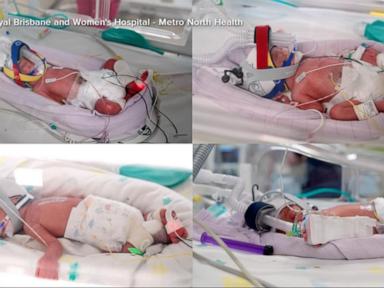
The spontaneous conception and successful delivery of monozygotic quadruplets represents one of the most extreme statistical anomalies in human reproductive biology. While high-order multiple births typically result from assisted reproductive technology involving the implantation of multiple embryos, true identical quadruplets occur through the spontaneous division of a single fertilized egg into four genetically identical zygotes. The biological mechanisms, epidemiological rarity, and clinical management required for such a pregnancy underscore the extreme physiological demands placed on both maternal and fetal systems.
The Mechanisms of Zygotic Division
To understand the emergence of identical quadruplets, one must examine the timeline of embryogenesis and blastocyst differentiation. Monozygotic twinning occurs when a single blastocyst splits during the earliest stages of cleavage. The timing of this division determines the chorionicity and amnionicity—the structural configuration of the placenta and amniotic sacs—which dictates the clinical risk profile of the pregnancy. Also making headlines recently: The Structural Mechanics of Emergency Surgery Centralization and System Failure.
- Days 1 to 3 post-fertilization: Division occurs prior to the differentiation of the trophoblast. This results in dichorionic diamniotic multiples, where each subgroup possesses an independent placenta and outer membrane.
- Days 4 to 8 post-fertilization: Division occurs at the blastocyst stage after inner cell mass differentiation. This leads to monochorionic diamniotic configurations, sharing a single placenta but maintaining separate inner sacs.
- Days 8 to 13 post-fertilization: Division occurs after the formation of the amniotic cavity, yielding monochorionic monoamniotic multiples. Fetuses share both a single placenta and a single amniotic cavity, introducing severe risks of umbilical cord entanglement.
In identical quadruplets derived from a single zygote, sequential or simultaneous cleavage events occur within this critical window. A primary zygotic split followed by secondary splits in both daughter cells creates four distinct embryos. If all splits occur within the monochorionic window, four genetically identical fetuses depend on a single shared placental mass.
Quantitative Probability and Incidence Rates
Spontaneous high-order multiple births exist at the outer margins of reproductive statistics. Hellin's Law, a historical mathematical approximation for spontaneous multiple gestations, posits that the frequency of twin births is approximately 1 in 89, triplets 1 in $89^2$, and quadruplets 1 in $89^3$ (roughly 1 in 704,000 births). Further information regarding the matter are explored by World Health Organization.
However, Hellin's Law fails to account for the distinction between dizygotic/polyzygotic and monozygotic events. The overwhelming majority of naturally occurring quadruplets result from multiple ovulation events rather than a single splitting zygote.
When isolating spontaneous monozygotic quadruplets—where one single zygote divides thrice to produce four identical embryos—the estimated probability drops to approximately 1 in 11 million to 1 in 67 million live births. The variance in statistical estimates stems from the rarity of recorded occurrences and the historical lack of DNA zygosity testing in surviving high-order gestations.
Hemodynamic and Physiological Challenges
The primary clinical challenge of a monochorionic quadruplet pregnancy is placental vascular architecture. In a shared placenta, vascular anastomoses connect the circulatory systems of the fetuses. These vascular bridges fall into three categories:
- Arterio-arterial (AA) anastomoses: High-pressure surface connections that allow rapid bidirectional blood flow.
- Veno-venous (VV) anastomoses: Low-pressure surface connections that facilitate passive blood transfer.
- Arterio-venous (AV) anastomoses: Deep placental connections where an artery from one fetus supplies a capillary bed drained by a vein of another fetus.
Unbalanced flow through deep arterio-venous anastomoses precipitates Twin-to-Twin Transfusion Syndrome (TTTS), or in the case of quadruplets, Higher-Order Transfusion Syndrome. The donor fetus suffers from hypovolemia, oliguria, and severe oligohydramnios, while the recipient fetus experiences hypervolemia, polyuria, polyhydramnios, and potential cardiac overload. In a monochorionic quad-amniotic configuration, managing hemodynamic stability across four connected circulatory systems presents severe microvascular complications.
Beyond vascular dynamics, physical uterine capacity imposes an absolute threshold on gestational age. Human uterine architecture is optimized for a single fetus. High-order gestations cause extreme uterine overdistension, triggering early cervical effacement, preterm premature rupture of membranes (PPROM), and spontaneous labor.
Structural Clinical Management Strategy
Navigating a spontaneous monochorionic quadruplet pregnancy requires a stratified clinical intervention model aimed at extending gestational duration while monitoring vascular equilibrium.
The primary objective during early diagnosis involves advanced ultrasound mapping to determine chorionicity and amnionicity. Confirming a shared placental mass mandates bi-weekly Doppler ultrasound surveillance starting as early as 16 weeks gestation to evaluate umbilical artery peak systolic velocity and ductus venosus flow profiles across all four fetuses.
Maternal metabolic demands scale non-linearly with fetus count. Caloric intake and micronutrient supplementation must be optimized to counteract rapid maternal tissue depletion and support concurrent fetal organogenesis. The physical strain on maternal cardiovascular infrastructure increases the risk of early-onset preeclampsia, gestational diabetes, and severe maternal anemia.
Elective delivery via planned Cesarean section is mandatory. The timing of delivery balances the risks of extreme prematurity against the exponential increase in intra-uterine fetal demise caused by placental insufficiency or acute transfusion crises. Deliveries are typically targeted between 28 and 32 weeks gestation, requiring four independent neonatal resuscitation teams present in the delivery suite simultaneously.
Obstetric units handling high-order monozygotic pregnancies must immediately establish early vascular mapping via color Doppler imaging, schedule maternal cardiovascular monitoring starting at 12 weeks, and coordinate multi-disciplinary neonatal intensive care units well prior to the third trimester to optimize surviving infant neurological outcomes.
:max_bytes(150000):strip_icc()/AprilbyKunbi-ac7999afd721433e9c73e191cd311248.jpeg)