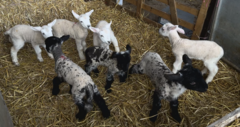
The occurrence of a septuplet birth in a commercial sheep flock represents a radical departure from standard biological efficiency, pushing the physical and metabolic limits of the Ovis aries species. While a typical high-performance ewe is managed for a 200% scanning percentage—two lambs per pregnancy—a seven-lamb event creates a 350% increase in fetal demand over the ideal baseline. This phenomenon is not merely a statistical anomaly but a high-risk biological event that highlights the fragile intersection of genetics, hormonal hyper-stimulation, and nutrient partitioning.
The Mechanism of Hyper-Fecundity
The primary driver behind such an extreme litter size is polyovulation, where the ovaries release multiple ova during a single estrus cycle. In commercial operations, this is usually governed by the Booroola (FecB) gene or similar mutations in the TGF-beta signaling pathway. These genetic markers reduce the inhibitory feedback of inhibin on follicle-stimulating hormone (FSH) levels, allowing for the maturation of an atypical number of follicles. Learn more on a related issue: this related article.
When seven embryos successfully implant, the biological system shifts from a growth model to a survival-partitioning model. The uterine capacity of a standard ewe is finite. As the number of fetuses increases, the available placental surface area per fetus decreases logarithmically. This leads to Intrauterine Growth Restriction (IUGR), ensuring that while the total litter weight is high, individual birth weights are dangerously low.
The Metabolic Cost Function
The energy requirements of a gestating ewe do not scale linearly with the number of fetuses. Instead, they follow a compounded curve due to the metabolic overhead of maintaining multiple placental units and the sheer physical displacement of the rumen. Additional analysis by NPR explores related perspectives on the subject.
Rumen Displacement and Intake Paradox
As the seven fetuses expand within the abdominal cavity, they physically compress the rumen. This creates a physiological bottleneck: the ewe requires a massive increase in caloric density to support the pregnancy, yet her physical capacity to ingest dry matter is at its lowest point.
The Ketosis Threshold
If the energy deficit is not managed through high-density glucose precursors (typically propylene glycol or concentrated cereals), the ewe enters a state of negative energy balance. The system begins mobilizing adipose tissue, leading to an overproduction of ketone bodies. In a septuplet scenario, the "Pregnancy Toxemia" threshold is reached almost instantly if the nutritional plane drops even slightly. The cause-and-effect chain is absolute: insufficient glucose leads to hyperketonemia, followed by neurological decline and, frequently, fetal or maternal death.
Survivability and Labor Economics
The management of a seven-lamb litter transforms a passive agricultural process into a high-intensity clinical intervention. The labor-to-yield ratio is inverted. While a single lamb requires minimal postnatal supervision, a litter of seven demands a 24-hour monitoring cycle to mitigate the following risks:
- Thermoregulation Failure: Small-birth-weight lambs possess a high surface-area-to-volume ratio, causing them to lose body heat faster than they can generate it via brown fat thermogenesis.
- Colostrum Competition: A ewe possesses only two functional teats. In a septuplet event, five lambs are systematically excluded from the initial immunological transfer. Without human intervention to provide exogenous colostrum, the mortality rate for the "excess" five lambs approaches 100% within the first 48 hours.
- Maternal Rejection: The hormonal surge of oxytocin during labor is designed to facilitate bonding. However, the physical exhaustion of a prolonged multi-fetal delivery often blunts this response. The ewe may only recognize the first two or three lambs, viewing the subsequent four as external stressors rather than offspring.
Statistical Rarity and the World Record Baseline
The world record for sheep births stands at eight lambs (octuplets). The jump from a standard twin birth to seven or eight is not a gradual progression but a jump across several standard deviations of a bell curve.
Most commercial flocks operate on a "replacement rate" logic. If a ewe produces one lamb, she covers her maintenance costs. If she produces two, she generates profit. At seven lambs, the profit margin is threatened by the cost of milk replacer, veterinary oversight, and the high probability of maternal "wear and tear." A ewe that produces seven lambs rarely repeats the feat; the physical toll on her uterine wall and metabolic reserves often leads to premature culling.
Structural Constraints of the Placenta
The efficiency of a pregnancy is dictated by the "Placental Efficiency Ratio," defined as grams of fetus produced per gram of placenta. In a septuplet birth, the ratio is skewed.
- Caruncle Competition: The ewe's uterus has a fixed number of caruncles (attachment points for the placenta). In a seven-lamb pregnancy, each fetus is forced to share or compete for these points.
- Nutrient Shunting: The system often prioritizes the largest fetuses, leading to a "runt" effect where the smallest lambs receive barely enough blood flow to maintain organogenesis.
- Hypoxia Risks: During the birthing process, the later-born lambs face an increasing risk of hypoxia as the placental detachments begin while they are still in the birth canal.
Strategic Allocation of Resources
To convert this biological anomaly into a successful outcome, the producer must abandon traditional grazing models in favor of a neonatal intensive care strategy. This requires a three-tiered approach to resource allocation.
Tier 1: Immediate Immunological Stabilization
The first six hours are a hard deadline. Every lamb must receive at least 50ml per kg of body weight of high-quality colostrum. Because the ewe cannot provide this for seven, the producer must use a stored "colostrum bank" from high-performing older ewes or bovine substitutes.
Tier 2: Artificial Rearing Transition
The ewe cannot physically support the lactation requirements for seven lambs. The strategy dictates "triaging" the litter. The two strongest lambs are left with the mother to maintain her lactation cycle and maternal health. The remaining five must be transitioned immediately to an automated milk feeder or a bottle-rearing system. This introduces a significant "variable cost" per lamb that often exceeds the eventual market value of a light-weight lamb.
Tier 3: Long-term Growth Tracking
Lambs from hyper-fecund litters often suffer from permanent "metabolic programming" issues. Because their early development was stunted in the womb, they may never reach the same finishing weights as their twin-born counterparts. A data-driven producer must track these seven individuals separately to determine if they are viable as future breeding stock or if their growth curves suggest they should be sold early as stores.
The Genetic Paradox
While such a birth is a testament to the reproductive potential of a flock, it is rarely a trait that producers want to stabilize. If a flock's genetics lean too heavily toward hyper-fecundity, the mortality rates and labor costs begin to cannibalize the revenue gains. The "Goldilocks Zone" remains two to three lambs. A birth of seven is a biological marvel, but it serves more as a stress test for the farm's operational infrastructure than a viable business model.
The ultimate success of this event depends on the producer’s ability to bypass the ewe’s natural limitations. The animal has provided the raw biological output, but the survival of that output is now entirely dependent on the precision of the external management system.
The producer must now decide whether to retain any of these lambs for future breeding. The risk of propagating a "seven-lamb" genetic line is a high-fecundity trap; unless the farm is prepared to move toward a completely housed, high-labor intensive system, these genetics could inadvertently decrease the overall efficiency of a pasture-based operation. The strategic play is to treat this as a one-time windfall, maximize survival through aggressive artificial rearing, and maintain the current breeding objectives that prioritize lamb vigor over sheer quantity.