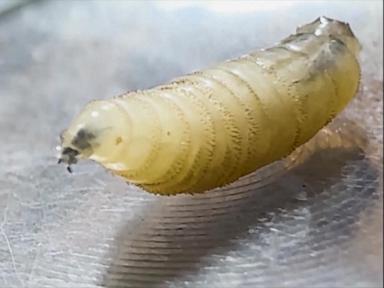
The confirmation of New World screwworm (Cochliomyia hominivorax) in a three-week-old calf in Zavala County, Texas, marks the first structural breach of the United States border by this parasite in decades. This is not a conventional livestock disease outbreak; it is a critical failure in a decades-old biological barrier. The re-emergence of the parasitic fly disrupts the agricultural economy, forcing an immediate transition from passive exclusion to active containment.
Understanding the mechanics of this biosecurity threat requires moving past sensational media coverage and examining the specific biological, logistical, and economic variables that dictate the success or failure of containment protocols.
The Vector Mechanics: Parasitic Architecture
Unlike standard blowflies that deposit eggs within necrotic tissue, the female New World screwworm fly targets live, warm-blooded mammals. The biological progression operates as an aggressive extraction function:
- Oviposition: The female fly deposits up to 400 eggs on the periphery of any breach in the dermal layer, including superficial lacerations, tick bites, castrations, branding marks, or the unhealed umbilicus of newborn livestock.
- Larval Instars: Within 12 to 24 hours, the larvae hatch and enter the wound. Equipped with specialized, sharp mouth hooks, they cut into healthy living tissue, burrowing vertically in a screw-like motion.
- The Destructive Feedback Loop: As the larvae feed, they secrete enzymes that enlarge the wound and induce secondary bacterial infections. This process emits a distinct odor that attracts additional gravid female flies, causing multi-generational infestations that can kill the host animal within seven to ten days if left untreated.
Because the parasite targets live flesh, its economic threat to livestock production is direct. Market implications appeared immediately following the USDA confirmation, as feeder cattle futures contracts dropped more than $5 per hundredweight. This market reaction reflects the anticipated structural costs of regional quarantine, strict movement controls, and mandatory physical inspections.
The Biosecurity Containment Framework
The containment strategy deployed by the USDA and the Texas Animal Health Commission (TAHC) relies on a dual-layer intervention model: geometric isolation and regional population suppression.
The Geometric Isolation Layer
The primary barrier against vector spread is the establishment of Infested Zone 01, a 20-kilometer (12-mile) quarantine perimeter centered on the La Pryor detection site. The operational protocols governing this zone establish a strict bottleneck for livestock logistics:
- Zero-Permit Movement Freeze: No warm-blooded animals—including commercial livestock, equine populations, and domestic pets—can exit the 20-kilometer perimeter without mandatory physical inspection and official clearance from a TAHC representative.
- Prophylactic Treatment Mandates: Animals cleared for transit must undergo topical chemical treatment to eliminate any undetected, early-stage larval infestations.
The structural limitation of this geometric isolation layer lies in its focus on managed hosts. While commercial cattle herds can be gathered, inspected, and restricted, local wildlife vectors—such as white-tailed deer and feral swine—move independently of agricultural fences. This introduces an unpredictable variable into the containment model.
The Sterile Insect Technique (SIT) Suppression Layer
Because physical quarantine cannot control wild hosts, the primary tool for eradication is the Sterile Insect Technique (SIT). This population-suppression model exploits a specific reproductive vulnerability: the female Cochliomyia hominivorax mates only once in her life cycle.
[SIT Factory: Mass Breeding] ---> [Gamma Radiation Sterilization]
                                                 |
                                                 v
[Wild Female (Mates Once)] <--- [Targeted Aerial & Ground Release]
            |
            v
[Non-Viable Eggs Laid] ---> [Population Collapse]
The success of SIT depends directly on the overflooding ratio, which requires introducing enough sterile males to ensure a wild female is statistically certain to select a sterile partner. If the sterile male population is insufficient, fertile matings will continue, allowing the infestation to expand beyond the quarantine boundaries.
The current intervention relies on a combination of ground release chambers inside the infested zone and an aerial drop of 4 million sterile flies per week. However, the international supply chain for these biological countermeasures faces significant constraints.
For decades, the single point of failure for North American biosecurity was the reliance on a single sterile-fly production facility in Panama, which maintained the biological barrier at the Darién Gap. The rapid northward advance of the parasite through Central America and Mexico over the last two years exposed the risks of this centralized supply chain.
While the USDA has allocated $21 million to convert a fruit-fly breeding facility in southern Mexico and is constructing a $750 million production facility in southern Texas, these facilities are not yet running at maximum capacity. This delay creates a temporary shortfall in sterile fly production just as demand peaks along the international border.
Regional Supply Disruptions and Trade Implications
The border breach forces a major reallocation of capital and alters cattle supply dynamics across North America. To slow the parasite's advance, the USDA suspended live cattle, horse, and bison imports from Mexico. This policy intervention cuts off a major source of feeder cattle for American feedlots, creating a distinct supply-side constraint.
| Variable | Baseline State (Pre-Breach) | Active Containment State (Post-Breach) |
|---|---|---|
| Import Pipeline | Open transit of Mexican feeder cattle via land ports of entry. | Complete suspension of live livestock imports across the southern border. |
| Logistical Overhead | Standard health certifications; predictable transit schedules. | Mandatory 20-km quarantine inspections, paperwork bottlenecks, and physical handling. |
| Production Costs | Standard veterinary management. | Intensive surveillance, mandatory wound treatment, and altered calving schedules. |
This regulatory shift creates a dual economic challenge. Feedlots face higher procurement costs due to the drop in imported cattle, while ranchers inside the quarantine zone face increased operational costs from mandatory animal handling and inspections.
The Operational Playbook for Producers
To minimize losses within the active containment zone, livestock operations must shift from passive herd observation to strict biosecurity protocols. The operational response centers on three main priorities:
- Chemical Prophylaxis: Ranchers must implement systematic wound management. Any elective surgical procedures, such as castration or branding, must be postponed or paired with long-acting topical larvicides.
- Calving Schedule Alignment: Newborn calves are highly vulnerable due to the open navel wound. Operations must align breeding cycles to ensure calving occurs during cooler months when adult fly activity drops sharply.
- Active Larval Surveillance: If a producer finds a suspicious wound, they must collect larval samples using forceps and preserve them in 70% alcohol for laboratory identification rather than attempting simple topical treatment. Early identification is critical to preventing local population growth.
The medium-term outlook for the North American livestock industry depends entirely on whether the La Pryor case remains an isolated incursion or indicates an established population. If the combination of strict movement controls and sterile fly releases fails to suppress the local population before the parasite spreads to wild animal populations, the containment zone will have to expand.
Such an expansion would trigger broader domestic trade restrictions, introducing long-term structural costs for the United States agricultural economy. Success depends on maintaining a high overflooding ratio of sterile flies and enforcing strict compliance with the quarantine boundary.