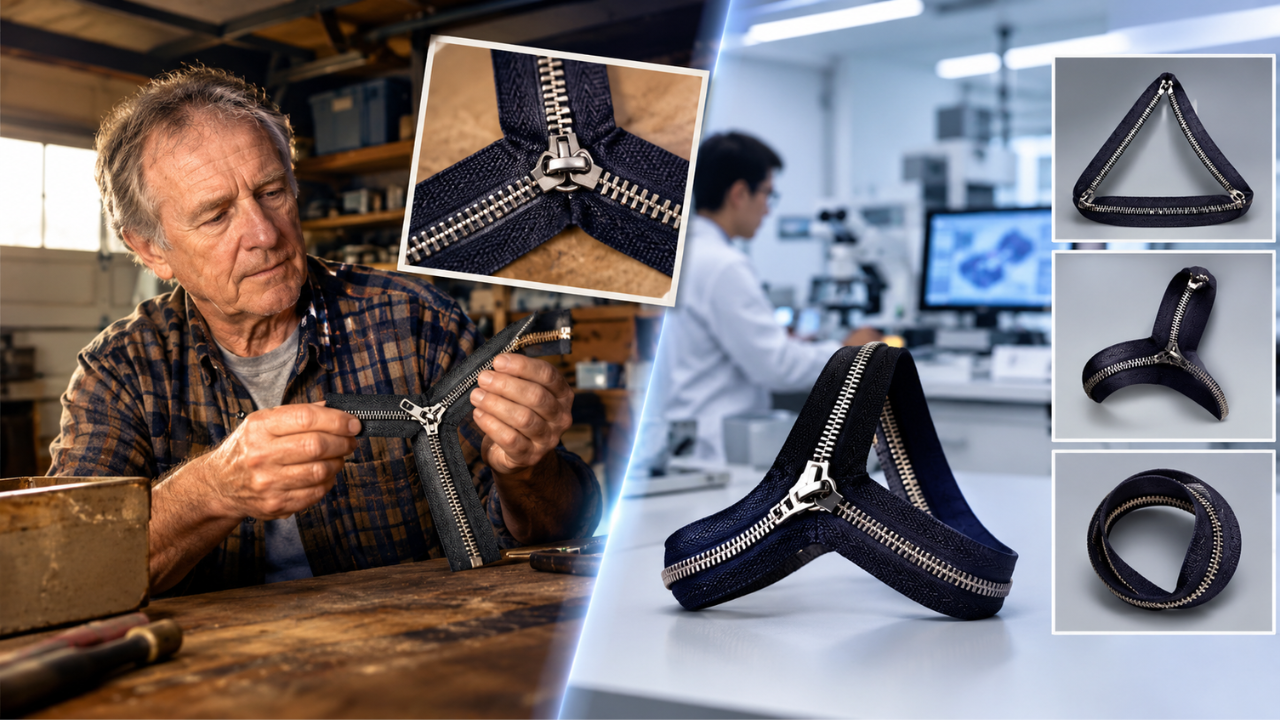
Forty years is a long time for an invention to sit in a dusty suburban garage. While the rest of the mechanical fastening world iterated on minor teeth geometry tweaks for standard two-way zippers, inventor Bill Freeman had already solved a three-dimensional topological problem that most engineers considered mathematically impossible. Or at least completely impractical.
The core premise centers on the three-sided zipper, a mechanical fastener designed to join three separate fabric or material panels simultaneously at a single convergence point. Traditional zippers operate on a binary principle. Two tracks meet along a linear path, forced together or pulled apart by a slider. Introduce a third edge, and standard mechanical logic breaks down. The teeth jam, the slider binds, and the junction tears itself apart under minimal tension.
Freeman cracked this problem in his basement workshop decades ago by rethinking the geometry of the interlocking elements and the internal channels of the slider. He built prototypes out of modified hardware, machined pieces by hand, and proved that three distinct textile panels could zip together into a single, cohesive plane without buckling or puckering. Then, life happened. Patent costs mounted, the apparel industry showed zero interest in overhauling supply chains for a novelty closure, and the prototype went into storage.
Now, researchers at the Massachusetts Institute of Technology have pulled Freeman’s mechanical blueprints and physical models back into the light.
Engineering departments love retro-futurism. Reviving forgotten patents looks great in a press release, but the re-emergence of Freeman's design highlights a deeper structural shift in modern manufacturing. We are moving away from planar manufacturing toward complex, multi-axis spatial assemblies. Whether you are building deployable space habitats, modular architectural facades, or high-performance composite shells for aerospace applications, linear joining methods are a bottleneck.
When you look at how engineers join three-dimensional structures today, the options are remarkably primitive. You rely on overlapping seams stitched with heavy industrial threads, messy epoxy resins that require curing time, or rigid mechanical fasteners that add unnecessary weight and create stress concentration points. None of these options offer the rapid deployment, easy disassembly, and structural continuity of a zipper.
Except standard zippers only handle two edges.
This is where the three-sided zipper transitions from a garage tinker's curiosity into a serious material science subject. MIT's interest is not in making better winter jackets or unusual backpacks. The focus is on topological interlocking and automated assembly. By mathematically mapping the tooth engagement angles, researchers can program robotic arms to snap complex composite structures together in seconds rather than hours.
To understand why this matters, look at how we currently assemble hexagonal honeycombs or triangular mesh panels for lightweight structures. Each joint must be secured individually. Every bolt or weld introduces a potential point of failure. A multi-directional zipper acts as a continuous structural seam that distributes tensile loads evenly across all three adjoining panels.
Of course, the apparel and gear industries will inevitably try to commercialize this for consumer goods. You can already picture the marketing copy for tents that pitch themselves or modular luggage systems that reconfigure on the fly. But consumer applications miss the grueling reality of textile manufacturing economics.
The global garment industry runs on an entrenched supply chain optimized for standard YKK-style linear teeth. Factories are tooled for straight lines. Introducing a three-way junction requires entirely new slider injection molds, specialized sewing techniques, and workers trained to feed three separate tensioned fabrics into a single carriage without skewing the weave. Margin-obsessed brands will not retool their factories for a niche fastener unless the structural benefits outweigh the logistical nightmare.
That is why the aerospace and defense sectors are far more likely early adopters than outdoor apparel brands. When you are deploying a temporary shelter on a lunar base or assembling an acoustic dampening array inside a satellite fairing, manufacturing cost per unit takes a back seat to rapid deployability and mass reduction.
Freeman's original design relied heavily on the precise tactile feedback of metal and hard plastics. Modern computational design allows MIT to take those analog insights and optimize them for additive manufacturing. Instead of machining individual teeth with brass cutters, researchers can print custom geometries directly onto the edges of technical textiles or carbon-fiber composite panels.
The geometry itself is fascinating from a mathematical standpoint. As the three tracks converge, the vector forces pull against each other in a three-way tug-of-war. If the teeth angle is off by even a fraction of a millimeter, the slider wedges solid. Freeman solved this through trial and error, filing down metal teeth until the movement felt smooth. Modern researchers use finite element analysis to simulate the stress distribution along the junction before cutting a single prototype.
Yet, digital simulation cannot completely replace physical intuition. The friction coefficients of different fabrics, the thermal expansion rates of polymers, and the cyclic fatigue of repetitive zipping all introduce variables that equations struggle to capture cleanly. The physical prototypes Freeman left behind in that garage provided an empirical baseline that saved the research team months of trial and error.
We often romanticize the lone inventor working in isolation, misunderstood by the mainstream until academia validates their genius decades later. The reality is usually more mundane. Freeman built a brilliant mechanical solution for a problem that the manufacturing ecosystem was not ready to solve yet.
The infrastructure required to manufacture, test, and integrate three-dimensional fasteners simply did not exist in the twentieth century. Laser cutting was in its infancy, computational stress modeling required mainframe access, and advanced composite materials were restricted to classified defense projects.
Today, desktop 3D printers and CNC routers sit in high school workshops. The barrier to prototyping complex mechanical geometries has dropped to zero. When MIT engineers pull an old patent file, they are not just looking at a clever mechanical trick. They are mining the past for solutions to problems that modern automation is finally equipped to tackle.
The three-sided zipper is no longer just a garage relic. It is a reminder that some of the best engineering ideas of our time are already written down, waiting for the technology around them to catch up.