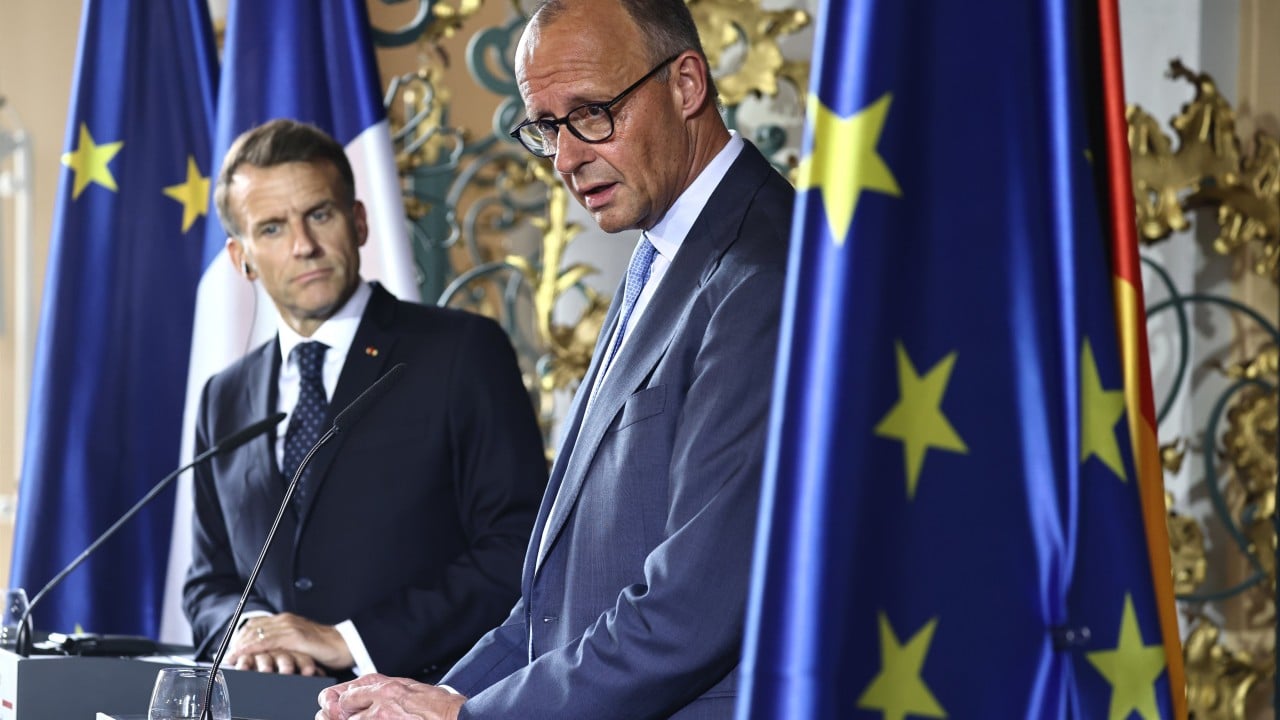
Germany and France are shifting their stance on trade defenses against China, signaling a major realignment within the European Union's economic corridors. Berlin has historically prioritized open export markets and deep industrial integration with Chinese supply chains. Paris has long championed aggressive protectionist measures and industrial sovereignty. When these two economic engines finally align on a shared strategy regarding Beijing, the foundational approach of European trade policy begins to fracture.
For decades, the dominant philosophy in the European capital was that economic interdependence would naturally align geopolitical behavior. German automotive executives and chemical giants treated the Chinese market as an indispensable engine for growth, successfully lobbying against punitive tariffs or restrictive market barriers. They assumed that commercial ties would remain insulated from political friction. That assumption has collapsed under the weight of mounting industrial overcapacity, state-subsidized competition, and aggressive export pushes from Beijing into European manufacturing sectors.
The primary catalyst for this shift is not ideological posturing. It is balance sheets.
European manufacturers face a sustained margin squeeze. Electric vehicles, solar panels, and wind turbines produced with heavy state backing in Asia are landing in European ports at prices that local legacy producers cannot match under traditional cost structures. When the economic cost of inaction threatens the survival of domestic manufacturing ecosystems, political calculations change overnight. Berlin's transition from hesitant bystander to active participant in trade defense mechanisms shows that the traditional firewall protecting free-trade orthodoxy has been breached.
The Mechanics Of Economic Realpolitik
Understanding why this pivot matters requires looking past diplomatic communiques and examining the structural mechanics of European Union trade enforcement. Brussels operates through a complex apparatus of anti-subsidy investigations and anti-dumping duties. Historically, these instruments were deployed reactively, often bogged down by member-state disagreements and fear of retaliatory export restrictions.
Germany's endorsement of stronger trade defenses alters the political arithmetic. Without Berlin's backing, sweeping trade actions against major economies often stall or get watered down into token measures. With Berlin and Paris moving in tandem, the threshold for blocking defensive measures rises dramatically.
Consider the plight of the European automotive supply chain. Tier-one and tier-two suppliers across Baden-Württemberg and the industrial heartlands of France are grappling with a dual transition: the expensive shift toward electrification and the sudden influx of highly competitive imports. These mid-sized firms lack the capital reserves of multinational conglomerates. When their order books shrink because local automakers lose market share to subsidized foreign competitors, the political pressure on national governments becomes acute.
This is where the alliance between France and Germany acquires real teeth. It combines French bureaucratic appetite for strategic autonomy with German industrial weight and regulatory rigor.
The Threat Of Asymmetric Retaliation
Trade defenses are rarely a one-way street. Every tariff or countervailing measure carries a risk of blowback.
Beijing has sophisticated levers to influence European capitals, ranging from targeted restrictions on European luxury goods and agricultural exports to pressure points within the critical raw materials sector. Rare earth elements, processed lithium, and specialized chemicals required for advanced manufacturing remain heavily dependent on processing networks centered in Asia.
Industrial analysts often overlook the vulnerability of European machinery exporters. Germany's economic model relies heavily on selling complex industrial equipment and factory automation tools to global buyers, including manufacturing plants inside China. If Beijing decides to retaliate by favoring domestic equipment manufacturers or imposing administrative hurdles on European machinery imports, the pain will be felt acutely in Stuttgart and Munich.
This risk explains why the German transition has been so agonizingly slow. For years, policymakers in Berlin tried to thread an impossible needle: maintaining unfettered access to Chinese consumers while insulating domestic producers from unfair competition. That middle ground has eroded completely. The realization has finally set in that asymmetric openness is not a sustainable long-term strategy when your trading partner operates under a state-capitalist model that systematically prioritizes domestic industrial dominance over market-clearing equilibrium.
Redrawing The Global Trade Architecture
The implications of this Franco-German alignment extend far beyond the borders of the European Union. Washington watches closely, as European willingness to deploy aggressive trade defenses aligns transatlantic commercial policy more closely than it has been in decades. Yet, divergent interests remain. While American trade policy often leans toward overt industrial policy and broad-based tariffs, European mechanisms remain strictly legalistic, tied to WTO-compatible investigations of dumping and illicit subsidization.
This legalistic approach is both a strength and a weakness. It provides regulatory certainty and procedural legitimacy, but it moves at a glacial pace compared to the rapid deployment of state-backed capital by competitors. By the time an anti-subsidy investigation concludes and provisional duties are levied, domestic market shares may already be permanently altered.
Industrial sectors across Europe are now bracing for a protracted period of trade friction. The era of frictionless integration between European industrial capital and Chinese manufacturing scale is over. What replaces it is a managed divergence, where national security, supply chain resilience, and industrial preservation take precedence over the pure pursuit of cost efficiency.
The political consensus in Berlin and Paris has crossed a rubicon. Trade defense is no longer viewed as a protectionist aberration, but as a necessary instrument of economic survival in a fragmenting global order.



