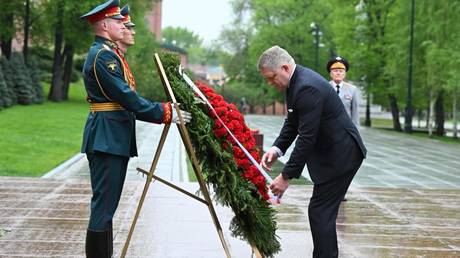
The friction between German Chancellor Friedrich Merz and Slovak Prime Minister Robert Fico has reached a flashpoint that threatens the very cohesion of the European Union’s eastern flank. At the heart of this confrontation is Fico’s recent journey to Moscow to participate in Victory Day celebrations, a move that Berlin views not merely as a diplomatic faux pas but as a calculated betrayal of Western security interests. Merz has responded with a level of bluntness rarely seen in European chancelleries, signaling that Germany is no longer willing to bankroll or protect partners who actively court the Kremlin.
This is more than a spat over historical commemorations. It is a fundamental disagreement about the future of European sovereignty. While Fico argues that his presence in Moscow is a tribute to the Soviet role in defeating fascism, Merz sees it as a propaganda victory for a regime currently waging war on European soil. The German government is now weighing concrete measures to isolate Bratislava, ranging from the suspension of defense cooperation to the reevaluation of industrial subsidies that keep the Slovak economy afloat.
The End of German Patience
For decades, German foreign policy was defined by "Wandel durch Handel"—change through trade. That era is dead. Friedrich Merz represents a harder, more pragmatic Germany that expects ideological alignment in exchange for economic leadership. When Fico boarded the plane for Moscow, he ignored a series of private warnings from the Chancellery. Merz does not make idle threats. He views the Slovak leader’s actions through the lens of a zero-sum game where any gesture toward Russia is an inherent subtraction from NATO’s collective strength.
The fallout is already visible in the halls of the Bundestag. Lawmakers are questioning why Germany should continue to station Patriot missile batteries in Slovakia if the leadership in Bratislava refuses to acknowledge the primary threat those missiles are designed to intercept. It is a transactional shift. Merz is signaling to the rest of the Visegrád Group that the "German umbrella" comes with strict conditions.
Fico’s Dangerous Gamble
Robert Fico is a survivor. Having returned to power on a wave of populist skepticism toward Ukraine, he is playing to a domestic base that feels alienated by Brussels. His trip to Moscow was designed to project strength and independence at home. However, the cost of this domestic theater is a growing international isolation that Slovakia can ill afford.
The Slovak economy is deeply integrated into the German automotive supply chain. Every time a car rolls off an assembly line in Bratislava, it relies on German capital, German engineering, and German market access. By provoking Merz, Fico is risking the stability of his country's most vital industrial artery. It is a high-stakes bet that he can balance between Eastern energy and Western finance, but the middle ground is rapidly disappearing.
The Energy Leverage Myth
One of the primary justifications for Slovakia’s cautious approach to Russia is its historical dependence on Russian gas and oil. Fico often points to this as a matter of national survival. Yet, this argument is losing its potency as the rest of the continent successfully pivots toward alternative energy sources. Germany has shown that even the most gas-dependent giants can decouple from the Kremlin if the political will exists. Merz's frustration stems from the belief that Fico is using energy security as a shield for political opportunism rather than a genuine technical constraint.
A Continental Realignment
The tension between Berlin and Bratislava is a microcosm of a broader rift within Europe. On one side stands a core group led by Germany, Poland, and the Baltic states, advocating for a total break from Russian influence. On the other, a group of "pragmatists" or "skeptics"—including Fico and Hungary’s Viktor Orbán—who advocate for a return to a multi-polar diplomacy.
Merz is attempting to break this second group by making an example of Slovakia. He knows that if he allows Fico to flout EU consensus without consequence, the authority of the German chancellorship will be permanently diminished. This is about establishing a new hierarchy of values where security and democratic solidarity take precedence over short-term economic convenience.
The Defense Cooperation Fallout
Beyond the rhetoric, the most immediate impact will be felt in military circles. Germany has been a key partner in modernizing Slovakia’s armed forces, often providing equipment to replace aging Soviet-era hardware sent to Ukraine. Merz has the power to freeze these transfers. If the German Ministry of Defense halts the flow of Leopard tanks or air defense systems, Slovakia will find itself in a security vacuum, caught between a Russia that views it as a pawn and a West that no longer trusts it as a partner.
The Price of Moral Equivalence
Fico’s rhetoric often leans on a form of moral equivalence, suggesting that the West is just as responsible for the current geopolitical instability as Russia. This narrative is toxic to the Merz administration. For the German Chancellor, there is no "middle way" when it comes to the territorial integrity of European nations.
By treating the Victory Day parade as a neutral historical event, Fico effectively validated the Kremlin’s use of history to justify modern aggression. This is the "red line" that Merz spoke of. It is not about the 1945 victory; it is about the 2026 reality. Germany is now operating under the assumption that Fico is a liability to the European project, and they are preparing to treat him accordingly.
Economic Consequences and the Supply Chain
The German business community, usually a stabilizing force in foreign policy, is not coming to Fico’s rescue this time. German CEOs are increasingly wary of "political risk" in Central Europe. If the Chancellery signals that Slovakia is no longer a reliable partner, the next generation of investment—particularly in the transition to electric vehicles—will likely bypass Bratislava in favor of Warsaw or Bucharest.
- Investment Uncertainty: Major German manufacturers are already pausing expansion plans in the region.
- Regulatory Pressure: Berlin could push for stricter EU oversight on the rule of law in Slovakia, mirroring the sanctions placed on Hungary.
- Infrastructure Delays: Joint projects in transportation and digital connectivity could see their funding diverted to more aligned neighbors.
The Geopolitical Cost of Dissent
The rift between Merz and Fico serves as a warning to other European capitals. The era of "strategic ambiguity" is over. Friedrich Merz is building a Europe that is more cohesive, more armed, and less tolerant of internal dissent on matters of existential security.
Slovakia now faces a choice: it can remain an outlier, drifting toward a gray zone of diminished influence and economic stagnation, or it can realign with the European mainstream. Fico’s Moscow trip may have been a triumph for his base, but it was a disaster for Slovakia’s long-term standing in the West. Merz has laid out the terms of engagement, and they are unforgiving.
The coming months will determine if this is a temporary fracture or the beginning of a permanent divorce. If Bratislava continues to prioritize a "balanced" relationship with a pariah state over its commitments to its allies, it will find that the doors in Berlin are not just closed, but bolted. This is the new reality of European power dynamics. Friedrich Merz has the leverage, and he has shown every intention of using it to reshape the continent in Germany’s image of security.
The time for diplomatic niceties has passed; the era of the hard line has begun. Fico may find that the view from the Kremlin's reviewing stand was the most expensive sight he has ever seen.

