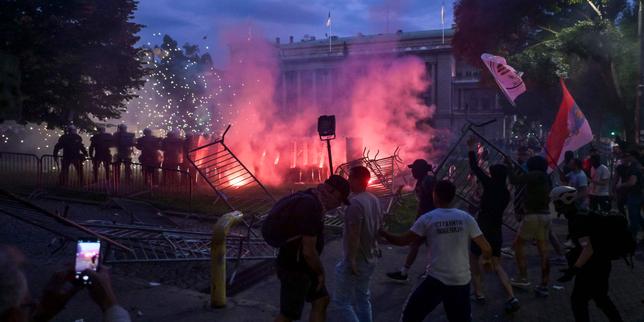
More than 180,000 people flooded the streets of Belgrade this week, transforming the Serbian capital into a sea of flashlights and whistles. This is not just another protest. It is a massive, calculated gamble by a population that feels its democratic levers have been disconnected from the machine of state. While the official demand focuses on snap elections to restart a stalled anti-corruption movement, the reality on the ground reveals a much deeper fracture in the Balkan power structure.
The sheer scale of the mobilization has caught the ruling Serbian Progressive Party (SNS) off guard. For years, the government has relied on a fragmented opposition and a controlled media environment to maintain a veneer of stability. That veneer cracked when the masses occupied the Gazela Bridge, effectively halting the city's pulse to demand a total overhaul of the electoral system. If you found value in this post, you should check out: this related article.
The Mechanics of Discontent
Protests in the Balkans often flare up and die out with the seasons. This time is different. The movement has moved past vague slogans about "better lives" and transitioned into a technical assault on the way the state functions. The core grievance centers on the "Bulldozer" effect—the perception that the current administration has flattened independent institutions to clear a path for cronyism.
Organizers are no longer asking for minor concessions. They want a complete purge of the regulatory bodies that oversee television frequencies, arguing that state-aligned channels have become tools for character assassination rather than information. By demanding elections under "fair and free" conditions, the movement is admitting that any vote held tomorrow under the current rules would be a mathematical impossibility for the opposition. For another angle on this event, see the latest coverage from Reuters.
Why Corruption is the Lightning Rod
Corruption in Serbia isn't just about bribes under the table. It has evolved into a sophisticated system of patronage where public sector jobs and infrastructure contracts are linked directly to party loyalty. This creates a closed loop. The government provides the jobs, the employees provide the votes, and the cycles repeat.
The 180,000 people in the streets represent the "un-aligned" middle class and the youth who find themselves locked out of this economy. They are watching billions of euros in foreign investment flow into the country while their own purchasing power stagnates. They see the gleaming towers of Belgrade Waterfront as monuments to an elite that no longer speaks their language.
The Electoral Trap
The government’s response has been a classic display of tactical retreat and counter-offensive. President Aleksandar Vučić has hinted at early elections, but the opposition knows this is a trap. Calling for elections without changing the media law is like asking a boxer to fight with his hands tied behind his back while the referee is on the other fighter's payroll.
- Media Domination: Pro-government tabloids and national broadcasters provide 24/7 coverage of the presidency while ignoring or vilifying dissenters.
- Voter Pressure: Reports of "captive voters"—employees in state enterprises forced to attend rallies—remain a persistent shadow over the democratic process.
- Institutional Capture: The Election Commission and the judiciary are viewed by many as extensions of the executive branch.
To win, the protesters need more than just a date on a calendar. They need a transition period where the playing field is leveled. This is the sticking point that could lead to a long, cold winter of civil disobedience.
The Geopolitical Tightrope
Belgrade is the center of a geopolitical tug-of-war. The European Union watches these protests with a mixture of hope and anxiety. On one hand, Brussels wants a democratic, corruption-free Serbia. On the other, they rely on the current leadership to maintain a fragile peace with Kosovo and to keep Russian influence at bay.
This creates a paradox. The protesters feel abandoned by Western democracies that prioritize "stabilitocracy" over actual democracy. They see European officials shaking hands with the very leaders they are trying to oust. This has birthed a new strain of Serbian activism—one that is fiercely pro-European in values but deeply skeptical of the European bureaucracy.
The Role of the Youth
Generation Z in Serbia is not interested in the wars of the 1990s or the tired rhetoric of nationalist identity. They are digital natives who compare their lives to their peers in Berlin or Warsaw. When they see a minister accused of plagiarism or a state contractor getting rich off a bridge project, they don't see "politics as usual." They see their own future being stolen in real-time.
They are the ones coordinating the logistics of these marches. Using encrypted apps and decentralized leadership, they have made it difficult for the police to identify single "ringleaders" to arrest or discredit. This horizontal structure is the movement's greatest strength and its most significant vulnerability. Without a clear face, it is hard to negotiate; without a clear face, it is impossible to decapitate.
Breaking the Cycle of Apathy
The government's strategy is to wait. They believe that the crowds will thin as the weather turns and the daily grind of survival takes over. They are banking on "protest fatigue." In the past, this strategy has worked brilliantly. People get tired of walking, tired of shouting, and eventually, they go home.
However, the 180,000 figure is a psychological threshold. It signals that the fatigue has been replaced by a quiet, burning resentment that does not evaporate easily. The demand for elections is merely the "legal" container for a much larger demand: the right to a country where the law applies to everyone equally.
The Economic Undercurrent
While the headlines shout about democracy, the stomach growls about inflation. Serbia has seen a sharp rise in the cost of basic goods, far outstripping wage growth for those outside the ruling party's circle. When food prices spike while the government announces multi-million euro stadiums, the optics are disastrous.
The anti-corruption movement has successfully linked these two issues. They have convinced the public that the reason eggs are expensive is the same reason the judicial system is broken: a lack of accountability. By framing corruption as a kitchen-table issue, they have broadened their base from university students to pensioners.
The Path to a Deadlock
We are approaching a stalemate. The government cannot crack down too hard without risking EU sanctions and more massive turnouts. The opposition cannot back down without losing the momentum they have spent months building.
If elections are called under the current conditions, the opposition may boycott, stripping the resulting government of its legitimacy. If elections are not called, the protests will likely escalate into strikes and blockades of major transit arteries. Neither side has a clear exit ramp that allows them to save face.
The movement has moved beyond the point of simple "reform." It is now a contest of endurance. The streets are full because the ballot boxes are perceived as empty. Until that perception changes, the bridges of Belgrade will remain a battlefield for the soul of the country.
The state's monopoly on power is being challenged by a monopoly on the truth of the street. Whether this leads to a genuine democratic reset or another decade of managed autocracy depends entirely on whether those 180,000 people are willing to stay in the cold long after the cameras have left. The next few weeks will determine if Serbia is a country in transition or a country in stasis.
Every whistle blown in the streets of Belgrade is a reminder that the social contract is currently being shredded.


