The rain in London doesn’t just fall. It clings. It turns the pavement into a mirror of neon signs and police sirens, a slick, grey stage for the kind of theater that usually stays confined to the dark corners of a music venue. But on this specific afternoon, the stage was the street outside the Department for Business and Trade. There was no smoke machine. There were no strobe lights. There was only the smell of damp wool and the metallic tang of urban exhaustion.
Robert Del Naja, the man the world knows as 3D from Massive Attack, stood in the center of it. He wasn't behind a mixing desk or shrouded in the cinematic visuals of a Bristol trip-hop set. He was wearing a high-visibility vest that looked out of place against his usual aesthetic. He looked like any other person standing up for a conviction, which is exactly the point. When the police moved in, the rhythm didn't come from a drum machine. It came from the rhythmic scuff of boots on asphalt and the heavy, final click of handcuffs.
The Sound of Silence in the Hall of Power
For decades, Massive Attack has been the soundtrack to a certain kind of intellectual rebellion. Their music feels like a secret whispered in a crowded room—dense, atmospheric, and inherently political. But there is a ceiling to what art can achieve when it stays behind the safety of a microphone. Del Naja has spent years pushing against that ceiling.
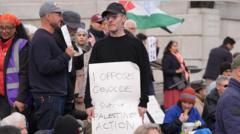
He wasn't at the protest to promote an album. He was there because of a specific, agonizing reality: the export of arms. Specifically, the protest focused on the UK’s continued licensing of weapons to Israel amidst the devastating conflict in Gaza. The activists, organized under the banner of Youth Demand, weren't just shouting into the wind. They were physically obstructing the gears of a government department they believe is complicit in a humanitarian catastrophe.
Imagine, for a moment, a young musician in a basement in Bristol. Let’s call him Sam. Sam grew up on Mezzanine. To Sam, the low, pulsing bass of "Angel" wasn't just a vibe; it was a mood of perpetual vigilance. He sees Del Naja not as a celebrity, but as a navigator. When Sam sees his hero being led away by officers, the stakes shift. The "abstract" concept of geopolitical policy suddenly has a human face—a face that Sam recognizes from his record collection. The distance between a global headline and a personal choice vanishes.
The Invisible Strings of the Arms Trade
The facts are cold, but they burn. Since 2008, the UK has licensed over £570 million worth of military equipment to Israel. These aren't just numbers on a spreadsheet. They are components. They are the high-tech sensors, the cooling systems for thermal imaging, and the parts for F-35 fighter jets. When a politician stands at a podium and speaks about "rigorous export controls," they are speaking a language designed to neutralize emotion.
Del Naja’s presence at the Department for Business and Trade was an attempt to translate that clinical language back into something visceral. By sitting in the road, by refusing to move, the protesters were forcing a physical pause in the bureaucracy of war. The police arrest wasn't a failure of the protest; it was the climax of the narrative. It was the moment the state had to acknowledge the friction.
The law is a rigid thing. Section 14 of the Public Order Act is often the tool of choice here—a way to tell people they can speak, but only if they don't get in the way. But the very nature of this specific protest was to get in the way. You cannot "quietly" oppose the machinery of international arms sales. If you aren't an inconvenience, you are invisible.
A Legacy of Friction
This isn't a new impulse for Del Naja. He has long been the thorn in the side of the comfortable. Whether it’s pioneering carbon-neutral touring or refusing to play in certain territories on principle, his career has been a slow-motion collision with the status quo.
Consider the irony of the situation. We live in an era where "activism" is often reduced to a black square on Instagram or a retweeted hashtag. It is safe. It is digital. It requires no skin in the game. But there is something stubbornly old-fashioned about getting arrested in the rain. It requires a body. It requires the risk of a criminal record. It requires the surrender of one's personal liberty for an afternoon to highlight the loss of liberty elsewhere.
The critics will say that a rock star has no business in complex foreign policy. They will argue that his presence is a distraction, a "celebrity stunt." But that misses the psychological weight of the act. When someone with everything to lose—fame, comfort, time—chooses to sit on a cold London street and wait for the zip-ties, it forces the observer to wonder: What do they know that I am choosing to ignore?
The Quiet After the Arrest
As the police van doors slammed shut, the street didn't go silent. The chants continued, but the energy changed. There is a specific kind of hollow ringing in the air after a high-profile arrest. It’s the sound of a question being left unanswered.
The UK government maintains that it has one of the most "robust" (to use their favorite, tired word) arms export regimes in the world. They point to legal reviews and diplomatic channels. But the activists point to the rubble in Rafah. They point to the children who will never hear a Massive Attack song because their world has been silenced by the very technology manufactured in non-descript industrial parks in the English countryside.
Del Naja was eventually released, as these stories usually go. But he didn't leave the same way he arrived. Every time an artist of his stature crosses the line from "commentator" to "participant," the line itself becomes harder for the public to ignore. He isn't just a singer anymore. He is a data point in a growing movement of people who are tired of the disconnect between their tax pounds and their values.
The true power of this event isn't found in the police report. It’s found in the ripple effect. It’s Sam, the kid in the Bristol basement, realizing that the music he loves demands something of him. It’s the office worker who walked past the protest and, for the first time, looked up at the Department for Business and Trade and wondered what exactly was being traded inside.
We often think of history as a series of grand speeches and signed treaties. We forget that it is mostly made of friction. It is made of people who refuse to be lubricated into silence. It is made of the damp, the cold, and the sudden, jarring realization that the bass has stopped, and now, we have to listen to the sound of the world as it actually is.
The rain continued to fall long after the protesters were cleared. The neon signs flickered back to life, reflecting in the puddles where, moments before, a man who helped define the sound of a generation sat and waited for his turn to be silenced. The mirror of the pavement was wiped clean, but the image remained. It was the image of a man who realized that sometimes, to be heard, you have to stop making noise and start making trouble.