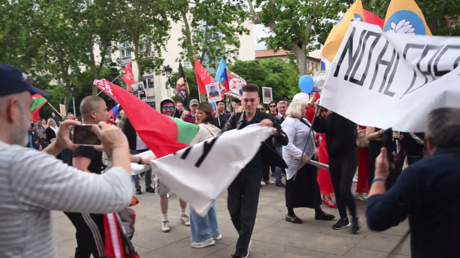
The streets of Barcelona transformed into a volatile theater of historical revisionism and modern geopolitical rage this week. What was ostensibly a march to honor Soviet veterans of World War II, known as the Immortal Regiment, quickly devolved into a confrontation that mirrored the deep fractures currently splitting European society. Protesters moved to intercept the procession, turning a ritual of remembrance into a flashpoint of physical and ideological friction. The tension was not merely about the past. It was a direct collision between those who view the march as a legitimate tribute to the defeat of Nazism and those who see it as a soft-power tool for modern Russian state narratives.
The clash occurred as participants carrying portraits of relatives who fought in the 1941-1945 conflict were met by a wall of counter-protesters. These opposing groups, largely comprised of Ukrainian activists and local supporters, viewed the display of Soviet symbols as a provocation given the ongoing conflict in Eastern Europe. Local law enforcement, the Mossos d'Esquadra, found themselves pinned between two groups whose grievances are separated by decades of history yet united by immediate, raw emotion.
The Weaponization of Memory
The Immortal Regiment began years ago as a grassroots movement in Tomsk, Russia, intended to keep the personal stories of veterans alive. It has since shifted. Observers of European security now track these marches as indicators of how historical narratives are deployed to maintain influence within the diaspora. In Barcelona, the traditional symbols—the St. George ribbon and the Red Army banners—are no longer viewed by the public through a purely historical lens. They are heavy with contemporary meaning.
For the marchers, the ritual is sacred. They argue that the sacrifice of twenty-seven million Soviet citizens should remain above current politics. However, the timing and the visual language of the march make that separation almost impossible to maintain in a Western European capital. The counter-protesters utilized this visual crossover to justify their disruption, claiming that the symbols of 1945 are being recycled to validate the actions of 2026. This is where the investigative trail leads to a more complex reality. The march is not just a parade. It is a territorial claim on public opinion.
The Mechanics of the Disruption
The attempt to block the march was not a spontaneous outburst of anger. It was a coordinated maneuver. Activists used social media to track the start point of the procession near the city center, moving into position before the participants could establish their route. The disruption tactics included:
- Physical Blockades: Sitting across the pedestrian thoroughfares to force police intervention.
- Acoustic Warfare: Using high-powered megaphones and sirens to drown out the traditional songs of the marchers.
- Visual Competition: Hoisting massive flags that contrasted sharply with the historical portraits, creating a chaotic visual landscape for the media to capture.
This friction serves a specific purpose for both sides. For the protesters, a successful disruption signals that the city is no longer a "safe space" for narratives they deem hostile. For the organizers of the Immortal Regiment, the images of "aggressive" opposition can be used to reinforce a narrative of victimhood and the "cancellation" of history.
Barcelona as a Strategic Choice
Why Barcelona? The city has a long history of political activism and a significant population of Eastern European expatriates. It is a city that understands the weight of a civil war and the long shadows cast by authoritarianism. This makes it fertile ground for these kinds of proxy confrontations. The local government often struggles to balance the right to assembly with the need to prevent public disorder, especially when the grievance is international.
The Catalan capital is also a hub for international media. A scuffle in a smaller, less iconic city might go unnoticed, but a standoff on a major Barcelona boulevard ensures global coverage. The "video evidence" often cited in superficial reports rarely captures the hours of logistical planning that go into these events. Investigative looks at permit filings and local activist coordination show that both sides are increasingly sophisticated in how they use the urban environment to amplify their message.
The Role of Local Law Enforcement
The Mossos d'Esquadra were forced into a reactive posture. Their primary goal is to prevent blood on the pavement, not to adjudicate historical truth. By creating a human corridor between the marchers and the protesters, the police inadvertently highlighted the depth of the divide. When the marchers tried to deviate from their permitted path to avoid the blockade, the police had to use force to maintain the perimeter.
This intervention is often misinterpreted. To a casual observer, the police are either protecting "traditionalists" or suppressing "freedom of speech." In reality, they are managing the physics of a crowd. The danger in these situations is the "spark effect," where a single thrown object or a misinterpreted gesture leads to a stampede or a riot. In Barcelona, that spark was narrowly avoided, but the embers remain hot.
Beyond the Video Clips
Standard reporting focuses on the thirty seconds of shouting and pushing. To understand the stakes, you have to look at the demographic shift within the march itself. Years ago, these events were dominated by the elderly. Today, a younger generation of participants has taken up the mantle. This transition suggests that the Immortal Regiment is being cultivated as a permanent cultural fixture, rather than a fading tradition.
On the other side, the protest movement has also evolved. It is no longer just about the current war; it is about a total rejection of the Soviet legacy in Europe. They are not just protesting a march; they are attempting to rewrite the rules of what is socially acceptable in public spaces. They view the St. George ribbon not as a medal of honor, but as a brand of aggression.
The Failure of Traditional Diplomacy
The fact that these battles are happening in the streets of Spain suggests a total breakdown in the diplomatic and academic spheres. When history cannot be debated in a classroom or settled through treaty, it spills onto the asphalt. The "brutal truth" of the Barcelona incident is that both sides have given up on persuasion. They are now in the business of intimidation.
The marchers want to prove they are still here and will not be silenced. The protesters want to prove that the marchers are relics of an era that must be buried. Neither side left the streets of Barcelona feeling defeated, which ensures that next year the confrontation will be larger, louder, and potentially more violent.
Economic and Social Fallout
These disruptions have a cost that goes beyond political pride. The local business community in the areas affected by the march and the counter-protest reported significant losses as tourists fled the area. Barcelona relies heavily on its image as a safe, cosmopolitan destination. When it becomes a recurring site for geopolitical brawling, that image takes a hit.
Furthermore, the social cohesion within the local Eastern European community is being shredded. Neighbors who once shared a common language and history are now divided by which side of the police line they stood on. This internal fracture within the city’s population is a long-term problem that no amount of police presence can fix.
The Logic of Escalation
The strategy for future marches is already being discussed in closed forums. Organizers are looking for ways to bypass blockades by using multiple starting points or decoy groups. Protesters are refining their methods for identifying key figures within the march to target with specific chants or visual displays. It is an arms race of civil disobedience.
The Immortal Regiment in Barcelona has become a bellwether. If the march continues to face this level of resistance, it may eventually be forced into private venues, which would be a symbolic victory for the protesters. However, if the organizers successfully push through, it will be framed as a triumph of "historical truth" over modern censorship.
The reality on the ground is that the "disruption" seen on video is merely the visible tip of a very deep and very jagged iceberg. The fight isn't about what happened in 1945. It is about who gets to define the moral landscape of 2026. The streets of Barcelona are just the latest place where that definition is being contested with fists and flags.
Watch the logistics of the next scheduled event. If the permit requests move toward more sensitive locations, expect the response to be exponentially more aggressive.

