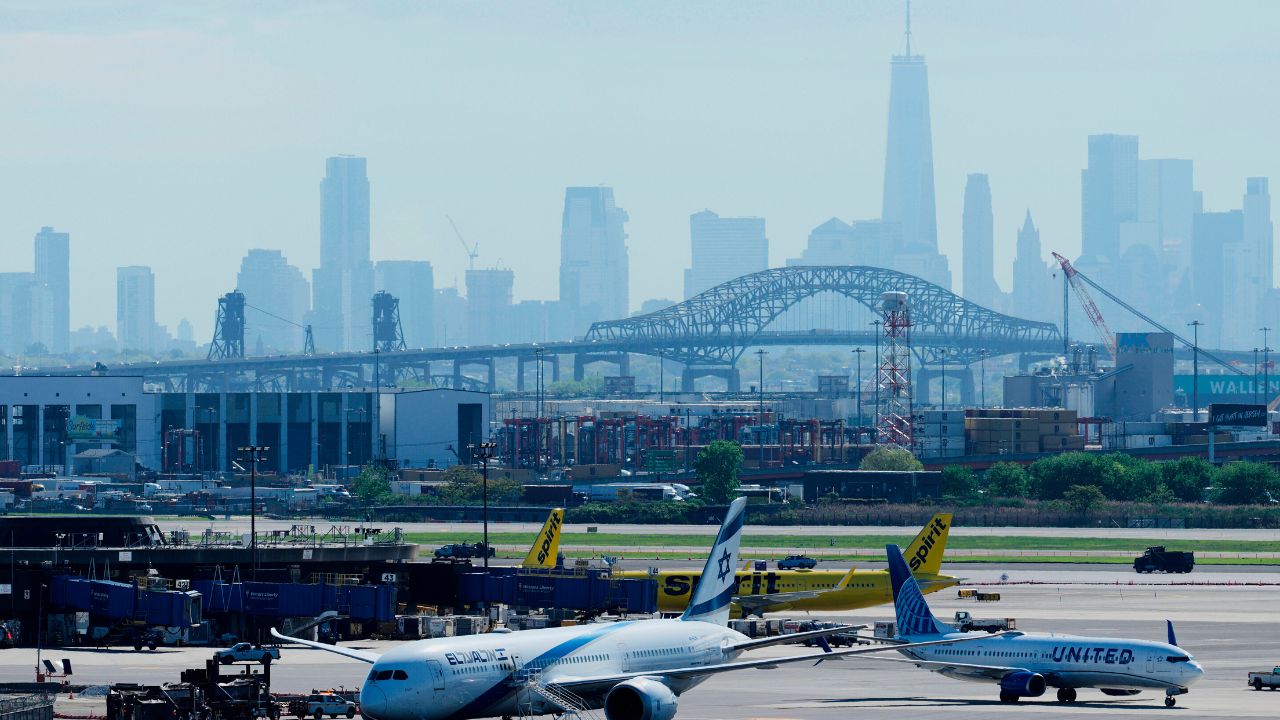
The collision between a descending commercial aircraft and ground-based infrastructure near Newark Liberty International Airport serves as a localized failure point within the complex, high-energy system of terminal airspace. This incident is not merely an isolated operational error; it is a manifestation of the interaction between terminal approach trajectories and physical constraints in highly congested urban environments. Understanding this event requires isolating the variables that govern final approach safety, specifically the intersection of navigation precision, obstacle clearance zones, and ground-level secondary infrastructure density.
Terminal Airspace and Obstacle Clearance Mechanics
Commercial flight operations within terminal airspace operate under strict adherence to Terminal Instrument Procedures (TERPS). These procedures define a protected volume of airspace around an airport, designed to ensure that an aircraft maintaining a stabilized approach profile avoids all man-made or natural obstructions. When an aircraft deviates from these parameters to the extent of physical contact with surface-level infrastructure, the causal chain typically bifurcates into two distinct categories: guidance error or environmental deviation.
The primary defense against these incidents is the Obstacle Free Zone (OFZ). This volume of airspace is specified to keep the runway environment free of objects that could interfere with navigation aids or the flight path of an aircraft during landing or takeoff. When an aircraft makes contact with a pole on a thoroughfare like the New Jersey Turnpike—which passes in close proximity to the approach paths for Newark—the incident highlights a breach of the lateral or vertical buffer zones intended to prevent such interactions.
Energy Dissipation and Infrastructure Impact
The kinetic energy involved in an aircraft-to-ground-object strike is significant, even at the lower speeds of a final landing approach. An aircraft in the landing configuration, despite having deployed flaps and landing gear to maximize lift and drag, possesses substantial mass. The impact with a utility pole or delivery vehicle is governed by the conservation of momentum.
The structural integrity of a commercial aircraft fuselage and its control surfaces is optimized for aerodynamic load, not impact resistance against rigid steel or concrete poles. The transfer of energy during such a collision results in immediate structural deformation. When the aircraft damaged a delivery truck, the mechanics of this transfer involved:
- Mass differential: The aircraft serves as the primary energy carrier, with the delivery truck acting as a secondary target of impulse.
- Structural vulnerability: The leading edges of wings, landing gear assemblies, and engine cowlings are the most exposed components during a low-altitude off-runway excursion.
- Secondary impact potential: Debris from the initial pole strike acts as secondary projectiles, which further compromises the integrity of the aircraft's propulsion or flight control systems.
The Risk Profile of Urban Proximity
Newark Liberty International Airport represents one of the most operationally constrained aviation hubs in the United States. Its location mandates that approach paths are tightly integrated with the surrounding metropolitan infrastructure. The proximity of the New Jersey Turnpike—one of the nation's most heavily trafficked highway arteries—to the airport's runway threshold creates a perennial friction point.
The risk management strategy in these environments relies on:
- Precision Navigation: Utilizing Instrument Landing Systems (ILS) or Required Navigation Performance (RNP) to maintain a strict vertical and lateral glide slope.
- Buffer Zone Maintenance: Ensuring that airport property limits and approach surfaces are sufficiently buffered from public road networks.
- Operational Thresholds: Establishing strict limits on acceptable crosswind components or visibility conditions that might force a pilot to deviate from the established path.
When these systems fail to prevent an incident, investigators assess the "human-in-the-loop" factor. Pilots are trained to execute a "go-around"—a maneuver to abort a landing—if the approach becomes unstable. The inability to execute or initiate this maneuver prior to contact suggests a rapid transition from a perceived safe state to an unrecoverable flight condition.
Failure Analysis of Terminal Constraints
The fundamental challenge in urban aviation is the compression of flight corridors. As air traffic density increases, the margin for error decreases. A pilot's ability to maintain a stabilized approach relies on a high degree of predictability. Any unexpected disruption—such as extreme wind shear, an instrument malfunction, or sudden loss of situational awareness—compresses the time available to initiate corrective action.
The incident at Newark indicates a failure within the "Safety Management System" (SMS). In aviation, an SMS is a systematic approach to managing safety, including the necessary organizational structures, accountabilities, policies, and procedures. If an aircraft makes contact with a pole outside the airport boundary, the SMS must account for why the aircraft was positioned outside the protected flight path.
Strategic Mitigation and Systemic Oversight
To mitigate future instances of ground-level structural interference, airport operators and aviation authorities must shift their focus toward three tactical adjustments:
- Enhanced Situational Awareness Geometry: Implementing geofencing technology that provides pilots and air traffic controllers with real-time, high-fidelity visual indicators when an aircraft's projected flight path diverges from the certified obstacle clearance zone.
- Infrastructure Decoupling: Evaluating the spatial distance between runway approaches and high-density transportation corridors. While full separation is rarely possible in dense urban centers, the placement of permanent utility infrastructure must be reassessed to minimize the risk of being a strike point.
- Predictive Turbulence Modeling: Improving the micro-meteorological data provided to pilots on final approach. Often, the interaction between tall buildings, highways, and the aircraft wing creates localized vortices that can induce sudden roll or pitch changes, reducing the pilot's effective control authority.
The investigation into this event must prioritize the retrieval of the Flight Data Recorder (FDR) and Cockpit Voice Recorder (CVR) to reconstruct the exact control inputs during the final seconds of the approach. By isolating the delta between commanded input and actual aircraft position, authorities can determine if the deviation was a byproduct of external environmental factors or an internal procedural breakdown.
Future flight path planning must account for the increasing frequency of extreme weather events, which exacerbate the difficulty of maintaining stable approaches in complex urban environments. Authorities should mandate a review of the physical obstruction height limits within a 5-mile radius of the runway threshold, specifically targeting infrastructure that does not currently meet modern safety clearance standards.