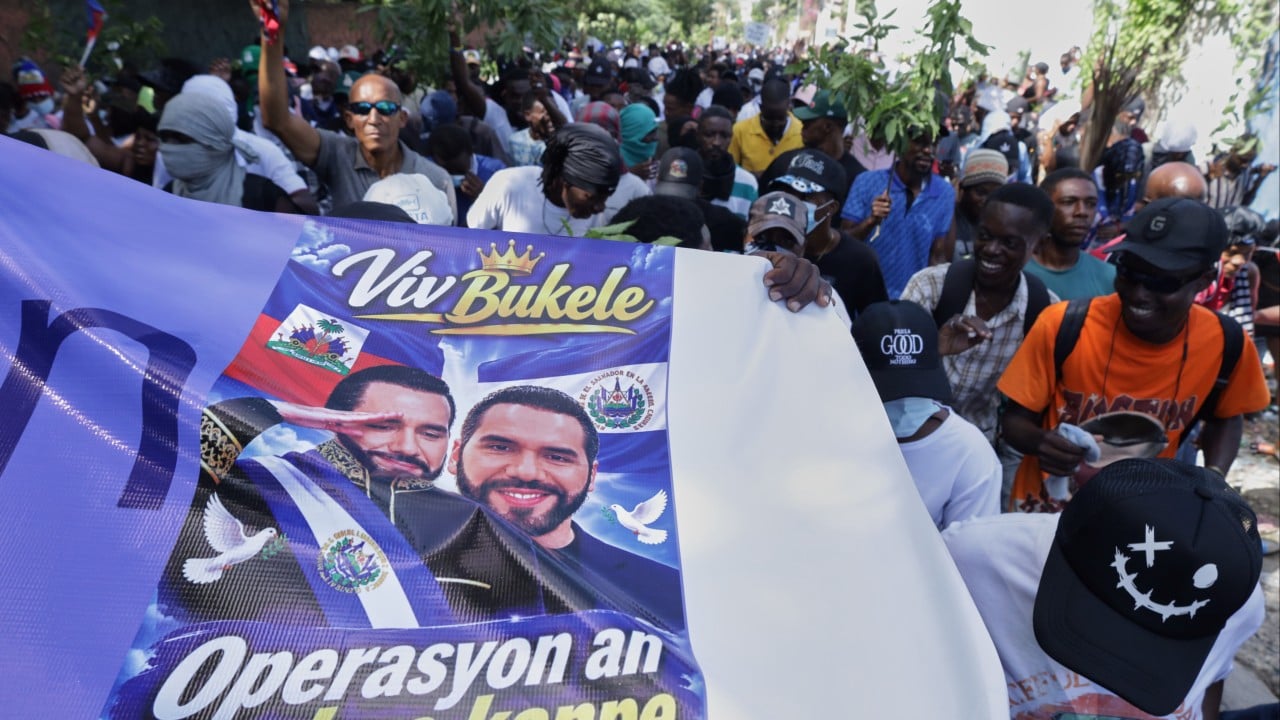
When Salvadoran President Nayib Bukele announced that deployed Salvadoran security forces had destroyed the residence of a prominent Haitian gang leader, the statement operated simultaneously as a tactical military report and a strategic communications asset. Standard news coverage treats such announcements as isolated kinetic events—a simple ledger of troops deployed, targets struck, and turf cleared. That framing misses the underlying operational mechanics. Exporting the Salvadoran security apparatus to Port-au-Prince is not a linear extension of domestic policing; it is an asymmetric expeditionary experiment that collides with fundamentally different institutional, geographic, and economic variables.
To evaluate the viability of Salvadoran intervention in Haiti, analysts must separate theatrical deterrence from durable territorial control. Destroying a physical compound removes a symbolic asset, yet gang networks in Haiti do not rely on fixed real estate for command and control. Understanding why a tactical strike in Port-au-Prince produces different outcomes than a sweep in San Salvador requires breaking down the structural divergence between the two theaters, the mechanics of international security mandates, and the operational friction of urban counter-insurgency. Read more on a connected subject: this related article.
The Structural Divergence Between El Salvador and Haiti
The primary error in assuming the Salvadoran security model can be exported wholesale lies in equating two fundamentally distinct criminal ecosystems. Between 2022 and 2024, the Bukele administration dismantled MS-13 and Barrio 18 through mass incarceration, suspension of constitutional due process under a state of exception, and saturation policing. That campaign succeeded because the target variables in El Salvador possessed specific vulnerabilities that do not exist in Haiti.
Institutional Baseline and State Monopoly on Force
In El Salvador, the state retained a functioning administrative core, a unified military command, and an intact judiciary prior to the crackdown. The Salvadoran Armed Forces (FAES) and the National Civil Police (PNC) operated on internal lines of communication within a compact territory of roughly 21,000 square kilometers. When the executive branch authorized mass arrests, the state possessed the bureaucratic capacity to process, transport, and warehouse over 80,000 detainees, culminating in the construction of the Terrorism Confinement Center (CECOT). Additional journalism by USA Today highlights similar views on this issue.
Haiti presents the inverse condition. State institutions in Port-au-Prince have suffered systemic hollowing. The Haitian National Police (PNH) suffers from chronic attrition, equipment deficits, and severe numerical inferiority relative to the armed coalitions it faces. There is no intact judicial pipeline to process mass detentions, nor is there a secure penal infrastructure capable of holding high-value targets without triggering coordinated prison breaks—a vulnerability demonstrated repeatedly when armed coalitions breached major penitentiaries in Port-au-Prince and Croix-des-Bouquets. When Salvadoran troops operate in Haiti, they are not reinforcing an existing state monopoly on violence; they are acting as a kinetic patch over an institutional vacuum.
Organizational Topology of the Target Networks
Salvadoran gangs historically operated as hierarchical, identity-driven street organizations financed primarily through localized micro-extortion of small businesses and public transit. Their members were identifiable through tattoos, geographic turf boundaries, and rigid clique structures. Once the state severed communication between imprisoned leadership and street-level cells, the operational cohesion of the gangs collapsed.
Haitian armed groups—most notably the Viv Ansanm coalition led by figures such as Jimmy "Barbecue" Chérizier—function as decentralized warlord networks and mercenary militias. Their revenue streams are diversified across macro-level choke points:
- Port and Customs Extortion: Controlling access to the Autorité Portuaire Nationale (APN) and private terminals, allowing gangs to tax imported food, fuel, and commercial goods at the point of entry.
- Transit Corridor Tolls: Establishing fortified checkpoints along Route Nationale 1 and Route Nationale 2, effectively severing Port-au-Prince from the northern and southern peninsulas unless transit fees are paid.
- Kidnapping-for-Ransom Syndicates: Operating industrialized abduction networks that target both domestic elites and foreign nationals, generating liquid capital independent of local retail extortion.
- Political Patronage: Maintaining historical ties to rival political and economic factions that supply weaponry and intelligence in exchange for street-level coercion.
Destroying a gang leader's physical mansion disrupts a node of prestige, yet it leaves these revenue arteries intact. Unlike Salvadoran cliques dependent on neighborhood foot traffic, Haitian coalitions operate like decentralized insurgencies that disperse into dense urban slums—such as Cité Soleil, Bel Air, and Martissant—whenever heavy armor or specialized infantry enters a sector.
Kinetic Deterrence vs. Territorial Consolidation
Military doctrine divides urban stabilization into distinct phases: shape, clear, hold, and build. The demolition of a high-profile compound falls squarely into the "shape" and "clear" phases. It demonstrates reach, degrades the enemy's psychological aura of invulnerability, and signals to the civilian population that external forces can penetrate gang-controlled zones.
The operational bottleneck emerges immediately after the demolition crews withdraw. Without a permanent garrisoning force to execute the "hold" phase, the cleared terrain reverts to insurgent control within hours. In El Salvador, the "hold" phase was executed by saturating neighborhoods with tens of thousands of domestic soldiers and police officers who remained permanently stationed in the communities, backed by informants and emergency decree powers.
In Haiti, the international footprint—comprising the Kenya-led Multinational Security Support (MSS) mission alongside specialized contingents from El Salvador, Guatemala, and Jamaica—lacks the troop density required for continuous territorial occupation across a metropolitan area of nearly three million residents. An expeditionary contingent can execute targeted raids, destroy fortified structures, and secure specific logistical corridors such as the Toussaint Louverture International Airport or the main port facilities. It cannot simultaneously garrison every contested commune in the Ouest department.
The Mechanics of Strategic Signaling
If destroying a single compound does not permanently alter the tactical balance of power on the ground in Port-au-Prince, the operation must be analyzed through the lens of political economy and international relations. For the Bukele administration, deploying forces to Haiti yields high strategic returns relative to the operational cost.
First, it establishes El Salvador as a net exporter of security rather than a recipient of foreign aid. For decades, Central American nations were framed in Washington and Brussels strictly as sources of instability and irregular migration. By deploying specialized troops to the Western Hemisphere's most acute security crisis, San Salvador repositions itself as an indispensable regional partner to the United States, which provides logistical, financial, and intelligence backing for the Haiti mission.
Second, publicizing the destruction of a gang leader's residence reinforces domestic political capital. The visual narrative of Salvadoran forces projecting power abroad validates the administration's core brand: uncompromising, decisive kinetic action against organized crime. In information warfare, the demolition of a luxury compound owned by a warlord who terrorizes a impoverished population creates an immediate, easily digestible symbol of retributive justice.
Third, the deployment serves as a live-fire training laboratory for elite Salvadoran units. Operating in a non-permissive, complex urban environment alongside multinational partners upgrades the tactical proficiency of Salvadoran special forces, drone operators, and logistics planners without exposing the domestic homeland to blowback.
Operational Friction and Mission Constraints
Sustaining an expeditionary security presence in Haiti introduces four compounding friction points that limit long-term scalability:
- Mandate and Rules of Engagement (ROE) Asymmetry: Domestic operations in El Salvador occurred under a state of exception that eliminated standard evidentiary hurdles and lowered the threshold for lethal force. Multinational deployments in Haiti operate under strict international human rights monitoring and UN Security Council authorization frameworks. Navigating dense urban terrain where combatants routinely shield themselves behind non-combatants creates severe legal and reputational hazards if collateral damage occurs.
- Linguistic and Intelligence Deficits: Effective counter-insurgency relies on granular human intelligence (HUMINT) to distinguish between armed combatants, coerced collaborators, and neutral civilians. Spanish-speaking Salvadoran units operating in a Haitian Creole environment depend entirely on PNH translators and local informants. In an ecosystem where police ranks have historically suffered from gang infiltration, intelligence leaks frequently compromise raids before troops arrive on target.
- Logistical Tail and Sustainment Costs: Projecting and sustaining even a modest contingent of troops, armored vehicles, and aviation assets across the Caribbean requires continuous maritime and aerial resupply. Without permanent financing mechanisms—such as a formal United Nations peacekeeping assessment—bilateral contingents remain vulnerable to funding shortfalls and equipment wear.
- Retaliatory Adaptation by Armed Coalitions: When faced with superior firepower, armed groups rarely engage in symmetric firefights. Instead, they shift toward asymmetric retaliation: burning police stations, targeting critical infrastructure like electrical substations and water treatment plants, or launching mass casualty attacks against soft civilian targets to break the political will of the host government and troop-contributing nations.
Evaluating the Transferability of the "Bukele Model"
Policy debates across Latin America frequently treat the Salvadoran security strategy as an off-the-shelf software package that can be installed in Ecuador, Honduras, or Haiti to yield identical drops in homicide rates. This assumption ignores the prerequisite conditions that made the Salvadoran turnaround possible.
A rigorous comparative framework requires evaluating four baseline variables before attempting to replicate the model:
- Territorial Geometry: El Salvador's small size and high road density allowed rapid troop movement across the entire nation. Countries with vast jungles, mountainous terrain, or fractured island geography—or mega-cities with impenetrable informal settlements—require exponentially higher force-to-space ratios.
- Fiscal Capacity for Carceral Infrastructure: Mass arrest strategies fail if the state cannot build and secure high-capacity prisons. Exporting the arrest tactic without the carceral infrastructure simply turns existing prisons into command centers for gang networks.
- Cohesion of the Security Apparatus: The Salvadoran military and police executed orders without internal mutiny or widespread defection. Where security forces are fractured by partisan loyalties or deeply compromised by narco-capital, aggressive crackdowns often trigger intra-state violence.
- External Diplomatic Insulation: El Salvador absorbed significant diplomatic criticism from international human rights bodies during its state of exception because it did not rely on multilateral troop contributions to execute the mission. An international coalition in Haiti cannot ignore the domestic political constraints of its donor nations.
The Strategic Trajectory for Haiti Stabilization
Kinetic strikes against gang infrastructure, including the destruction of leadership compounds, are necessary to break the psychological dominance of armed coalitions in Port-au-Prince, but they represent an incomplete tactical tool. If multinational forces limit their operations to episodic raids and structural demolitions, Haitian gangs will absorb the material losses, relocate their command nodes, and wait out the international deployment's mandate.
To convert tactical raids into durable security, mission planners must execute three concrete shifts in operational posture:
- Prioritize Infrastructure Interdiction Over Symbolic Targets: Shift intelligence and strike assets away from residential compounds and toward the economic choke points that fund the coalitions. Establishing permanent, fortified security perimeters around the Port-au-Prince maritime terminals, fuel depots, and primary highway arteries starves the gangs of the customs extortion and transit tax revenue required to purchase ammunition and pay fighters.
- Embed Joint Hold-Force Garrisons: Pair every multinational clearing operation with an immediate, static deployment of vetted PNH units backed by international advisors. No sector should be cleared unless logistics are in place to establish a hardened forward operating base within that neighborhood on the same day.
- Institutionalize Vetting and Carceral Isolation: Direct international funding toward constructing a modular, high-security detention facility isolated from the urban core of Port-au-Prince, staffed by internationally vetted personnel. Without a secure facility to permanently remove captured mid-level commanders from the battlefield, tactical arrests merely recycle combatants back into the street within weeks.
Until international forces pair kinetic demolition with permanent economic blockade of gang revenue streams and hardened territorial holding, the destruction of individual compounds in Haiti will remain a tactical punctuation mark rather than a strategic resolution.