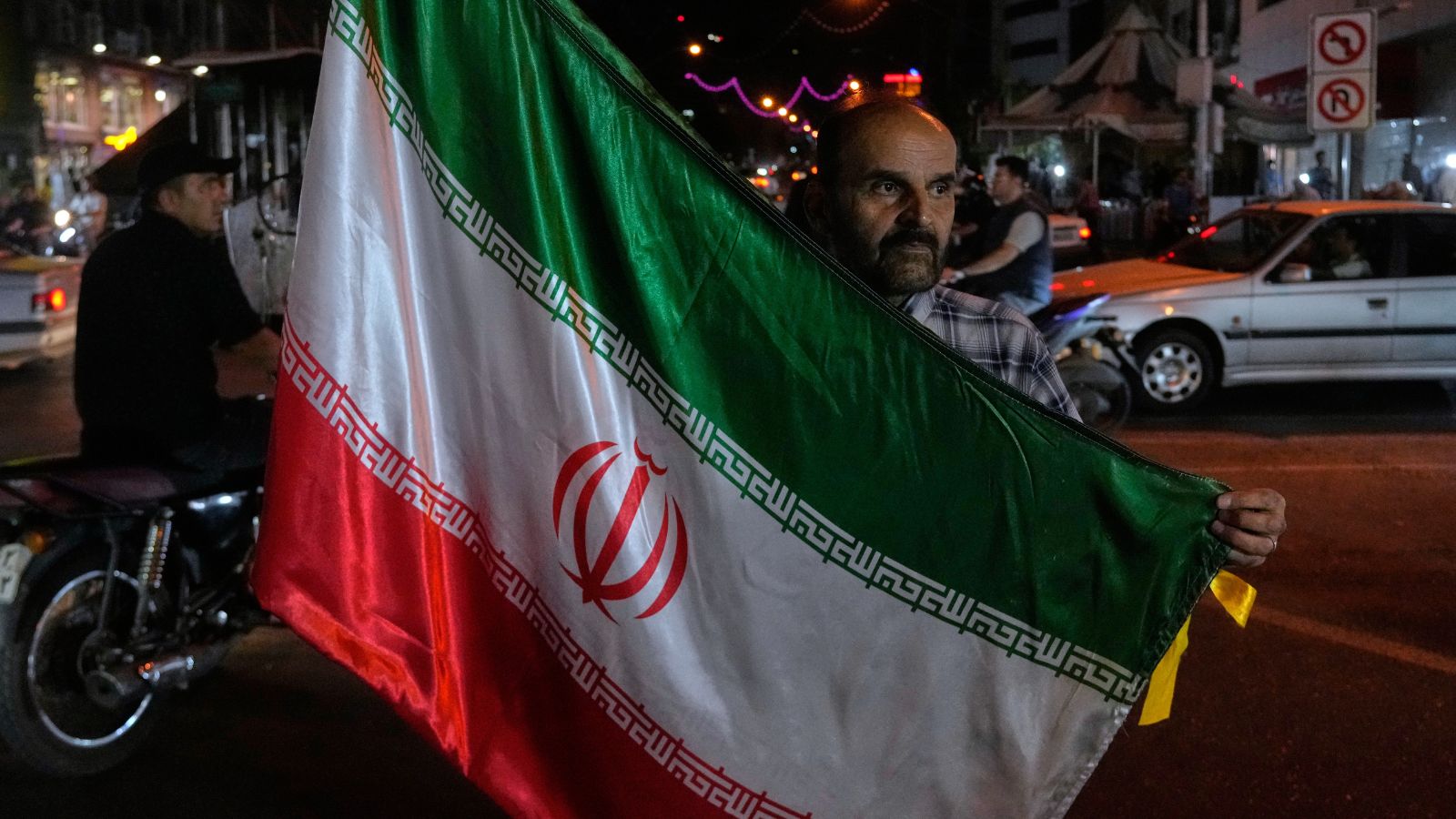
The current friction between Iranian-backed paramilitary groups and United States regional assets is not a precursor to total war but a calculated application of kinetic signaling. While media narratives often focus on the inflammatory rhetoric of "missiles and drones locked on targets," a rigorous strategic analysis reveals a sophisticated cost-imposition strategy designed to achieve political leverage through calibrated violence. This framework operates on the principle that the threat of escalation is more valuable than escalation itself, provided the threat remains credible through periodic, localized strikes.
The Architecture of Proportional Deterrence
The tension is anchored in a three-pillar strategy employed by Tehran to offset the conventional military superiority of the United States. By deconstructing these pillars, we can quantify the risk profile of the current "stalled" peace talks.
1. The Cost-Exchange Ratio
The primary tactical advantage for proxy forces lies in the radical disparity between the cost of the attack and the cost of the defense. A standard "one-way attack" (OWA) drone may cost between $10,000 and $20,000 to manufacture. In contrast, the interceptor missiles used by US Arleigh Burke-class destroyers or land-based Patriot batteries cost between $2 million and $4 million per unit.
This creates a negative attrition loop for the defender. Even if 100% of the incoming threats are neutralized, the defender suffers a financial and logistical drain that the attacker can sustain indefinitely. The strategic intent here is not to sink a ship or destroy a base, but to force the US to expend high-value, finite munitions against low-value, mass-produced targets.
2. Plausible Deniability and the Proxy Layer
By utilizing a network of decentralized actors across Iraq, Syria, and Yemen, Iran creates a buffer that complicates the US response cycle. This "gray zone" activity forces the US to choose between two suboptimal paths:
- Targeting the Proxy: This achieves localized tactical success but fails to address the source of the munitions or the strategic intent.
- Targeting the State Sponsor: This risks a transition from a controlled shadow war to a regional conflagration, a threshold the US has historically been reluctant to cross without a mass-causality event.
3. Integrated Firepower Geometry
The shift from isolated rocket attacks to integrated drone and missile swarms represents a significant technological evolution. By launching multiple vectors—low-flying cruise missiles, high-altitude ballistic missiles, and slow-moving loitering munitions—simultaneously, the attacker attempts to oversaturate the AEGIS or THAAD combat systems. The goal is to find a "leakage" point in the defensive umbrella where the sheer volume of data exceeds the system's processing or engagement capacity.
Quantifying the Threshold of Escalation
The stalled peace talks serve as a catalyst for increased kinetic activity because the diplomatic vacuum creates an "escalation floor." Without a viable political track, the only available currency for negotiation is military pressure. To understand where this leads, we must examine the specific mechanics of the Iranian "threat" through the lens of operational capabilities.
The Loitering Munition Bottleneck
The effectiveness of the Iranian threat is currently constrained by the logistics of their supply chain. While the design of the Shahed-series drones is simple, the acquisition of dual-use electronic components (GPS modules, microcontrollers) remains a point of friction.
Strategic intelligence indicates that the "threat" is often synchronized with the arrival of new shipments to regional hubs. Therefore, the frequency of these threats is a better indicator of supply-chain health than it is of immediate intent to launch a total offensive. The US response has shifted toward interdicting these shipments in the littoral environment, recognizing that destroying the "missile on the rail" is exponentially more efficient than intercepting it in flight.
The Role of Precision Guidance (PGM)
The transition from unguided "dumb" rockets to Precision Guided Munitions (PGMs) has fundamentally altered the risk calculus for US installations. In previous decades, a rocket attack on a base was a statistical gamble with low probability of hitting critical infrastructure. Modern Iranian-supplied drones utilize optical matching and inertial navigation systems that allow for "surgical" strikes on fuel depots, hangars, or command centers.
This precision allows for a "calibrated harm" strategy. The attacker can choose to strike an empty barracks to send a message or a vital radar array to degrade capabilities. This level of control allows for a ladder of escalation where each rung is clearly defined, preventing accidental slips into total war while keeping the pressure at a maximum.
The Strategic Bottleneck of Peace Talks
The stagnation of diplomatic efforts is not merely a pause in conversation; it is a structural failure of the current negotiation framework. The primary obstacle is the Asymmetry of Objectives.
- The US Objective: Regional stability, the containment of nuclear proliferation, and the protection of global maritime trade routes (specifically the Bab al-Mandab and the Strait of Hormuz).
- The Iranian Objective: The expulsion of US forces from the Middle East, the lifting of primary and secondary sanctions, and the recognition of its regional sphere of influence.
Because these objectives are diametrically opposed, "peace talks" often become a theater for tactical stalling rather than a path to resolution. The "missiles locked on targets" rhetoric is the kinetic accompaniment to this stalling tactic. It signals to US domestic audiences that the "cost of staying" is rising, aiming to trigger a political withdrawal similar to the 2021 Afghanistan exit.
The Mechanism of Modern Brinkmanship
In classical game theory, brinkmanship involves pushing a situation to the edge of disaster to force the opponent to back down. However, the current US-Iran dynamic follows a recurrent friction model.
$$E = \frac{V \times P}{C}$$
In this simplified model:
- $E$ represents the Escalation Potential.
- $V$ is the perceived Value of the political objective.
- $P$ is the Probability of success through kinetic means.
- $C$ is the Cost of retaliation.
Currently, Iran perceives $C$ to be manageable and $V$ to be high. As long as the US response remains focused on defensive interception rather than offensive cost-imposition (targeting the economic or military infrastructure of the sponsor), the $E$ value will continue to rise.
Tactical Realities of the Drone Threat
The specific mention of drones being "locked on" targets highlights a shift in aerial warfare. Unlike traditional aircraft, loitering munitions do not require a constant radar lock to be effective. They utilize waypoint navigation.
The Kill Chain Evolution
- Surveillance: Small, commercial-grade drones or localized human intelligence (HUMINT) identify the static coordinates of high-value targets.
- Programming: The flight path is programmed to utilize terrain masking, flying through valleys or behind urban structures to avoid long-range radar detection.
- Launch: Mobile, truck-mounted launchers allow for "shoot and scoot" tactics, making pre-emptive strikes difficult.
- Terminal Phase: Upon reaching the target area, the drone uses onboard sensors to home in on a specific heat signature or visual contrast.
The defense against this requires a "layered" approach that includes electronic warfare (jamming the GPS signal), directed energy weapons (lasers), and kinetic interceptors. The weakness in the current US posture is the sensor-to-shooter gap. Detecting a low-flying, carbon-fiber drone against the "clutter" of the ground is a significant technical challenge that has not been fully solved by existing radar arrays.
The Logistical Constraint of Proxy Warfare
A critical oversight in standard reporting is the assumption that these proxy groups have an infinite supply of munitions. In reality, they are governed by a Logistical Ceiling.
The "fresh threat" of missiles is often a psychological operation intended to mask a temporary depletion of on-the-ground stocks. By announcing that targets are "locked," a group can maintain the illusion of readiness while awaiting the next smuggling corridor to open. The US Navy’s focus on the "maritime bypass"—the route from the Gulf of Oman to the Yemeni coast—is the most effective counter-escalation measure available. Every intercepted dhow carrying missile components represents a three-to-six-month delay in the proxy's ability to execute a large-scale strike.
The Intelligence Gap in "Peace Talks"
One of the reasons talks "stall" is the lack of a verification mechanism for non-state actors. Even if a formal agreement is reached with a central government, the decentralized nature of proxy groups means that a "rogue" commander can trigger a regional crisis with a single drone launch. This command-and-control (C2) ambiguity is a deliberate feature of the Iranian strategy, allowing for plausible deniability whenever a strike goes too far and threatens to trigger a massive US retaliation.
Strategic Playbook: The Path Forward
The current cycle of threat and counter-threat will not resolve through traditional diplomacy because the incentives for escalation remain higher than the incentives for compromise. To break the deadlock, the strategy must shift from Defensive Interception to Active Cost Imposition.
- Degrading the Manufacturing Base: Rather than shooting down drones over US bases, the focus must shift to the production facilities and the "technical advisors" who facilitate the assembly of these systems. This moves the cost of the conflict back to the sponsor.
- Economic Sanctions on Dual-Use Supply Chains: A "whack-a-mole" approach to front companies in Europe and Asia that provide the microelectronics for these weapons is necessary. This increases the manufacturing cost for the attacker, narrowing the cost-exchange ratio.
- The "Porcupine" Defense for Regional Allies: Strengthening the integrated air defense systems (IADS) of regional partners like Saudi Arabia and the UAE creates a unified "wall" that makes proxy strikes less effective and more likely to be intercepted before reaching US assets.
- Leveraging Kinetic Signaling in Reverse: The US must utilize its own "gray zone" capabilities to demonstrate that the cost of sponsoring proxies outweighs the benefits. This requires a shift in posture from reacting to threats to proactively shaping the environment.
The reality of the "stalled" peace talks is that they are not stalled at all; they have simply moved from the boardroom to the battlefield. The "threat" is the negotiation. The drones are the ink. The only way to change the terms of the deal is to change the reality on the ground. Expect a period of increased maritime interdictions and a surge in electronic warfare deployments as the US attempts to close the "leakage" in its defensive umbrella and re-establish a credible deterrent through technical superiority rather than diplomatic consensus.

