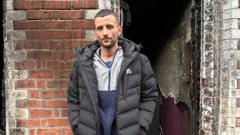
The smell of burning plastic doesn’t wash out of synthetic curtains easily. It clings to the fibers, a stubborn reminder of a Tuesday night that tore a neighborhood apart.
By sunrise, the street smells of old campfires and melted rubber. A solitary wheel from a burned-out wheelie bin sits in the gutter, slightly warped by heat that reached over one thousand degrees. On paper, this is a statistic. A line item in a police report detailing another night of civil unrest in Belfast. A paragraph in a news feed tucked beneath global market updates. Also making headlines lately: The Sanction Myth and Why Trump’s Threats Won't Force Iran’s Hand.
But statistics do not have to sweep charred debris off their front porch. People do.
The Sound of Breaking Glass
A brick passing through a double-glazed window makes two distinct sounds. First, a sharp, metallic crack as the outer pane shatters. Then, a heavier, duller thud as the debris punches through the inner layer, bringing fragments of the frame down onto the carpet. More insights on this are explored by Reuters.
For families living along the city's fractious interface areas, that sound is not a novelty. It is a recurring nightmare.
Consider a standard terraced house on a street where the architecture itself feels defensive. Red brick, narrow doorways, windows that look out onto a tarmac road that has seen decades of marchers, protesters, and police Land Rovers. When tensions spike over political stalemates or localized disputes, these homes cease to be sanctuaries. They become frontline positions in a conflict the residents did not choose.
The human brain adapts to trauma in strange ways. You learn to listen differently. A car door slamming too hard at 2:00 AM causes a physical jolt. A crowd shouting three streets away isn't background noise; it is a cue to check the locks and move the children into the back bedroom, away from the glass.
The physical damage is quantifiable. The Northern Ireland Housing Executive can calculate the cost of replacement PVC frames, plywood hoarding, and asphalt repair down to the penny. What escapes the ledger is the cost of the sleepless hours between the first brick and the arrival of the fire brigade. It is the invisible tax levied on the mental health of working-class communities who bear the brunt of geopolitical friction.
The View from the Front Porch
The morning after a riot follows a predictable choreography.
Council sweeping trucks arrive early, their rotating brushes making a rhythmic whirring sound as they gather up shattered beer bottles and the remains of petrol bombs. Police cordons are taken down. Neighbors emerge, mugs of tea in hand, standing on their doorsteps to survey the black scorch marks on the roadway.
There is a quiet fury in these interactions. It is not the loud, performative anger seen on television broadcasts or social media feeds. It is a weary, deep-seated resentment directed at the fact that their lives have been used as a backdrop for someone else’s grievances.
The narrative often framed by outsiders suggests a community divided cleanly by ideology, with each side actively participating in the chaos. The reality on the ground is far more frustrating. The vast majority of residents are hostages to the actions of a few dozen youths, often coordinated by older figures who remain safely in the shadows, far away from the smoke.
An elderly woman sweeps the pavement outside her gate. Her movements are methodical. She has lived on this road since 1974. She points at a blackened patch of tarmac where a car was incinerated just hours before. That car belonged to a nurse who works night shifts at the Royal Victoria Hospital. Now, the nurse cannot get to work, the community has lost a vehicle, and the toxic residue of burning upholstery is airborne, drifting into the bedrooms of toddlers sleeping nearby.
The destruction of local infrastructure hits hardest in areas that can least afford it. When a bus is burned, a route is cancelled. When a shopfront is smashed, an independent business owner considers closing for good. The community shrinks. The circle of safety grows smaller.
The Anatomy of an Escalation
Violence does not erupt in a vacuum. It builds like a slow-moving weather system, predictable to anyone who knows how to read the clouds.
Political rhetoric cools and warms in air-conditioned rooms miles away from these streets. But words have a trajectory. When politicians use inflammatory language to describe their opponents or frame democratic processes as existential threats, those words travel down the hill. They land in neighborhoods where unemployment is high, educational attainment is low, and historical grievances are passed down like family heirlooms.
For a young person with few prospects, a riot offers something the local economy does not: a sense of purpose. A feeling of belonging. The adrenaline of standing against an adversary, real or imagined, provides a temporary escape from the monotony of a neglected neighborhood.
But the thrill is brief. The consequences are permanent.
A criminal record acquired on a smoke-filled street corner at seventeen ensures that the doors to employment, travel, and higher education remain firmly shut. The very system the teenager believes they are fighting against simply absorbs them into its judicial machinery. The neighborhood gains another disillusioned adult, and the cycle prepares for its next iteration.
Meanwhile, the older generation watches with a sense of profound deja vu. They remember the same smoke from twenty, thirty, forty years ago. They recognize the slogans painted on the walls. They know that when the cameras pack up and the journalists head back to their hotels, the damp smell of soot remains.
The Long Memory of Brick and Mortar
A city carries its history in its geography. Belfast is a place where maps are memorized not just by street names, but by allegiances, flashpoints, and the locations of old peace walls. These walls, massive structures of concrete and iron sheeting, were built as temporary measures decades ago. They remain because the fear that necessitated them has never truly dissipated.
When unrest flares, these walls become focal points. They are the places where stones are thrown over the top, blind into the yards of people who simply want to watch television in peace.
The psychological impact of living in the shadow of these barriers is profound. It creates a siege mentality on both sides. It turns neighbors into abstract threats. When a fire is lit at an interface, the glow is visible from both sides of the wall. Both sides watch the same flames, feel the same fear, and blame the other for the smoke.
The true tragedy of these nights is the erosion of trust. Years of slow, painstaking cross-community work—the youth clubs that organize joint football matches, the community workers who maintain contact via burner phones to defuse rumors—can be undone in three hours of sustained rioting. Trust is a fragile thing, built over decades but demolished by a single well-aimed petrol bomb.
The morning sun eventually cuts through the haze, illuminating the gray reality of the aftermath. The street is open again, but it feels different. The air is heavy. The kids walking to school have to navigate around the oil stains and the broken glass. They look at the scorched ground, then up at the adults, learning the silent, bitter vocabulary of a divided city.
The sweeping brushes finish their work. The council trucks drive away. But the ash stays on the sofa, a fine, grey powder that smells of ruin, waiting for someone to clean it up.